
Working out with diabetes doesn’t have to mean avoiding activity because you’re scared of crashing. But if you’ve ever felt your legs go weak mid-run, or woke up in the middle of the night drenched in sweat after a morning bike ride, you know the fear is real. About half of people with type 1 diabetes say they skip exercise because they’re afraid of their blood sugar dropping too low. The good news? You can still lift, run, swim, or dance - you just need to know how to play the game.
Why Exercise Drops Your Blood Sugar
When you move, your muscles don’t wait for insulin to grab glucose from your blood. They just take it - on their own. That’s why even if your insulin levels are steady, your blood sugar can still fall during a workout. And it doesn’t stop when you finish. Your body stays more sensitive to insulin for up to three days after exercise, which means you could crash hours later - even while sleeping.
It’s not just about how hard you work. It’s about when you work, what you’ve eaten, and how much insulin is still active in your body. If you took a bolus for lunch and then hit the gym at 4 p.m., you might be asking for trouble. That insulin? It’s still working. And now your muscles are pulling glucose out faster than ever.
Check Before You Start - And Keep Checking
Don’t just guess your blood sugar. Check it. Right before you start. If it’s below 90 mg/dL, you need fuel. If it’s between 90 and 150 mg/dL, you still need fuel - just a little less. The rule of thumb: eat 0.5 to 1 gram of carbs per kilogram of body weight before you begin. For someone who weighs 70 kg (about 154 lbs), that’s 35 to 70 grams of carbs. Think: a banana and a tablespoon of peanut butter, or a granola bar and a small apple.
During longer workouts - anything over 30 minutes - check again every 30 to 60 minutes. If you’re using a continuous glucose monitor (CGM), watch the trend arrow. A steady drop? Time to eat. Even if your number looks okay, if it’s falling fast, don’t wait. A 15-gram carb snack - like 4 glucose tablets or half a cup of juice - can keep you in the safe zone.
Timing Matters More Than You Think
There’s a reason your glucose acts differently on Monday versus Wednesday, even if you did the same workout. It’s not you being inconsistent. It’s insulin timing.
If you use insulin, avoid exercising during peak action. For rapid-acting insulin, that’s usually 1 to 3 hours after your bolus. If you take insulin at 7 a.m. for breakfast, don’t plan your run for 9 a.m. Wait until 11 a.m. or later. Or better yet - move your workout to the same time every day. Consistency trains your body to respond predictably.
And here’s something most people miss: insulin-on-board (IOB). That’s the amount of insulin still working in your system. If you have 2 units of insulin active and you’re about to bike for an hour, your body might treat that like 3 or even 4 units because exercise makes insulin work harder. Most pumps and apps calculate IOB - use it. If your IOB is high, consider reducing your pre-workout bolus by 25% to 50%, or lowering your basal rate 60 to 90 minutes before you start.
Not All Workouts Are Created Equal
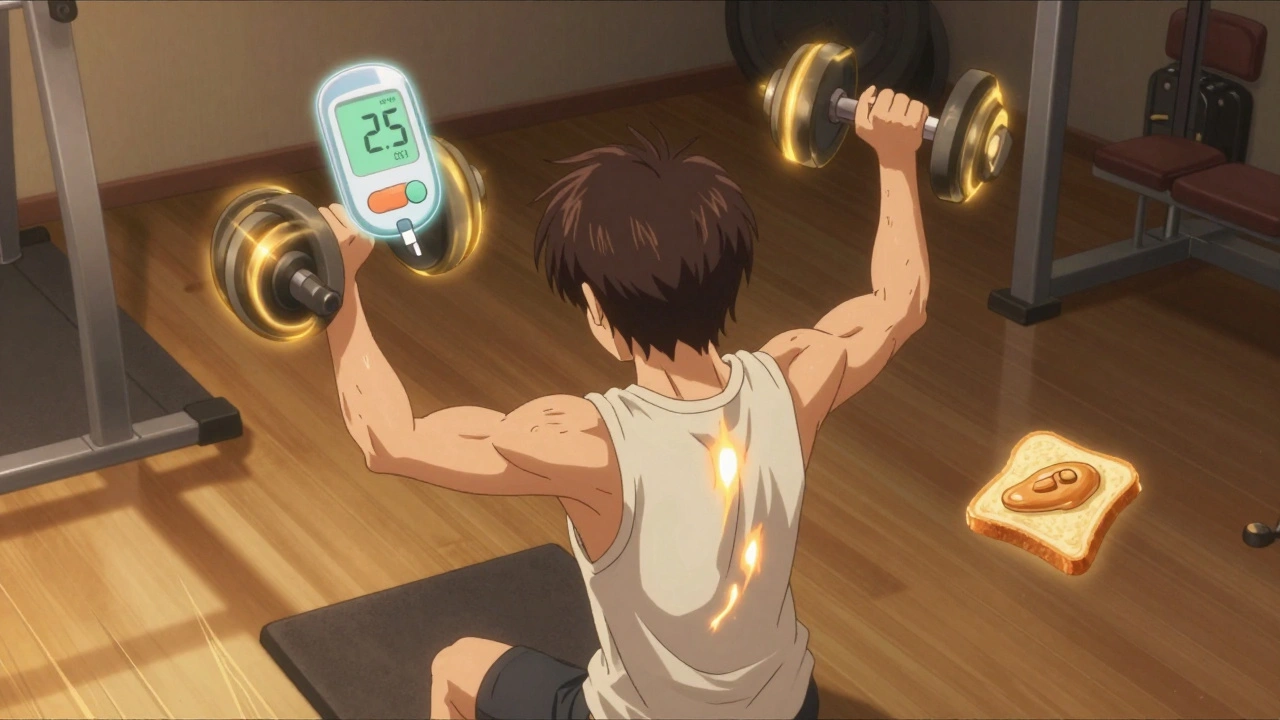
Not every type of exercise lowers your blood sugar the same way. Aerobic stuff - running, cycling, swimming - tends to drag glucose down slowly but steadily. But resistance training? That’s different. Lifting weights, doing push-ups, or using resistance bands? Those can actually raise your blood sugar a bit during the session because your body releases stress hormones.
Here’s the trick: do resistance training first. A 2018 study showed that 45 minutes of strength work before 45 minutes of cardio kept blood sugar 20 points higher than doing cardio alone. That’s huge. Same workout. Same insulin. Different order. Different result.
Even better? Throw in a 10-second all-out sprint before your main workout. A quick burst of high-intensity effort - like sprinting on a bike or sprinting up a hill - triggers a natural glucose boost. People with type 1 diabetes who added this to their routine cut their hypoglycemia episodes in half. You don’t need to go all-out for long. Just 10 seconds. Then recover. Then start your regular workout.
High-intensity interval training (HIIT) also helps. Short bursts of intense effort followed by rest - like 30 seconds of jumping jacks, then 60 seconds of walking - keeps glucose more stable than steady-state cardio. The spikes and drops even out. And the effect lasts up to 45 minutes after you finish.
What to Eat and When
Carbs aren’t the only tool. Protein and fat slow down absorption. That’s why a snack with both - like Greek yogurt with a handful of nuts, or cheese with whole-grain crackers - can help prevent lows that come later.
For workouts longer than 60 minutes, keep carbs handy. Not just before - during. A small packet of honey, a few gummy bears, or a sports drink you sip every 20 minutes. Don’t wait until you feel shaky. By then, it’s too late.
And here’s a counterintuitive tip: sometimes, starting with your blood sugar a little higher - around 150 to 180 mg/dL - gives you a buffer. Especially for intense or unpredictable workouts. It’s not about chasing perfect numbers. It’s about staying safe.
The Silent Danger: Nighttime Lows
One of the scariest things about exercise and diabetes? The crash doesn’t always happen during the workout. It happens hours later - often while you’re asleep. About 42% of people with type 1 diabetes report at least one severe nighttime low per month after daytime exercise.
That’s why checking your glucose before bed is non-negotiable after a workout. If it’s below 120 mg/dL, eat a small snack with carbs and protein. Think: a tablespoon of peanut butter on a slice of toast, or a small cup of cottage cheese with half a banana. The protein slows digestion. The carbs give you a quick boost. Together, they help you sleep through the night without crashing.
And if you’re using a CGM, set an overnight alert. Most devices let you adjust thresholds. Lower your low alert to 70 mg/dL if you exercised that day. That way, you get woken up before it gets dangerous.

Technology Is Your Ally
CGMs aren’t just fancy glucose meters. Modern ones like Dexcom G7 have an “exercise mode” that lowers alert thresholds during activity. That means you get warned earlier if your sugar starts falling - even if you’re still technically in the “normal” range.
Pumps are getting smarter too. The Tandem t:slim X2 pump, approved in March 2023, has an “Exercise Impact” feature. It uses your past data - how your body reacted to similar workouts - to predict when your glucose might drop and automatically reduces insulin delivery. It’s not perfect, but it’s a big step forward.
And the future? Closed-loop systems that deliver glucagon when needed. Right now, NIH trials are testing artificial pancreas systems that can pump glucagon - a hormone that raises blood sugar - during exercise. Early results show a 52% drop in hypoglycemic events. That’s not science fiction. That’s coming by 2026.
What Works for One Person Won’t Work for All
One person sprints before their run and never crashes. Another eats a full meal and still drops. Why? Because everyone’s body responds differently. Your insulin sensitivity, your muscle mass, your sleep, your stress levels - all of it changes how exercise affects you.
That’s why tracking matters. Write down what you did, when you did it, what you ate, your insulin doses, and your glucose numbers before, during, and after. Do this for a few weeks. Look for patterns. Maybe you always crash after yoga. Maybe you’re fine after lifting weights but need carbs after swimming. Your journal will show you what’s true for you - not what’s true for someone else on Reddit.
And don’t be afraid to adjust. If you’re consistently going low after a certain workout, reduce your pre-workout insulin. Eat more carbs. Change the order. Try a sprint. Test it again. It’s trial and error - but it’s your body, and you’re the scientist.
Start Small. Build Confidence.
You don’t need to run a marathon tomorrow. Start with a 20-minute walk. Check your glucose before. Eat 15 grams of carbs if it’s under 100. Check again after. Then again an hour later. See what happens. Then try a bike ride. Then a strength session. Each time, you learn a little more.
The goal isn’t to avoid lows forever. It’s to know how to handle them. To feel in control. To move without fear. You’ve already taken the hardest step - deciding to get active. Now it’s just about learning the rules. And you’re already ahead of the game because you’re asking the right questions.
Can I exercise if my blood sugar is below 70 mg/dL?
No. If your blood sugar is below 70 mg/dL, treat it first with 15 grams of fast-acting carbs - glucose tablets, juice, or regular soda. Wait 15 minutes, then recheck. Only start exercising once your glucose is above 100 mg/dL and stable. Exercising while low can make things worse and lead to dangerous drops.
Should I reduce my insulin before working out?
Yes, often. If you use insulin, reducing your basal rate by 50-75% for pump users - or cutting your pre-workout bolus by 25-50% for those on injections - can prevent lows. Do this 60 to 90 minutes before exercise. Always calculate your insulin-on-board first. If you have a lot of active insulin, reduction is usually needed.
Why do I get low after exercise, even when I ate?
Because exercise increases insulin sensitivity for up to 72 hours. Even if you ate before and didn’t go low during your workout, your body is still pulling glucose into muscles more efficiently afterward. That’s why nighttime lows are common. Check your glucose before bed and have a small snack with carbs and protein if it’s under 120 mg/dL.
Is it safer to lift weights or do cardio?
Lifting weights is generally safer for preventing lows during the workout because it triggers stress hormones that raise blood sugar. But the best strategy is to combine them: do resistance training first, then aerobic exercise. Studies show this cuts glucose drops by nearly half compared to cardio alone.
Do I need to check my glucose during short workouts?
If it’s under 30 minutes and your blood sugar was above 120 mg/dL before you started, you might not need to check mid-workout. But if you’ve had lows before, or you’re trying something new, check anyway. It only takes 10 seconds. Better safe than sorry.
Can I use a continuous glucose monitor (CGM) to prevent lows?
Yes - and it’s one of the most effective tools. CGMs show real-time trends, so you can see if your glucose is falling fast before it gets dangerous. Many devices now have exercise modes that lower alert thresholds, giving you earlier warnings. Users with CGMs are 60% more likely to check glucose before exercise than those without.
What if I’m not sure how my body will react?
Start slow. Pick one new activity. Do it at the same time of day. Track everything: food, insulin, glucose before, during, and after. Do this for 3-6 sessions. Patterns will emerge. You’ll learn if you need more carbs, less insulin, or a different order of exercises. Nobody learns this overnight - but you will learn it.









Olivia Portier December 8, 2025
i just started working out again after 2 years and honestly i was terrified of crashing. this post saved me. i did a 20 min walk yesterday with a banana and a glucose tab just in case and i didn't drop once. i'm crying rn lol 💕
Brianna Black December 9, 2025
This is an exceptionally well-researched and clinically grounded exposition on exercise physiology in the context of type 1 diabetes management. The integration of insulin-on-board dynamics with temporal biomechanical variables is both nuanced and actionable. A masterclass in patient-centered education.
Ronald Ezamaru December 10, 2025
I’ve been lifting for 8 years with T1D. The sprint-before-workout trick? Game changer. I used to crash after every cardio session. Now I do 10 seconds on the rower at max effort, then chill for a minute, then start. My CGM stays flat. No more midnight lows. Just do it.
Iris Carmen December 12, 2025
so i tried the peanut butter on toast before bed after a run and honestly? i slept like a baby. no alarms. no panic. just peace. i feel like a genius now lmao
Darcie Streeter-Oxland December 14, 2025
One must question the empirical validity of recommending carbohydrate ingestion prior to exercise as a universal protocol. The physiological heterogeneity among individuals renders such generalized advice potentially hazardous, particularly in the absence of continuous glucose monitoring infrastructure.
Sarah Gray December 15, 2025
I’m sorry, but if you need to eat 70 grams of carbs before a walk, maybe you shouldn’t be exercising at all. This is just glorified carb-loading for people who can’t manage their insulin. You’re not a marathoner. You’re a glucose-dependent machine.
Kathy Haverly December 17, 2025
Oh wow, another ‘exercise is safe if you do it right’ post. Let me guess-your CGM is a magic wand? You think people with T1D don’t know about IOB? I’ve been in the hospital three times because someone told me ‘just eat a banana.’ Thanks for the advice, Captain Obvious.
Graham Abbas December 19, 2025
There’s something deeply poetic about the body’s ability to adapt-how muscle cells, in their hunger for energy, bypass insulin’s gatekeeper and take what they need. It’s not a flaw. It’s evolution whispering: move, and I will sustain you. We just have to learn to listen.
Haley P Law December 19, 2025
i tried the 10 sec sprint thing and i literally screamed like i was in a horror movie 😱 but my glucose stayed at 130 for 2 hours after 😭 thank you i love you
Nikhil Pattni December 20, 2025
I have been managing T1D for 22 years and I can tell you that the real issue is not the exercise or the insulin timing-it’s the pharmaceutical industry’s failure to develop a truly adaptive insulin delivery system that responds to metabolic demand in real time. The pumps and CGMs are still primitive. We’re using 1990s tech with 2024 biology. And don’t get me started on how the FDA slows down glucagon delivery systems because of liability concerns. I’ve run 15 marathons with T1D and I still have to carry three types of glucose gels, a backup meter, and a spare insulin pen. This is not healthcare. This is survival mode. And yes, I’ve tried everything mentioned here, but none of it replaces a closed-loop system that can predict and prevent hypoglycemia before it happens. We need innovation, not just tips.
precious amzy December 20, 2025
The notion that one should ‘start small’ implies a lack of discipline. True metabolic mastery requires rigorous control, not casual experimentation. The author’s suggestion to ‘track everything’ is inadequate-it must be quantified to the third decimal place, logged in a standardized ISO-compliant format, and cross-referenced against circadian rhythm data from wearable EEG monitors. Anything less is amateurish.
Carina M December 21, 2025
It is deeply irresponsible to recommend consuming carbohydrates prior to physical exertion when one has a documented metabolic disorder. This perpetuates a culture of dependency on exogenous glucose, rather than fostering true metabolic flexibility through ketosis and fasting protocols. One should train the body to utilize fat as fuel-not treat diabetes like a snack-time schedule.
William Umstattd December 22, 2025
I’ve been doing this for 15 years. I don’t eat carbs before workouts. I adjust my basal. I don’t need a banana. I don’t need a CGM. I have a meter and a brain. If you’re running around with gummy bears and juice boxes like a toddler, you’re not managing diabetes-you’re letting it manage you.