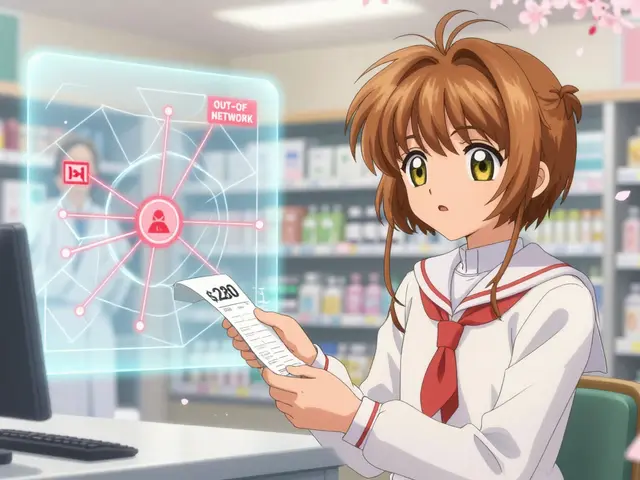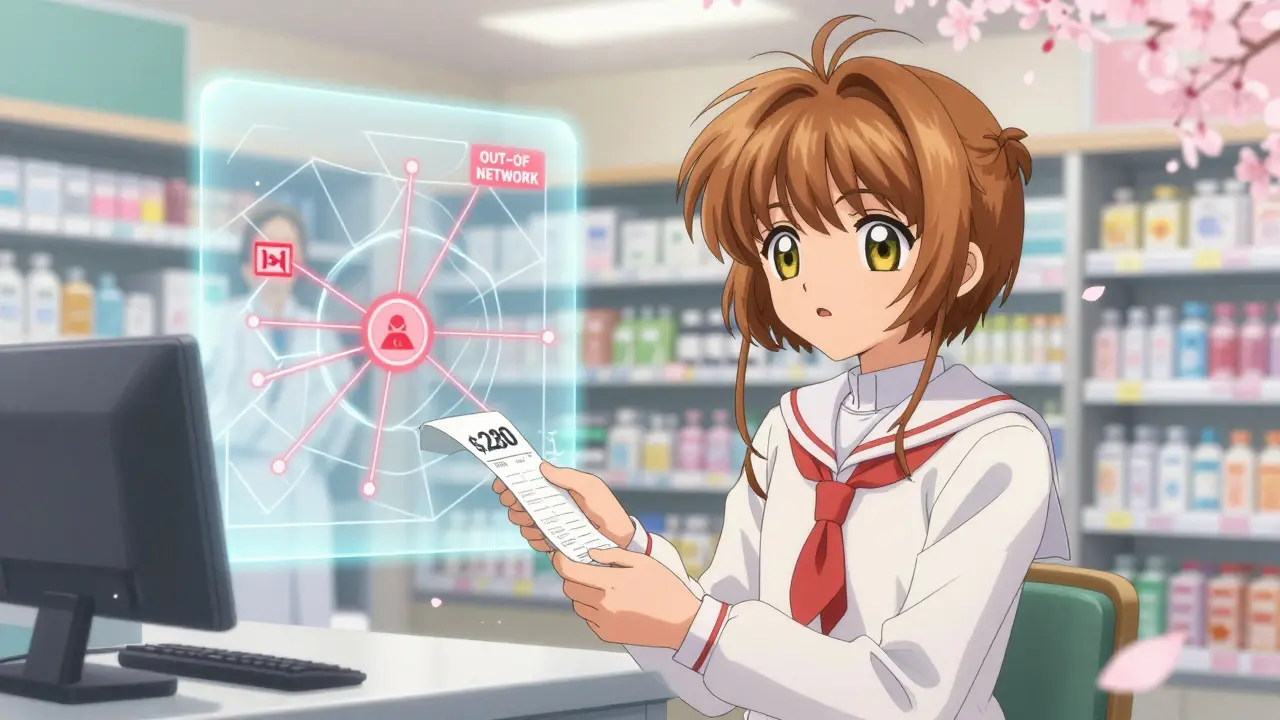
Imagine this: you walk into your local pharmacy to pick up a life-saving medication. You hand over your insurance card, expect to pay your usual $20 copay, and then the pharmacist says, "That’ll be $280." You’re stunned. You didn’t get a notice. You didn’t get a warning. You just got hit with a bill you never saw coming. This isn’t rare. In fact, out-of-network pharmacy surprises are one of the most common-and least talked about-cost traps in U.S. healthcare.
The No Surprises Act went into effect in January 2022 to stop surprise medical bills for emergency care and certain non-emergency services. But here’s the catch: it doesn’t cover prescriptions. That’s right. While you’re protected from surprise bills for an ER visit or an anesthesiologist you didn’t choose, your insulin, your cancer drug, or your monthly heart medication? Totally unprotected. Pharmacy benefits are handled separately by companies called pharmacy benefit managers (PBMs), and they operate under completely different rules.
Why Your Insurance Doesn’t Protect You at the Pharmacy
Your health plan and your pharmacy coverage aren’t the same thing. Most employers and insurers use separate networks for doctors and pharmacies. You might be covered at your hospital, your specialist, even your lab-but your local CVS or Walgreens could be out-of-network for your prescription drug plan. Why? Because PBMs like CVS Caremark, Express Scripts, and OptumRx negotiate their own deals with pharmacies. If your plan doesn’t have a contract with a specific pharmacy, you’re on your own.
And here’s the kicker: when you fill a prescription at an out-of-network pharmacy, you don’t get the negotiated discount your plan usually gets. You pay the full retail price. Then, if your plan offers any reimbursement at all, you have to file a claim and wait weeks for a partial refund-sometimes less than half of what you paid. That’s not protection. That’s a financial gamble.
According to a Kaiser Family Foundation survey from January 2023, 28% of commercially insured adults faced unexpected pharmacy costs in the past year. And for over half of them, those costs were over $100. Some paid more than $500 out of pocket for a single prescription.
How You Get Caught in the Trap
Most people don’t realize they’re at risk until it’s too late. Here’s how it usually happens:
- You switch jobs or health plans and don’t check your pharmacy network.
- You move to a new neighborhood and assume your old pharmacy is still covered.
- You’re prescribed a specialty drug and your plan only covers it through one specific specialty pharmacy you’ve never heard of.
- You use a mail-order pharmacy without verifying it’s in-network.
- You refill a prescription at a different location-like a grocery store pharmacy-because it’s more convenient.
And here’s the worst part: you won’t know you’re out-of-network until you’re at the counter. Unlike medical providers, pharmacies don’t have to tell you ahead of time. No notice. No warning. Just a bill that shocks you.
What You Can Do to Stay Protected
You can’t rely on the law to protect you. But you can protect yourself. Here’s how:
1. Get Your Pharmacy Network Directory
Don’t rely on your insurer’s general provider directory. That’s for doctors and hospitals. You need the pharmacy network directory. It’s a separate list, often buried in your plan documents or online portal. Look for phrases like “pharmacy network,” “retail pharmacy network,” or “preferred pharmacies.”
If you can’t find it, call your plan or PBM directly. Ask: “Can you send me the current list of in-network pharmacies for my plan?” Don’t settle for a yes or no. Get the list. Save it. Print it.
2. Check Before You Fill
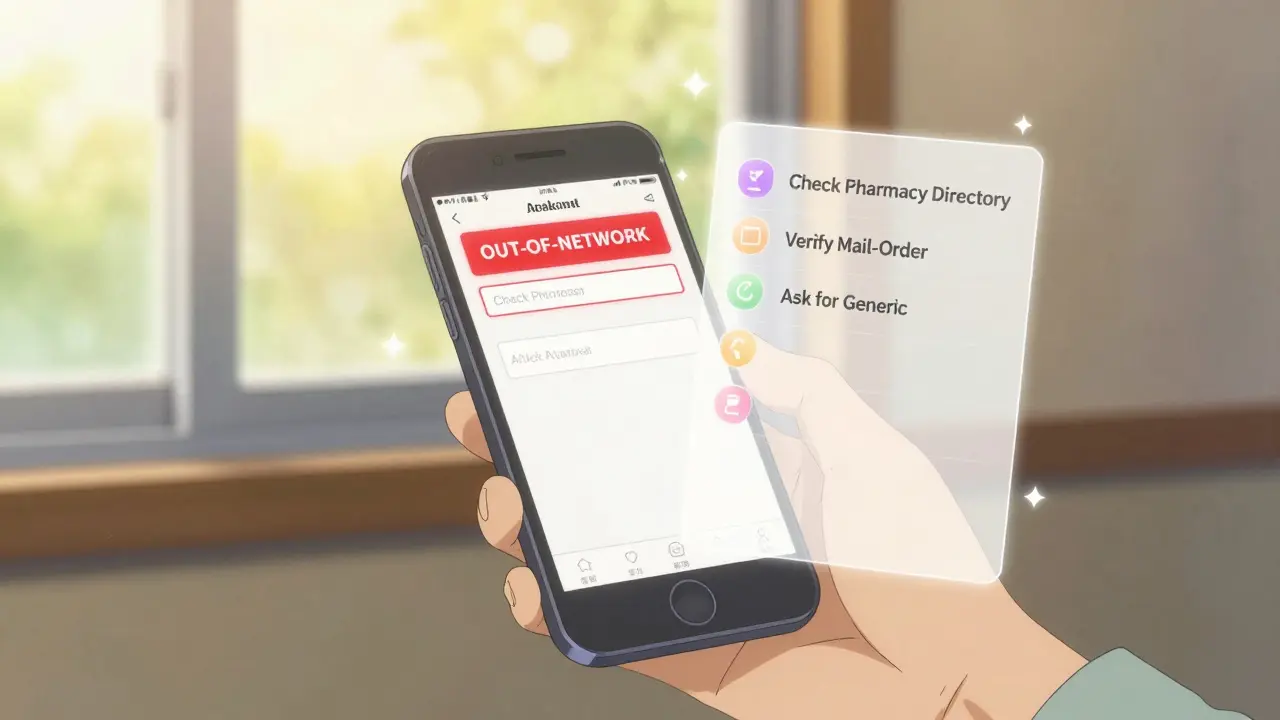
Before you go to the pharmacy, check your plan’s website or call them. Some plans offer real-time benefit checks through their mobile app. Enter your drug name, dosage, and the pharmacy location. It’ll tell you exactly how much you’ll pay-and whether the pharmacy is in-network.
Pro tip: If the app says “out-of-network,” don’t just assume you’ll pay more. Ask if the pharmacy can switch to a different one that’s in-network. Many pharmacies can transfer your prescription electronically.
3. Know Your Specialty Drug Rules
Drugs for conditions like multiple sclerosis, rheumatoid arthritis, or cancer often require prior authorization and must be filled through a specialty pharmacy. These are usually mail-order or limited retail locations. If your plan requires you to use one, and you go to your local pharmacy instead, you’ll pay full price.
Check your plan’s formulary (the list of covered drugs) to see if your medication is restricted. If it is, you’ll need to use the designated specialty pharmacy-or risk a huge bill.
4. Use Mail Order When Possible
Mail-order pharmacies are often in-network and can save you money-especially for maintenance drugs you take every month. Many plans offer 90-day supplies at lower copays. And since they’re managed by your PBM, they’re less likely to be out-of-network.
Just make sure you’re using the one your plan approves. Some plans have multiple mail-order options. Pick the one with the best price and delivery speed.
5. Ask for Generic or Lower-Cost Alternatives
Even if you’re in-network, your drug might still be expensive. Ask your doctor or pharmacist: “Is there a generic version?” or “Is there another drug in the same class that’s cheaper?”
For example, if you’re on a brand-name statin, there’s almost always a generic alternative that works the same way but costs a fraction of the price. And if your plan has tiered formularies, ask which tier your drug is on. Tier 1 (preferred generics) usually costs less than Tier 3 or 4 (brand-name or specialty drugs).
What to Do If You Already Got Surprised
If you’ve already paid too much at the pharmacy, don’t just accept it. Here’s what to do:
- Call your PBM. Ask if they’ll reimburse you for out-of-network costs. Some will, especially if you can prove you didn’t know the pharmacy was out-of-network.
- File a formal appeal. Most plans have a process. Submit your receipt and a letter explaining the situation.
- Check if your state has protections. States like California and New York are moving toward laws that require PBMs to notify patients before they fill out-of-network prescriptions. Even if your state hasn’t passed one yet, your insurer might still be willing to help.
And if you’re on Medicare Part D, use the Medicare Plan Finder tool. It lets you compare pharmacy networks across plans. If you’re switching plans, make sure your pharmacy is covered before you enroll.

What’s Changing (And What’s Not)
The good news? More people are talking about this. The Department of Health and Human Services just allocated $25 million in 2024 to study how to fix surprise pharmacy billing. Congress is considering bills that would require PBMs to show real-time network status when you fill a prescription.
But here’s the reality: as of February 2026, there is still no federal law protecting you from out-of-network pharmacy bills. The No Surprises Act didn’t cover it. And until it does-or your state passes its own law-you’re on your own.
That means your best defense isn’t waiting for government action. It’s knowing your plan, checking your pharmacy, and asking questions before you pay.
Real Talk: What Happens When You Don’t Check
A Reddit thread from March 2023 had over 140 comments from people who got hit with $300 bills for drugs that should’ve cost $30. One woman paid $420 for her diabetes medication because she used her local pharmacy after moving. Another man’s $1,200 cancer drug was denied coverage because his plan only covered it through a mail-order pharmacy he didn’t know about.
These aren’t edge cases. They’re standard outcomes of a broken system. And they’re preventable.
If you’re taking any medication regularly, this isn’t optional. It’s essential. Treat your pharmacy network like your car insurance. You don’t wait until you’re in an accident to check your coverage. You check it every year. Do the same with your prescriptions.