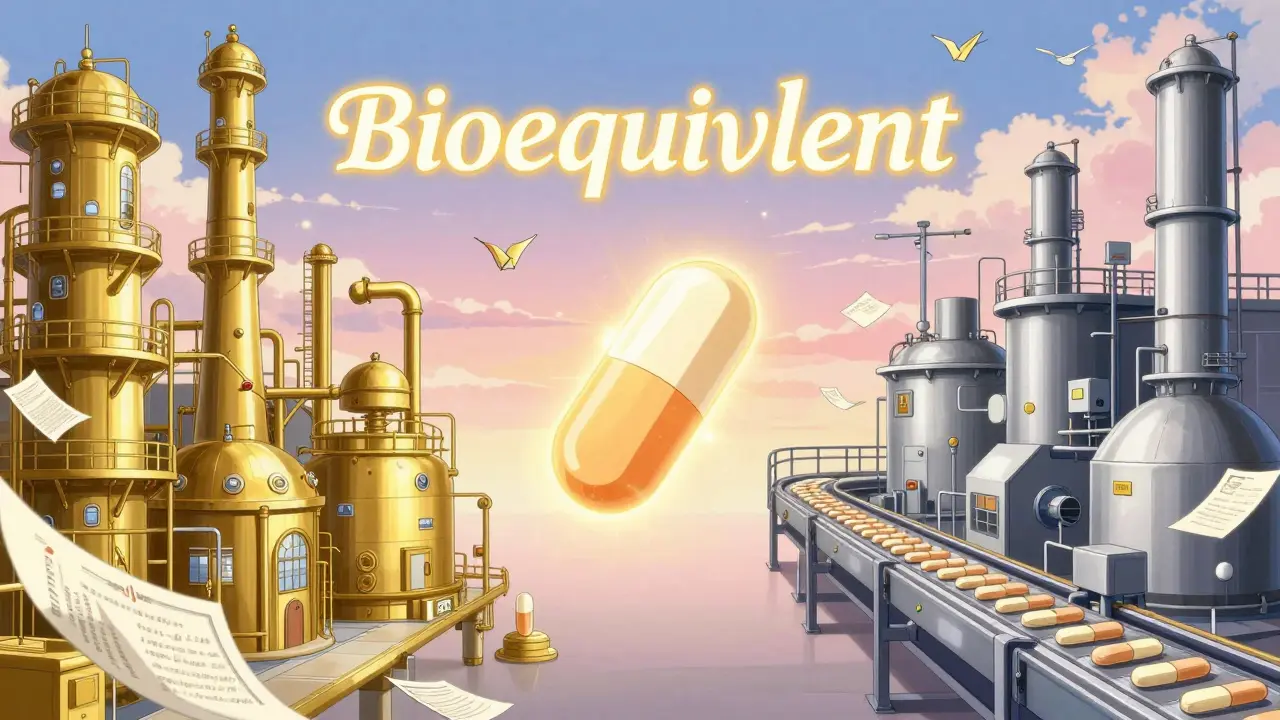
When you pick up a prescription for a generic drug, you’re paying maybe $5. A branded version of the same medicine? $50 or more. It’s not a scam. It’s not a marketing trick. It’s simple math - and it all comes down to how these drugs are made.
Why Generic Drugs Cost So Much Less
Generic drugs aren’t cheaper because they’re low quality. They’re cheaper because they don’t have to pay for the research, testing, and marketing that branded drugs do. The difference starts before the first pill is even made.The brand-name drug company spent 10 to 15 years and over $2.6 billion to develop its drug. That money went into lab research, clinical trials on thousands of patients, regulatory paperwork, and building a marketing machine. When the patent runs out, other companies can step in. But they don’t need to repeat any of that.
Instead, they just need to prove their version works the same way. That’s called bioequivalence. The FDA doesn’t require new clinical trials. They just check if the generic delivers the same amount of active ingredient into the bloodstream at the same speed. That process costs between $2 million and $5 million - less than 0.2% of what it took to create the original.
The Cost Breakdown: What You’re Actually Paying For
Let’s break down what goes into the price of a generic drug. There are four main pieces:- Active Pharmaceutical Ingredients (API) - This is the actual medicine. It makes up the biggest chunk of cost. Prices for these can swing up or down by 20-30% a year based on where the raw materials come from.
- Excipients - These are the inactive ingredients: fillers, binders, coatings. They’re cheap, but they have to be perfectly consistent. A bad coating can ruin a pill’s absorption.
- Quality Assurance - Every batch must be tested. Every factory must meet FDA standards. This isn’t optional. It’s built into the cost, and it’s non-negotiable.
- Packaging - Blister packs, bottles, labels, cartons. It sounds simple, but getting it right at scale matters. One mistake on a label can mean a recall.
Here’s the real kicker: for generic manufacturers, production costs eat up about half of their revenue. That’s how thin the margins are. A company making a generic version of a cholesterol drug might sell a bottle for $5. The cost to make it? Around $2.50. The rest goes to shipping, overhead, and profit - and that profit is tiny.
Scale Is Everything
The more you make, the cheaper each unit becomes. This isn’t just common sense - it’s math.For every doubling of total production volume, the cost per unit drops by 18%. That’s huge. But it gets even better. If you double the number of pills made for a single drug - say, only making 100 million tablets of one type instead of 50 million - the cost per tablet drops by 45%. That’s because you’re optimizing the same machines, the same workers, the same supply chain.
That’s why the biggest generic makers focus on a few high-volume drugs. Take amlodipine, a blood pressure pill. Over 100 companies make it. Each one churns out billions of pills a year. The factories run 24/7. Workers know the process by heart. Machines are fine-tuned. Waste is minimized. That’s how a pill can cost 95% less than the brand name.
But here’s the flip side: if you try to make too much of one thing - over 30 to 40 billion units of an oral tablet - costs start going back up. Too much volume strains logistics, increases waste, and forces overtime. There’s an optimal sweet spot. And the smartest generic companies know exactly where it is.
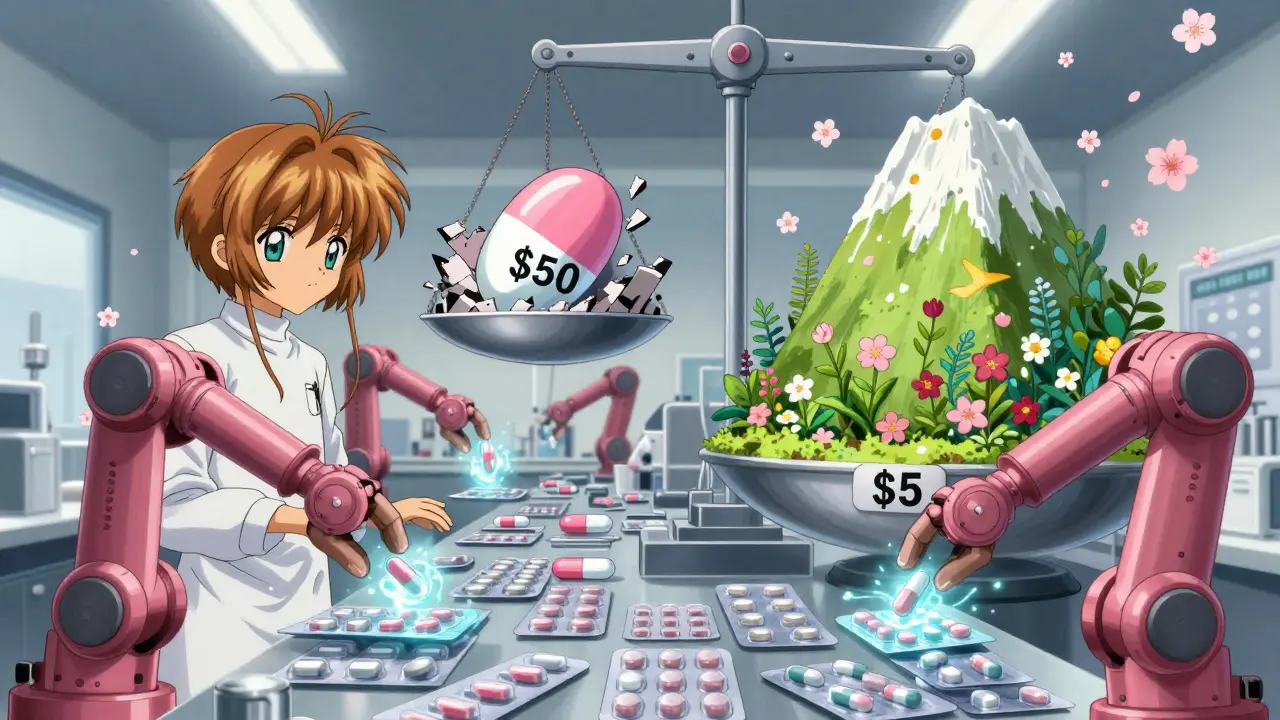
Competition Drives Prices Down
The moment a brand-name drug loses its patent, the race is on. The first generic company to get approval gets a short window of exclusivity - usually 180 days. They can charge a bit more. But then others come in.When only two generics are on the market, the price is about 54% lower than the brand. When six or more are competing? The price drops over 95%. That’s not a coincidence. It’s market dynamics in action.
One study looked at 1,200 generic drugs. When competition increased, prices didn’t just go down - they collapsed. And once prices hit rock bottom, companies had two choices: cut costs further or get out. That’s why generic manufacturing has become a game of extreme efficiency. A 1% improvement in production speed can mean the difference between survival and bankruptcy.
Why Branded Drugs Still Dominate Spending
You might think: if generics are 90% of prescriptions, why do they only make up 15% of total drug spending?Because most of the money is spent on a few expensive drugs - cancer treatments, rare disease therapies, new biologics. Generics dominate the common stuff: antibiotics, blood pressure pills, antidepressants. These are the drugs people take every day. They’re cheap. But they add up.
Take this: in the U.S., 8.9 billion generic prescriptions were filled in 2023. That’s 90% of all prescriptions. But the total cost? Just $443 billion out of $2.8 trillion in drug spending. That’s the power of volume and low price.
Meanwhile, branded drugs make up only 10% of prescriptions - but 85% of the money spent. Why? Because they’re priced to recoup R&D costs. And because doctors still prescribe them, even when generics exist. Sometimes because of habit. Sometimes because of patient pressure. Sometimes because of subtle marketing.
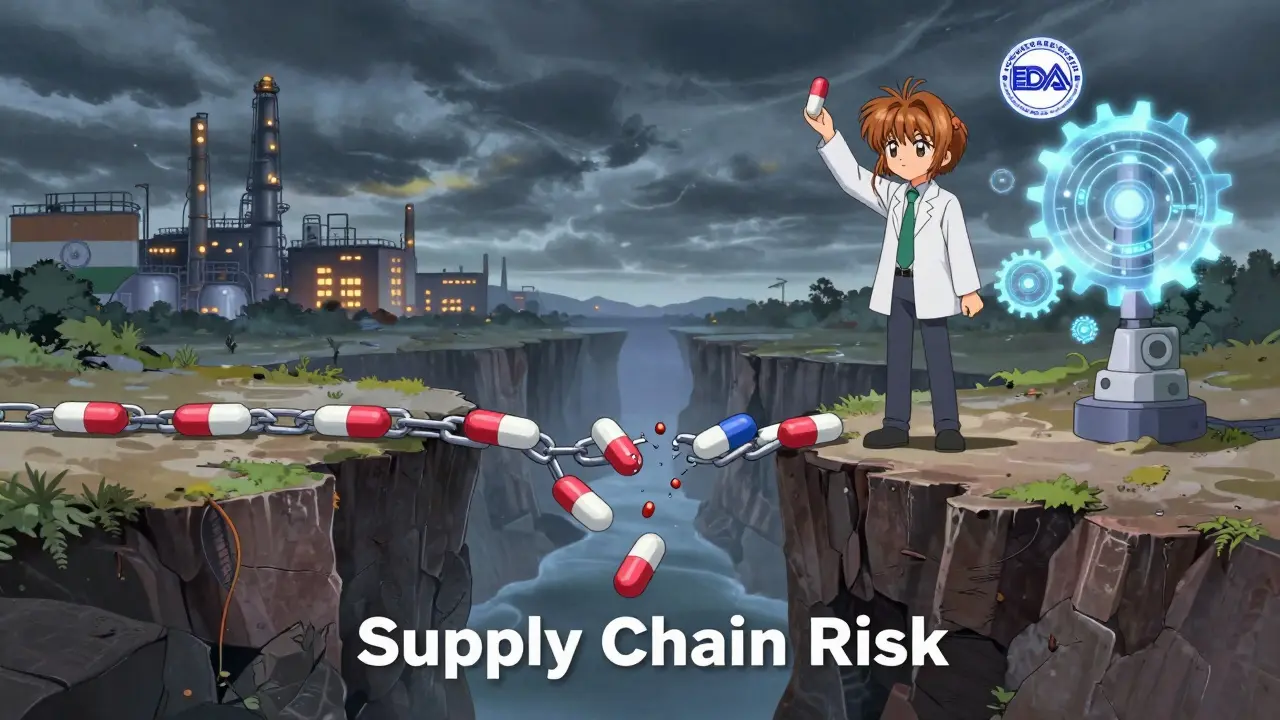
The Hidden Cost: Supply Chain Risk
There’s a dark side to this low-cost model. When margins are this thin, there’s no room for error.Most active ingredients are made in just a few countries - India and China dominate. If a factory there shuts down for a week - because of a flood, a labor strike, or a regulatory inspection - the entire supply chain stumbles. In 2022, there were 350 drug shortages in the U.S. alone. Many of them were for generic drugs.
Manufacturers can’t afford to keep extra inventory. They run lean. One broken machine, one delayed shipment, and a life-saving drug disappears from pharmacy shelves. That’s not a glitch. It’s built into the system.
Experts warn this isn’t sustainable. The pressure to cut every penny means there’s no buffer. No safety net. And when a shortage hits, patients suffer. And prices spike - sometimes by 1,000% - until someone else can fill the gap.
What’s Next? Automation, Regulation, and Change
The FDA is trying to fix some of this. In 2023, they launched new rules to speed up generic approvals. The goal? Cut approval time from 40 months to 24. That means more competitors enter faster - and prices fall quicker.Meanwhile, automation is coming. Continuous manufacturing - where pills are made in one long, uninterrupted line - is replacing batch production. It’s faster, cleaner, and cuts costs by 20-25% by 2027. Companies that don’t invest in this tech will get squeezed out.
But there’s a twist. The Inflation Reduction Act lets Medicare negotiate drug prices. That could push generic prices down another 10-15%. That’s good for patients. Bad for manufacturers.
And then there’s the supply chain. More companies are trying to move API production out of China. It’s expensive. It’s slow. It might raise costs by 5-8% in the short term. But it’s necessary. Relying on one country for half the world’s medicine is risky.
The Bottom Line
Generic drugs are cheaper because they avoid the massive costs of innovation. They don’t need to prove they work - just that they work the same. They don’t need to advertise. They don’t need to pay for failed trials. They just need to make a lot of pills, very efficiently.That’s why they save the U.S. healthcare system over $1.7 trillion between 2023 and 2027. That’s not magic. It’s manufacturing.
But the system is fragile. Thin margins mean no room for error. Low prices mean no room for investment. And global dependence means one disruption can leave millions without medicine.
The future of generic drugs isn’t about making them cheaper. It’s about making them resilient. Because if we lose the ability to reliably produce these drugs, the savings disappear - and so do the lives they protect.
Why are generic drugs so much cheaper than brand-name drugs?
Generic drugs are cheaper because they don’t have to repeat the expensive research, clinical trials, and marketing that brand-name drugs do. They only need to prove they’re bioequivalent - meaning they work the same way in the body. This cuts development costs from over $2.6 billion for a new drug to just $2-5 million for a generic. Manufacturing costs are also lower due to economies of scale, minimal marketing, and highly optimized production.
Do generic drugs have the same effectiveness as brand-name drugs?
Yes. The FDA requires generic drugs to have the same active ingredient, strength, dosage form, and route of administration as the brand-name version. They must also show bioequivalence - meaning they deliver the same amount of medicine into the bloodstream at the same rate. Studies show no meaningful difference in effectiveness or safety between generics and brand-name drugs.
Why do generic drug prices drop so much when more companies enter the market?
When multiple generic manufacturers compete, they drive prices down to stay competitive. With just two generics, prices are about 54% lower than the brand. When six or more companies make the same drug, prices can fall over 95%. This happens because each company is trying to win market share, and since production costs are low, they can afford to slash prices.
Why are there drug shortages for generic medications?
Generic drug manufacturers operate on razor-thin margins, so they don’t keep large stockpiles. Most active ingredients come from just a few factories - often overseas. If one factory has a shutdown due to quality issues, natural disaster, or supply chain disruption, there’s no backup. This creates shortages, especially for older, low-margin drugs that aren’t profitable enough to justify redundancy.
Will generic drug prices keep going down?
In the short term, yes - especially with new FDA rules speeding up approvals and Medicare negotiating prices. But long-term trends are mixed. Automation and continuous manufacturing will cut costs further. However, efforts to diversify supply chains away from China may raise prices temporarily by 5-8%. The bigger risk isn’t price - it’s reliability. If too many manufacturers exit due to low profits, supply chains will become even more fragile.



Steph Carr February 18, 2026
Let me get this straight - we spend $2.6 billion to invent a drug, then let anyone copy it for $5 million and sell it for $5? That’s not capitalism, that’s a public service announcement with a pharmacy label.
And yet, when a generic runs out, people lose their minds. Funny how we treat life-saving pills like toilet paper - only notice when it’s gone.
Brenda K. Wolfgram Moore February 19, 2026
The fact that we rely on a handful of factories in India and China to make our essential medicines is insane. We act like this is normal, but it’s one earthquake, one political crackdown, or one FDA inspection away from a national crisis. We need domestic production - not because it’s patriotic, but because it’s rational.
Agnes Miller February 19, 2026
sooo i work in a pharmacy and let me tell u the real issue isn't even the cost its the supply chain. one day we got 3000 pills of amlodipine the next day 0. no warning. no notice. just 'sorry, out'. patients get so mad. they dont get why we cant just 'order more'.
its not that simple.
Logan Hawker February 20, 2026
It’s fascinating - and deeply concerning - how the entire infrastructure of pharmaceutical manufacturing has been outsourced to a geopolitical chessboard where supply chain integrity is treated as an afterthought. The neoliberal fetishization of ‘efficiency’ has produced a system that is, by design, brittle, opaque, and fundamentally non-resilient.
When your entire supply of active pharmaceutical ingredients is contingent on the regulatory whims of a single nation-state, you’re not running a business - you’re gambling with public health.
guy greenfeld February 20, 2026
Think about it - what if this whole generic drug thing is just a distraction? What if the real money is in the ‘brand’ name drugs that get prescribed anyway? You know the ones - the ones with the jingle on TV? The ones doctors keep writing even when generics are right there?
What if the entire system is designed to make you think you’re saving money… while quietly funneling billions into the same corporations that own the patents? Just saying.
Who owns the generic manufacturers? Hint: it’s not who you think.
Adam Short February 22, 2026
Let’s be clear - America’s entire drug pricing crisis is a result of letting foreign governments subsidize our healthcare. India and China are basically running our medicine factories as state-backed loss leaders. We get the pills, they get the jobs. Meanwhile, our own manufacturing capacity has been gutted like a fish. This isn’t free market - it’s economic colonialism with a prescription pad.
Geoff Forbes February 23, 2026
They say generics are ‘just as good’ - but have you ever seen the label? ‘Manufactured in India’? ‘Contains corn starch’? ‘Not FDA-approved for all indications’? No? That’s because you’re not reading the fine print.
And don’t even get me started on the excipients. I’ve seen pills that dissolve in your mouth like chalk. That’s not bioequivalence - that’s a chemistry experiment gone wrong.
Liam Earney February 25, 2026
It’s heartbreaking, really. I’ve watched my father go without his blood pressure meds for three weeks because the batch from India was ‘under review.’ Three weeks. He’s 72. He didn’t complain. He just sat there. And I sat there too. And we both knew: this isn’t about cost. This is about how little we value the people who take these pills every day.
It’s not a supply chain issue. It’s a moral failure. And we’re all complicit because we’re too busy scrolling to care.
Prateek Nalwaya February 26, 2026
As someone from India, I’ve seen these factories up close. The workers? They’re brilliant. The machines? Mostly old, patched, but running like clockwork. The real miracle isn’t the drug - it’s the people who make it for $3 a day and still ensure every pill is perfect.
They don’t get credit. They don’t get raises. But when you pop that $5 pill, it’s their hands that kept you alive. Maybe we should start treating them like heroes - not just cogs in the machine.
Philip Blankenship February 27, 2026
My cousin works at one of the big generic manufacturers. She says the real secret isn’t scale - it’s repetition. Same machines, same workers, same shift patterns for 15 years. They know every squeak, every vibration, every smell that means ‘something’s off.’
It’s not automation that’s saving money - it’s human muscle memory. And that’s the thing no one talks about: we’re betting our health on people who’ve been doing the same job for decades… and getting paid less than a Starbucks barista.
And when they retire? Who’s left to keep the machines running?