Most kids know that pills are for feeling better - but do they know the difference between a brand-name medicine and the cheaper, same-effective version sitting next to it on the shelf? Many parents assume children don’t need to understand how drugs work. But in reality, teaching kids about generic drugs isn’t just about saving money. It’s about building trust, reducing fear, and giving them real control over their health.
Why Kids Should Learn About Generic Drugs
Generic drugs aren’t second-rate. They’re the exact same medicine as the brand name - same active ingredient, same dose, same safety profile. The only differences? The color, shape, or name on the bottle. And the price. Generics cost 80% less on average. Yet many adults still reach for the brand, thinking it’s stronger. Kids pick up on that. If they hear you say, ‘I won’t take the cheap one,’ they learn that cheaper means worse.
When children understand that a generic ibuprofen works just as well as Advil, they stop seeing medicine as something mysterious or expensive. They start asking questions: ‘Why does this one cost less?’ ‘Is it still safe?’ That curiosity is a gift. It turns them into smarter patients - not just now, but for life.
How to Explain Generic Drugs to Young Kids (Ages 3-8)
For little ones, keep it simple and visual. Use toys or drawings. Show two identical-looking cars - one with a fancy logo, one without. ‘They both go the same speed. One just costs less.’
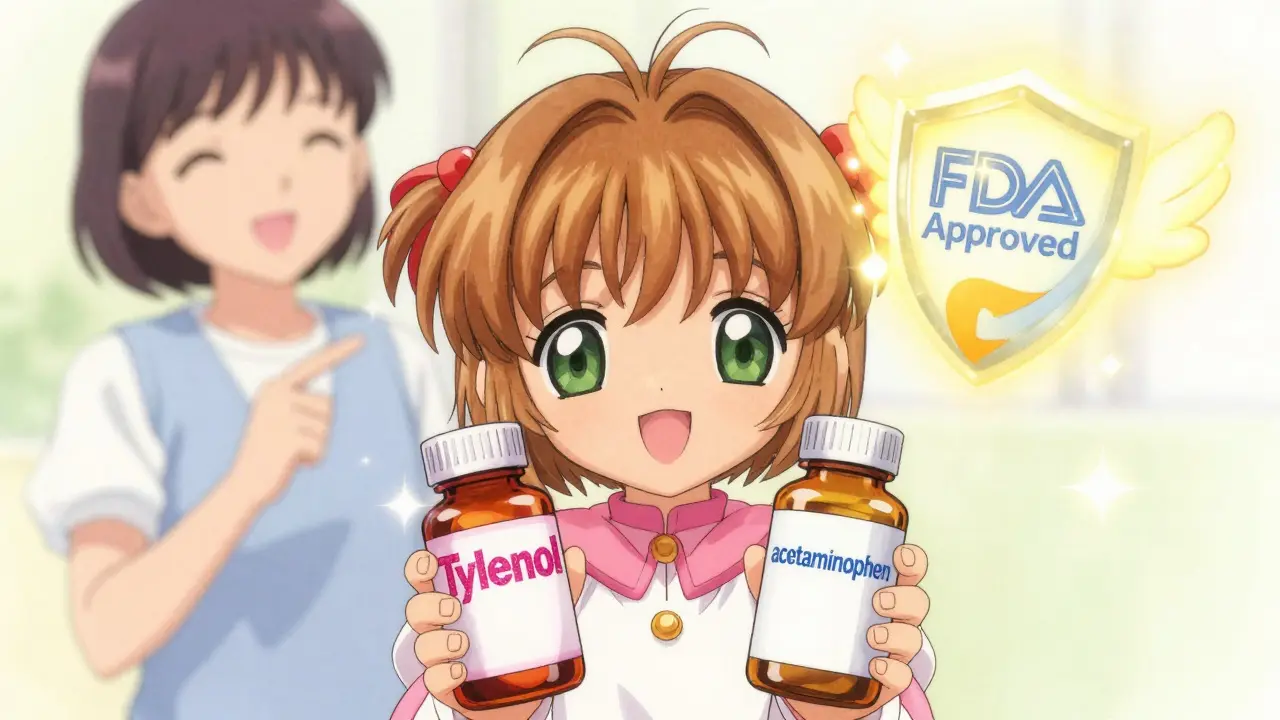
Use medicine bottles. Take two bottles: one with ‘Tylenol’ and one with ‘acetaminophen.’ Point to the active ingredient on each label. Say: ‘See this? This part is the same. It’s like two different names for the same superhero.’
Play a game: ‘Medicine Match.’ Put out three pill bottles - one brand name, two generics. Ask them to find the ones that are the same inside. Reward them with stickers or high-fives. Kids remember what they do, not what they’re told.
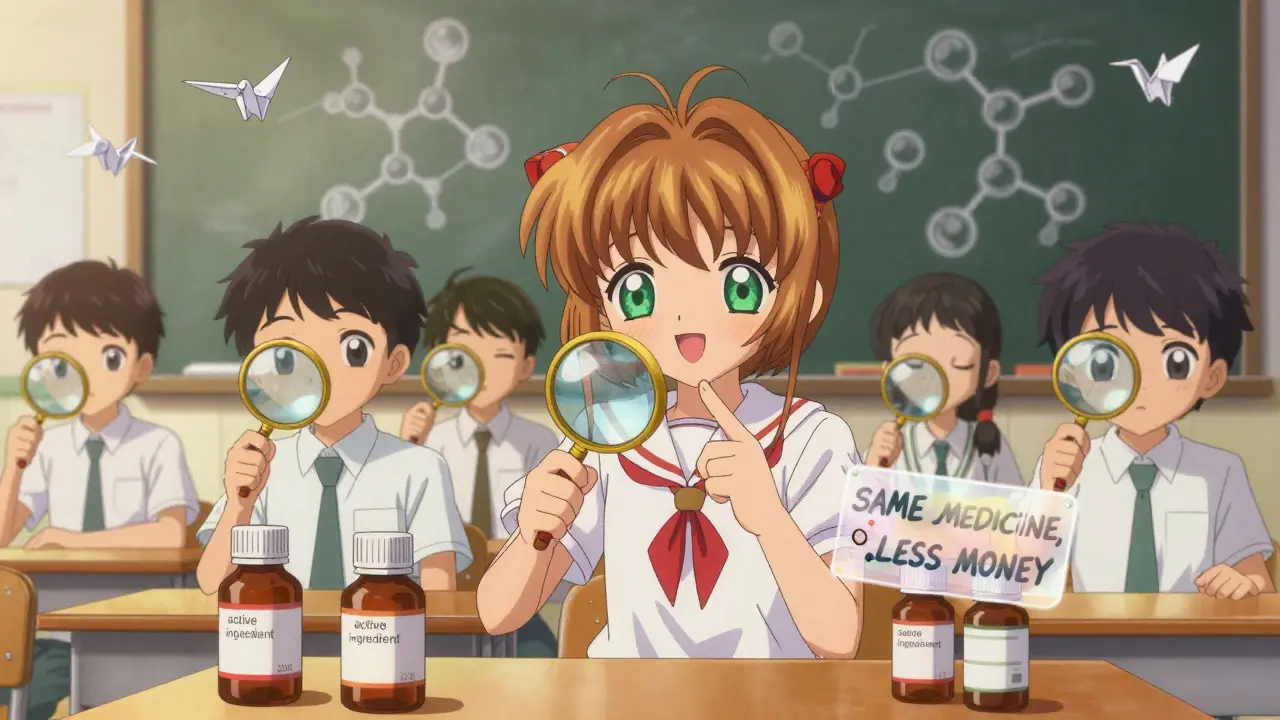
Don’t say ‘cheap.’ Say ‘same medicine, less money.’ Words matter. If you call it ‘cheap,’ they’ll think it’s low quality. If you call it ‘smart choice,’ they’ll think it’s wise.
For Older Kids (Ages 9-12): Digging Deeper
By this age, kids can handle a little more detail. Explain how the FDA makes sure generics are just as safe and strong as brand names. Show them the FDA logo on a medicine bottle. Tell them: ‘The government checks every generic before it goes on the shelf.’
Use real examples. ‘Your asthma inhaler? The brand costs $300. The generic? $30. Same puff, same help.’ Or: ‘Your mom’s blood pressure pill? The generic saves our family $1,200 a year. That’s a new bike or two months of ice cream.’
Let them look at the label. Show them where it says ‘active ingredient.’ Ask them to find it on different bottles. Make it a scavenger hunt. They’ll start noticing patterns: ‘All the cough syrups have dextromethorphan in them - even the ones with different names.’
Address their fears. Some kids worry: ‘If it’s cheaper, does that mean it’s made in a bad place?’ Explain that most generics are made in the same factories as brand names - just under different labels. The FDA inspects them all.
Teaching Teens: Beyond Price - Trust and Choice
Teens care about autonomy. They want to know why they should take what they’re given. This is the perfect time to talk about how insurance works. ‘Your plan covers the generic. If you want the brand, you pay the difference.’
Let them ask their pharmacist questions. Go together. Let them hear the pharmacist say: ‘Yes, this generic is identical to the brand. No difference in how it works.’
Use data they care about. ‘A study in the Journal of the American Medical Association found that 9 out of 10 people get the same results from generics as brands.’ Show them the study if they’re curious. Don’t just say it - let them see it.
And here’s the big one: teach them to speak up. If they’re told to take a brand-name drug but want the generic, they should feel empowered to ask: ‘Is there a generic version? Can we use that?’ That’s not being difficult. That’s being smart.
What Not to Do
Don’t use scare tactics. Don’t say, ‘If you take the wrong pill, you’ll get sick.’ That creates fear, not understanding.
Don’t hide the fact that generics exist. If you always buy the brand and never mention the other option, you’re teaching them that medicine is something to be blindly trusted - not questioned or understood.
Don’t assume they already know. A 2023 survey found that 61% of U.S. teens couldn’t name a single generic drug - even though they’d taken them before. They just didn’t know what they were.

Real-Life Wins: What Happens When Kids Understand
In Pittsburgh, a school nurse started a 10-minute lesson during health class: ‘What’s in your medicine cabinet?’ Kids brought in empty bottles. They matched generics to brands. One boy said, ‘I’ve been taking this cough syrup for two years and didn’t know it was the same as the one my grandma takes.’
A mother in Ohio told her 10-year-old daughter that the family was switching to generic antibiotics for ear infections. The girl asked, ‘Will it still work?’ The mom showed her the FDA website. The next day, the girl told her class: ‘Generics are just as good. My mom saved $40.’ Her teacher wrote it down. The school added it to their health curriculum.
These aren’t outliers. When kids understand, they become advocates. They ask their doctors. They remind their parents. They help others.
Where to Find Free Resources
You don’t need to buy anything. Free, science-backed tools exist:
- Generation Rx (generationrx.org) - free lesson plans for K-12, with activities, posters, and videos. Their ‘Medication Safety Patrol’ kit has coloring sheets for little kids and role-play cards for teens.
- NIDA for Teens (teens.drugabuse.gov) - explains how drugs work in the body, including how generics are tested.
- FDA’s ‘Medicines in My Home’ - printable worksheets showing how to read labels and spot active ingredients.
All of these are used in schools across the U.S. - and they’re designed by pharmacists, not marketers.
Start Small. Start Today.
You don’t need a lesson plan. Just the next time you hand your child a pill, say: ‘This is the generic version of [brand]. It’s the same medicine, just cheaper.’
Then pause. Let them ask a question. Answer honestly. If you don’t know, say, ‘Let’s look it up together.’
That moment - small, quiet, real - is how lifelong health literacy begins. Not in a classroom. Not in a pamphlet. But in the everyday moments when a parent chooses to be clear.
Generic drugs aren’t just a cost-saving trick. They’re a chance to teach kids that medicine doesn’t have to be mysterious. That being smart about health doesn’t mean spending more - it means understanding more.
Are generic drugs really as safe as brand-name drugs?
Yes. The U.S. Food and Drug Administration (FDA) requires that generic drugs have the same active ingredient, strength, dosage form, and route of administration as the brand-name version. They must also meet the same strict manufacturing standards. Thousands of studies show that generics work just as well. The only differences are in the inactive ingredients - like color or flavor - which don’t affect how the medicine works.
Why do generic drugs cost so much less?
Brand-name drugs are expensive because the company paid to develop them, run clinical trials, and market them. Once the patent expires, other companies can make the same drug without those costs. They don’t need to spend millions on advertising or research. So they can sell it for a fraction of the price - while still making a profit.
Can my child take a generic version of their prescription?
In most cases, yes. Pharmacists are required by law to substitute a generic unless the doctor writes ‘dispense as written’ or ‘no substitution.’ If you’re unsure, ask your pharmacist or doctor. They can confirm whether the generic is appropriate for your child’s condition. Most pediatric medications - like antibiotics, asthma inhalers, and ADHD meds - have safe, effective generics.
What if my child’s medicine looks different now?
That’s normal. Generic drugs often look different because they use different colors, shapes, or markings. But the active ingredient is the same. Always check the label for the drug name and dosage. If you’re confused, call the pharmacy. Never assume a different-looking pill is wrong - it might just be a different brand of the same medicine.
Should I let my child choose between brand and generic?
For older kids and teens, yes - with guidance. Let them see the price difference. Let them ask questions. Help them understand that the choice isn’t about quality, but about smart use of resources. Giving them a say builds responsibility. But always check with your doctor first, especially for critical medications like seizure or heart drugs.
Is it okay to switch from brand to generic mid-treatment?
For most medications, yes. The FDA approves generics as bioequivalent - meaning they work the same way in the body. But for a few drugs - like thyroid medicine or blood thinners - small differences in absorption can matter. If your child is on one of these, talk to their doctor before switching. For most others, switching is safe and common.



Terri Gladden January 5, 2026
OMG I JUST REALIZED MY KID HAS BEEN TAKING GENERIC ADDERALL FOR 2 YEARS AND I THOUGHT IT WAS A FAKE ONE?? LIKE I WASN'T EVEN AWARE?? THIS POST JUST BROKE MY HEART AND MY WALLET AT THE SAME TIME. I'M GOING TO CRY IN THE PHARMACY TOMORROW.
Jennifer Glass January 5, 2026
It’s wild how we treat medicine like a luxury brand instead of a science. The fact that kids don’t know generics are identical speaks to how deeply marketing has seeped into our understanding of health. We teach them to associate price with quality in everything - shoes, cereal, even pills. But medicine shouldn’t be about branding. It should be about biology. And if we start early, they’ll grow up seeing healthcare as something they understand, not something they fear.
Joseph Snow January 6, 2026
Let me guess - the FDA approves generics because they’re in bed with Big Pharma. Same factories? Sure. But who’s inspecting the inspectors? And why do so many generics come from India and China? You think the FDA has the manpower to check every batch? Don’t be naive. This is a cost-cutting scam dressed up as ‘smart parenting.’
Akshaya Gandra _ Student - EastCaryMS January 8, 2026
i luv this post!! i teach 7th grade sci in india and we just did a lesson on meds n my kids were shocked that 'tylenol' and 'acetaminophen' r same!! one girl said 'so my mom was wasting money??' i showed them the label n they all started checking their home meds. we made a poster: 'GENERIC = SMART, NOT CHEAP' lol. thx for the ideas!!
Michael Rudge January 10, 2026
Of course you’re pushing this. Because the people who write these articles never have to pay out-of-pocket for their kid’s insulin. You talk about ‘smart choices’ like it’s a virtue - but for most families, ‘generic’ means waiting weeks for a prescription because insurance won’t cover the brand, and the kid’s asthma gets worse. This isn’t education. It’s class warfare wrapped in a sticker.
Stephen Craig January 10, 2026
Understanding medicine as a system, not a mystery, is foundational. The real win isn’t saving money - it’s removing stigma. When kids stop associating ‘cheap’ with ‘bad,’ they stop internalizing shame about their health. That’s the quiet revolution here.
Jack Wernet January 11, 2026
As someone who grew up in a household where medicine was whispered about and never discussed, I wish I’d had this conversation at age 8. The fear around pills, the secrecy - it shapes how we interact with healthcare for life. This isn’t just about economics. It’s about dignity.
bob bob January 13, 2026
Just did this with my 6-year-old last night. We laid out all the bottles on the kitchen table. He pointed to the generic ibuprofen and said, ‘This one’s the quiet superhero.’ I cried. Not because it’s cute - because it’s true. He gets it. And I didn’t even try that hard.
Vicki Yuan January 14, 2026
Correction: The 2023 survey found 61% of U.S. teens couldn’t name a single generic drug - but that’s because they’ve never been taught to look. Not because they’re ignorant. We’ve failed to make the invisible visible. This guide fixes that. Thank you for writing it.