
When your body’s natural hormone balance gets thrown off, it’s not always obvious why. You might feel tired, lose your period, have trouble getting pregnant, or notice milk coming from your breasts even if you’re not nursing. For many people, the real culprit is a tiny, non-cancerous tumor in the pituitary gland called a prolactinoma. It’s the most common type of pituitary adenoma, making up nearly half of all cases. And while it sounds scary, it’s one of the most treatable hormone disorders out there-if you know what to look for.
What Exactly Is a Prolactinoma?
The pituitary gland sits at the base of your brain, no bigger than a pea. But it controls a lot: thyroid function, stress response, growth, and reproduction. A prolactinoma is a benign tumor that makes too much prolactin, the hormone that triggers milk production. In women, high prolactin levels can stop ovulation and periods. In men, it can lower testosterone, reduce sex drive, and cause erectile dysfunction. About 95% of women with prolactinomas have these symptoms. In men, it’s closer to 80%.
Not all pituitary tumors make hormones. Some just sit there and press on nearby structures. But prolactinomas are different-they’re active. And they’re common. Studies show about 1 in 10 people have some kind of pituitary growth, but only a small fraction ever cause symptoms. The ones that do? Most are under 1 centimeter. Those are called microadenomas. Larger ones, over 1 cm, are macroadenomas. When a prolactinoma gets big enough, it can squash the optic nerve and cause vision problems-especially loss of peripheral vision. That’s why an MRI is critical if your prolactin levels are high.
How Do You Know You Have One?
It starts with a blood test. If your prolactin level is over 150 ng/mL, there’s a 95% chance it’s a prolactinoma. Levels above 200 ng/mL almost always mean a larger tumor. But don’t jump to conclusions. Stress, pregnancy, certain medications (like antidepressants or stomach acid blockers), and even nipple stimulation can temporarily raise prolactin. That’s why doctors don’t diagnose based on one test. They’ll repeat it, check thyroid function (because low thyroid can also raise prolactin), and order a high-resolution MRI of the pituitary.
For tumors bigger than 1 cm, they’ll also check your vision. A simple field-of-view test can catch early damage. If your peripheral vision is fading, it’s a red flag that the tumor is pressing on the optic chiasm. This isn’t rare. About 20% of all pituitary adenomas are macroadenomas, and many of those are prolactinomas.
Medical Treatment: The First Line of Defense
Here’s the good news: for most people, medication alone can shrink the tumor and bring prolactin back to normal. The go-to drugs are dopamine agonists-medications that trick the brain into thinking there’s enough prolactin already. The two main ones are cabergoline and bromocriptine.
Cabergoline is the clear winner. It’s taken just twice a week, works better, and has fewer side effects. Studies show it normalizes prolactin in 80-90% of small tumors and 70% of large ones within three months. It also shrinks the tumor in 85% of cases. Most patients start at 0.25 mg twice a week. If prolactin doesn’t drop, the dose goes up slowly-usually by 0.25 mg every two weeks. The goal is the lowest dose that keeps prolactin normal.
Bromocriptine works too, but it’s harder to tolerate. People often get nauseous, dizzy, or lightheaded, especially at first. About 32% of users quit bromocriptine because of side effects. Only 18% stop cabergoline. That’s why most doctors start with cabergoline unless there’s a reason not to.
One thing to watch: long-term use of cabergoline (over 2.5 mg per week for more than three years) can, in rare cases, affect heart valves. That’s why the European Society of Endocrinology recommends an echocardiogram after a year and then every two years if you’re on high doses. The FDA has a black box warning for this, but the risk is low for most people on standard doses.

Surgery: When Medication Isn’t Enough
Surgery isn’t the first choice-but it’s a powerful option when needed. The standard procedure is transsphenoidal surgery: a tiny incision through the nose or upper gum to reach the pituitary. No skull is opened. No visible scar.
For small tumors, success rates are high-85-90% of patients get cured. The tumor is removed completely, prolactin drops fast, and many people can stop medication altogether. But for larger tumors that have spread into the cavernous sinus (a complex area near the brain), the cure rate drops to 30-50%. Even if the tumor is mostly removed, prolactin might stay elevated, meaning you still need medicine.
Surgery carries risks: a leak of spinal fluid (2-5%), temporary diabetes insipidus (5-10%), or, rarely, pituitary apoplexy (sudden bleeding into the tumor). Most patients are out of the hospital in 3-5 days. Many report feeling better within weeks. One case from Mayo Clinic followed a 34-year-old woman with a 2.4 cm tumor and prolactin levels at 5,200 ng/mL. After six months on cabergoline, her levels dropped to 18 ng/mL. Her tumor shrank by 70%. She didn’t need surgery.
Radiation: The Slow Option
Radiation is rarely used today as a first step. It takes years to work. Most patients still have symptoms after one year. It’s usually reserved for tumors that won’t shrink with meds or surgery, or for people who can’t tolerate either.
There are a few types. Fractionated radiation delivers small doses over 5-6 weeks. Gamma Knife uses a single high-dose beam focused precisely on the tumor. Proton therapy is newer and even more targeted. Gamma Knife has a 95% control rate at five years and much less risk to the optic nerve than older radiation methods.
The downside? It can take 2-5 years to lower prolactin. And about 30-50% of patients end up with low hormone levels in the pituitary (hypopituitarism) within 10 years. That means lifelong replacement therapy for thyroid, cortisol, or sex hormones. That’s why doctors avoid it unless absolutely necessary.
What Happens After Treatment?
Even if your prolactin normalizes and the tumor shrinks, you’re not done. You need monitoring. For the first year, prolactin is checked every three months. If it stays stable, once a year is enough. MRI scans aren’t needed every year unless symptoms come back.
One big mistake patients make: stopping medication too soon. Prolactin rebounds within 72 hours of missing a dose. Some people feel fine and quit. Then their periods stop again. Or their sex drive vanishes. Or the tumor grows back. That’s why adherence matters more than most realize.
Women who want to get pregnant can often stop cabergoline once pregnant-since prolactin naturally rises during pregnancy. But they need close monitoring. Men should check testosterone levels after treatment. If they’re low, replacement therapy might be needed.
What’s Next in Treatment?
The field is moving fast. In 2023, the FDA approved paltusotine for acromegaly-a related pituitary disorder-and trials are now testing it for prolactinomas. Researchers are also looking at CRISPR gene editing to fix mutations linked to tumor growth, like MEN1. AI is being used to plan surgeries with 3D models of individual pituitary anatomy.
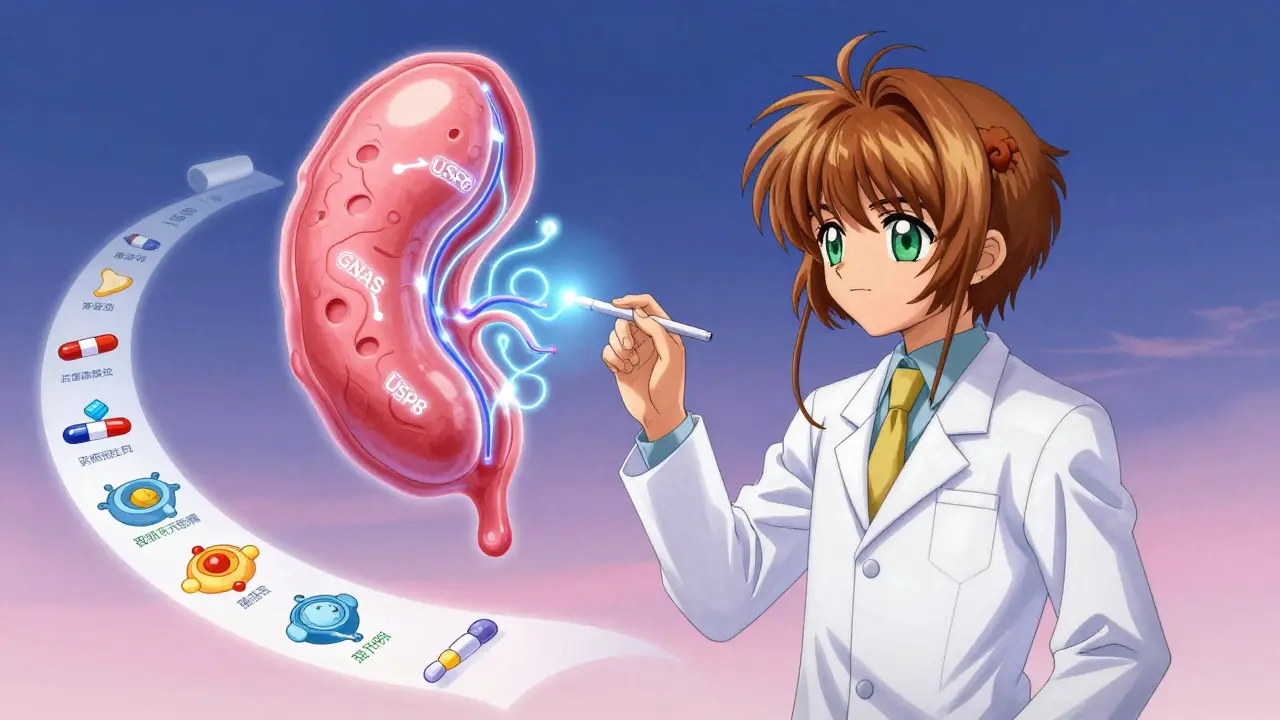
But the biggest shift? Personalized medicine. Scientists now know that tumors with certain gene mutations (like GNAS or USP8) behave differently. In the next five years, we’ll likely see treatment choices based on a tumor’s genetic profile-not just its size. One expert predicts this could raise cure rates from 70% to 90%.
Still, 30% of large prolactinomas don’t respond well to current treatments. That’s why research continues. For now, though, the message is clear: if you have unexplained hormone symptoms, get tested. Prolactinoma isn’t just a diagnosis-it’s a solvable puzzle.
Can a prolactinoma cause infertility?
Yes. High prolactin suppresses the hormones that trigger ovulation in women and testosterone production in men. This can lead to missed periods, lack of ovulation, low sperm count, and erectile dysfunction. In most cases, fertility returns after prolactin levels are brought back to normal with medication.
Is a prolactinoma cancer?
No. Prolactinomas are benign (non-cancerous) tumors. They don’t spread to other parts of the body. But they can cause serious problems by pressing on nearby structures like the optic nerve or by disrupting hormone balance. That’s why treatment is still important.
Why is cabergoline preferred over bromocriptine?
Cabergoline is more effective at lowering prolactin and shrinking tumors. It’s taken only twice a week, compared to daily for bromocriptine. Side effects like nausea and dizziness are also much less common-only about 18% of patients stop cabergoline due to side effects, versus 32% for bromocriptine.
Can I stop taking cabergoline if I feel fine?
Not without talking to your doctor. Stopping medication-even for a few days-can cause prolactin to spike again within 72 hours. The tumor may start growing back, and symptoms like infertility or low libido can return. Some patients can taper off after years of stable levels, but this is done carefully under medical supervision.
Do I need lifelong monitoring after treatment?
Yes. Even if your tumor is gone and prolactin is normal, you should have blood tests at least once a year. Tumors can regrow, especially if they were large. Also, if you had radiation or surgery, you may develop other hormone deficiencies over time that need replacement therapy.







Bhaskar Anand February 24, 2026
This is why India needs better healthcare infrastructure. People here suffer for years before getting diagnosed. Prolactinoma? Most doctors think it's stress or depression. No MRI, no blood tests. Just pills for anxiety. Meanwhile, the tumor grows. I've seen it. It's not just medical-it's systemic failure.
William James February 25, 2026
I love how this post breaks down the science without jargon. Seriously. Most medical content feels like a textbook. This? It feels like a conversation with a doctor who actually cares. I wish more health writers took this approach. It’s not just info-it’s empowerment.
Vanessa Drummond February 26, 2026
I had a prolactinoma. Took me 3 years to get diagnosed. My doctor said I was 'just stressed.' I cried in his office. Then I Googled my symptoms. Found this exact article. Started pushing for tests. Turned out my prolactin was 1,200. Cabergoline saved me. I'm pregnant now. Don't let anyone gaslight you. Trust your body.
Nick Hamby February 27, 2026
The elegance of dopamine agonists lies in their precision. They don't destroy; they restore. The pituitary is not a broken machine-it's a miscommunicating orchestra. Cabergoline doesn't silence the conductor; it gently recalibrates the tuning. This is biology as poetry. And yet, we treat it like a bug to be eradicated. Perhaps we need more humility in medicine.
kirti juneja February 27, 2026
OMG I’m so glad someone finally explained this without making it sound like a horror movie. I thought I was going crazy when I started leaking milk. My mom said it was 'hormonal drama' and told me to drink turmeric tea. Like, sis. It’s not a Bollywood flick. It’s a tumor. And it’s treatable. Thank you for this. I’m sharing this with my entire family.
Haley Gumm February 28, 2026
Let’s be real. The article says cabergoline works for 80-90% of microadenomas. But what about the 10-20% that don’t respond? They’re left with radiation or surgery. And guess what? Radiation causes lifelong hormone deficits. That’s not treatment. That’s trading one crisis for another. This isn’t a success story-it’s a compromise.
Gabrielle Conroy March 1, 2026
I just want to say THANK YOU for writing this!! 🙌 I’ve been on cabergoline for 4 years and I felt so alone. Reading this made me feel seen. Also-yes to the echocardiogram reminder! I got mine last year and it was fine. Please, if you’re on long-term cabergoline, don’t skip it. Your heart will thank you. And if you’re scared to talk to your doctor? Bring this article. It’s a game-changer. 💖
Christopher Wiedenhaupt March 2, 2026
The assertion that prolactinomas are 'one of the most treatable hormone disorders' is statistically accurate but clinically misleading. Treatment efficacy is contingent upon early detection, which is rare in low-resource settings. Furthermore, the reliance on dopamine agonists ignores socioeconomic barriers: cabergoline costs $300/month in the U.S. and is unavailable in many developing nations. The narrative of 'solvable puzzle' privileges access over equity.
Brandice Valentino March 3, 2026
I read this whole thing and I’m just like… wow. So basically, we’re just supposed to trust that a pea-sized tumor in our brain can be fixed with a pill we take twice a week? And no one’s worried about the long-term effects? Like… what if I just… don’t want to be on this forever? What if I just want to be normal? Is that too much to ask?
Larry Zerpa March 4, 2026
You claim cabergoline 'shrinks tumors in 85% of cases.' But you omit that 15% don’t respond. You say 'most patients feel better in weeks'-but what about the ones who develop hyponatremia, depression, or compulsive gambling? You gloss over the black box warning. This isn't education. It's pharmaceutical propaganda disguised as journalism. And you call it 'empowerment'? Pathetic.
Gwen Vincent March 4, 2026
I just wanted to say… I’ve been reading all these comments and I’m so glad we’re talking about this. I didn’t know I wasn’t alone. I thought I was just failing at being a woman. I didn’t realize my body was sick. Thank you all for sharing. It means more than you know.
Nandini Wagh March 6, 2026
Oh wow. So the 'treatable' part is only if you live in a country with healthcare and can afford $300/month? And if you're a man? You're just told to 'man up' and deal with low libido? Classic.
Holley T March 7, 2026
I appreciate the optimism here, but let’s not pretend this is a solved problem. The article mentions CRISPR and AI as future hope, but we’re still stuck with dopamine agonists that cause impulse control disorders in 10% of users. We’re still using 1970s-era protocols to treat a 21st-century condition. And yes, women are disproportionately affected, yet research funding for pituitary disorders is less than 1% of what’s spent on breast cancer. The real story isn’t the tumor. It’s the silence around it. The lack of funding. The dismissal of 'hormonal issues' as women’s problems. We need systemic change-not just better meds.