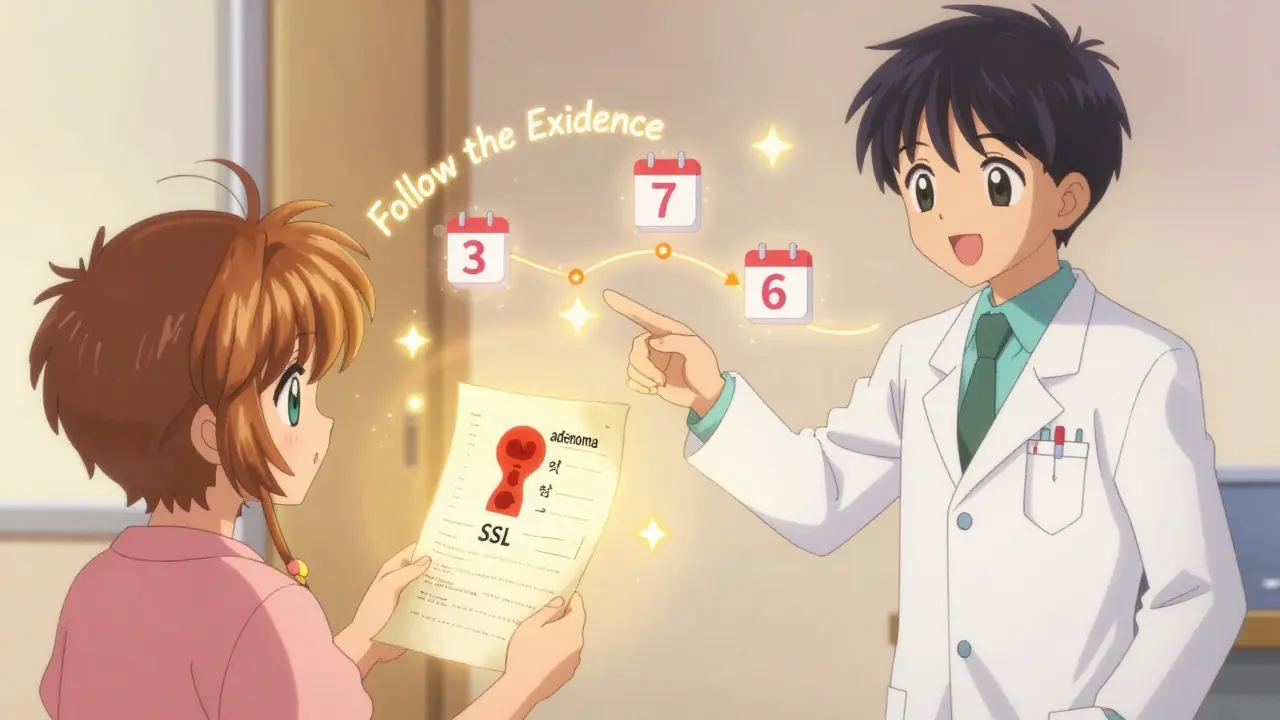
After a colonoscopy finds polyps, most people breathe a sigh of relief - the scary growths are gone. But then comes the question: When do I need another colonoscopy? It’s not a one-size-fits-all answer. The timeline depends on what kind of polyps you had, how many, how big they were, and even how clean your bowel prep was. Getting the next colonoscopy too soon means unnecessary cost, discomfort, and risk. Too late, and you could miss a dangerous growth growing unnoticed.
Not All Polyps Are the Same
The first thing your doctor looks at isn’t just whether you had polyps - it’s what kind they were. There are three main types that matter for follow-up: adenomas, serrated polyps, and hyperplastic polyps. Adenomas are the most common and the ones most likely to turn into cancer over time. Serrated polyps, especially sessile serrated lesions (SSLs), are trickier because they can hide in plain sight and develop into cancer faster than you’d expect. Hyperplastic polyps are usually harmless - unless they’re large or located in the right side of the colon.If your report says "low-risk adenoma," that usually means one or two polyps under 10 mm, with no signs of high-grade dysplasia or villous features. For these, the 2020 US Multi-Society Task Force guidelines say you can wait 7 to 10 years for your next colonoscopy. That’s a big change from the old 5-year rule. Studies show people with these small, simple polyps have nearly the same cancer risk as someone with a completely normal colonoscopy.
What Triggers a Shorter Wait?
If you had more than two adenomas, or any polyp 10 mm or larger, your clock resets to a shorter interval. Same goes if your polyp had villous features, high-grade dysplasia, or was a serrated lesion larger than 10 mm. These are red flags. They mean your colon is more likely to develop new polyps quickly. In these cases, the standard recommendation is a repeat colonoscopy in 3 years.What if you had three or four small adenomas (all under 10 mm)? That’s a gray zone. The guidelines say 3 to 5 years. Many doctors lean toward 3 years here, especially if your bowel prep wasn’t perfect or if you have a family history of colon cancer. It’s not just about counting polyps - it’s about your overall risk picture.
Serrated Polyps: The Silent Threat
Sessile serrated lesions (SSLs) are often missed during colonoscopy because they’re flat, pale, and blend in with normal tissue. Even if they’re small - say, 5 to 9 mm - having two or more of them means you need a follow-up in 5 years. If you had three to four, that drops to 3 to 5 years. Five or more? Back in 3 years. The tricky part? Many doctors still confuse SSLs with harmless hyperplastic polyps. That’s why some patients get the wrong advice.Here’s a real-world example: A 58-year-old man had two SSLs, each 7 mm, removed during his screening colonoscopy. His doctor, unaware of the updated guidelines, told him to come back in 5 years. That’s correct. But another patient with the same findings was told to return in 3 years - unnecessarily. The difference? The second doctor was being overly cautious, not following the evidence.
What About Big Polyps That Were Cut in Pieces?
Sometimes, a polyp is too big to remove in one piece. That’s called piecemeal resection. If the polyp was 20 mm or larger and removed in fragments, your risk of leftover tissue is higher. The US guidelines say wait 6 months for a follow-up colonoscopy. Why? Because if any cancerous cells were left behind, they’ll show up quickly. European guidelines are more flexible - suggesting 3 to 6 months - but the US standard is clear: 6 months.One study from a large Midwest hospital found that 14% of patients who had piecemeal resection of large polyps had residual adenoma tissue at their 6-month follow-up. That’s why skipping this step isn’t an option. Waiting a year? That’s dangerous.

Polyps That Aren’t Polyps
Not every growth is a threat. Hyperplastic polyps under 10 mm, especially in the lower colon, are almost always benign. You don’t need a repeat colonoscopy unless you had a lot of them - five or more - or if your doctor isn’t sure whether they’re hyperplastic or serrated. In those cases, 3 to 5 years is the safe call. If you had one large hyperplastic polyp (10 mm or bigger), especially in the right colon, you should be followed up in 3 to 5 years. Why? Because it’s hard to tell them apart from SSLs without expert review.Why So Many People Get the Wrong Timeline
Here’s the hard truth: most doctors aren’t following the guidelines. A 2020 study at a Veterans Affairs hospital found that only 18.6% of gastroenterologists recommended the correct 7- to 10-year interval for low-risk adenomas. The rest still told patients to come back in 5 years. Why? Fear. Fear of missing something. Fear of being sued. Fear of confusing patients.Even worse, only 28.5% of doctors correctly identified the right interval for sessile serrated lesions. That’s a massive knowledge gap. And it’s not just doctors - primary care providers often give out wrong advice because they’re not trained in the details. One patient was told by her PCP to get a colonoscopy in 2 years after having two small adenomas. She followed it. The colonoscopy showed nothing new. She was scared, wasted time, and spent hundreds of dollars for no reason.
Tools That Help - And What to Ask Your Doctor
There are apps now, like Polyp.app, that help doctors calculate the right interval based on your polyp report. If your doctor doesn’t mention one, ask: "Based on the size, number, and type of polyps I had, what’s the current guideline for my follow-up?" Then ask: "Can you show me the exact recommendation from the US Multi-Society Task Force?"You can also ask: "Was my bowel prep good?" Poor prep can make polyps harder to see, which might mean you need a repeat sooner - even if your polyps were low-risk. If your prep was rated "fair" or "poor," your doctor should consider a 3-year follow-up regardless of polyp type.

What’s Changing in the Next Few Years
The future of colonoscopy surveillance isn’t just about counting polyps. Researchers are testing blood and stool tests that look for DNA changes linked to cancer risk. One trial is studying whether a simple blood test can replace the 3-year colonoscopy for people with a history of polyps. If it works, you might only need a colonoscopy every 10 years - and a blood test every 3.The European Society of Gastrointestinal Endoscopy is updating its guidelines in late 2024, and they’re likely to tighten recommendations for certain serrated polyps. Meanwhile, Medicare is starting to enforce reimbursement rules based on the 2020 guidelines - meaning if your doctor recommends a colonoscopy too early, your insurance might not pay for it.
Bottom Line: Know Your Numbers
After your colonoscopy, get a copy of the report. Look for these key terms:- Number of polyps
- Size (in millimeters)
- Histology (adenoma, SSL, hyperplastic)
- Presence of high-grade dysplasia or villous features
- Method of removal (snare, piecemeal)
If you had 1-2 small adenomas (≤10 mm) - wait 7-10 years.
If you had 3-4 small adenomas - wait 3-5 years.
If you had any polyp ≥10 mm, villous features, or high-grade dysplasia - wait 3 years.
If you had 1-2 SSLs <10 mm - wait 5-10 years.
If you had a large polyp removed in pieces - wait 6 months.
Don’t let outdated advice or fear drive your schedule. The science is clear. Follow the evidence. Your colon - and your future - will thank you.
How soon should I get a repeat colonoscopy after having one small adenoma removed?
If you had one or two adenomas under 10 mm with no high-risk features, the current guideline recommends waiting 7 to 10 years. This is based on strong evidence showing cancer risk is nearly the same as someone with a normal colonoscopy. Many doctors still recommend 5 years out of habit, but that’s outdated.
Are serrated polyps more dangerous than adenomas?
They can be. Sessile serrated lesions (SSLs) are harder to spot and can turn into cancer faster than adenomas, even when small. If you have one or two SSLs under 10 mm, you need a follow-up in 5-10 years. If you have three or more, or if they’re larger than 10 mm, you need to return in 3 years. Many doctors miss this distinction, so make sure your report specifies "sessile serrated lesion," not just "polyp."
What if my bowel prep was poor?
Poor prep is a big deal. If your colon wasn’t fully cleaned out, your doctor may have missed polyps. Even if your polyps were low-risk, a poor prep usually means you should return in 3 years. Always ask your doctor how your prep was rated - it directly affects your follow-up timeline.
Can I skip my next colonoscopy if I feel fine?
Absolutely not. Colon cancer grows slowly and often causes no symptoms until it’s advanced. By the time you feel pain, bloating, or bleeding, it may be too late. Surveillance colonoscopies aren’t about how you feel - they’re about catching precancerous growths before they turn dangerous. Skipping your scheduled colonoscopy is the #1 reason people develop colon cancer after a normal exam.
Will insurance cover a colonoscopy if I’m told to come back too soon?
Medicare and most private insurers follow the US Multi-Society Task Force guidelines. If your doctor recommends a colonoscopy sooner than the guideline allows - like 3 years instead of 7 for low-risk adenomas - your insurance may deny coverage or charge you the full cost. Always ask your doctor to justify the interval based on current guidelines before scheduling.
What to Do Next
Get your pathology report. Write down the polyp details. Call your doctor’s office and ask: "Based on the 2020 USMSTF guidelines, what’s my recommended interval?" If they say "5 years" for one small adenoma, push back. Show them the data. Your health is worth it.And if you’re still unsure? Use Polyp.app - it’s free, widely used by GI specialists, and gives you the exact timeline based on your polyp report. Don’t guess. Don’t wait. Act on the evidence.







Marie Mee December 18, 2025
they're lying about the 7-10 year thing i got mine at 5 and they found another one already my doctor says its because the prep was bad but i think they just want to keep taking our money
Naomi Lopez December 19, 2025
The 2020 US Multi-Society Task Force guidelines are unequivocally clear: low-risk adenomas warrant a 7–10-year interval. Any deviation from this is not evidence-based-it’s institutional inertia masquerading as caution. The data is robust. The meta-analyses are conclusive. Why are we still clinging to 5-year cycles like it’s 2008?
Nishant Desae December 20, 2025
i just want to say to everyone reading this that you are not alone in feeling confused after getting your report i know it feels overwhelming with all the terms like adenoma and serrated and dysplasia but honestly you dont need to memorize all of it just take the report to your doctor and ask them to explain it in plain words they owe you that much and if they get impatient thats not your problem its theirs
Meghan O'Shaughnessy December 20, 2025
My cousin in Mumbai got her first colonoscopy at 45 after her mom passed from colon cancer. She said the whole process felt like a ritual-quiet, serious, almost sacred. In India, we don’t talk about guts much, but when we do, it’s with reverence. This post reminded me that health isn’t just science-it’s culture too.
Kaylee Esdale December 21, 2025
so i had two tiny polyps and my doc said come back in 5 years but now i read this and i think maybe i should push for 7? i mean i dont wanna be a pain but i also dont wanna die from something that couldve been avoided
Anu radha December 22, 2025
i had one small polyp and i was scared to death then i read this and realized maybe i dont need to panic every year
Jigar shah December 22, 2025
Interesting point about bowel prep quality affecting follow-up timing. I’ve always assumed the prep was either good or bad, but never considered how it might shift the recommendation even for low-risk cases. Would be helpful if reports included a standardized prep score.
Joe Bartlett December 23, 2025
Yanks overcomplicate everything. In the UK, we just say: if it’s small and harmless, wait ten years. If it’s big or weird, come back in three. No apps needed. No confusion. Just common sense.
Salome Perez December 24, 2025
As a clinical coordinator for a large endoscopy unit, I can confirm that adherence to the 2020 guidelines remains inconsistent-even among specialists. We’ve implemented a digital decision-support tool that auto-populates follow-up intervals based on histology and size. Since rollout, compliance has risen from 19% to 87%. Education works-but only when it’s embedded into workflow.
Kent Peterson December 25, 2025
Oh wow, another ‘follow the guidelines’ lecture. Let me guess-you also think the moon landing was real, vaccines don’t cause autism, and 2+2=4? The ‘guidelines’ are written by Big Gastro, paid for by endoscopy manufacturers. They want you back every 3 years because that’s where the money is. Don’t be fooled.
Sam Clark December 27, 2025
Thank you for sharing such a comprehensive and well-structured overview. For patients navigating this information for the first time, clarity like this can reduce anxiety and empower informed decision-making. I encourage every provider to distribute this as a patient handout.
Jessica Salgado December 27, 2025
I just got my report and I’m crying because I didn’t realize how much was at stake. I had three small adenomas and my doctor said 5 years. Now I’m terrified I waited too long. What if I’m already too late? I feel like I’ve been lied to my whole life.