
When your doctor switches your medication from a brand-name drug to a generic version, most people assume it’s a simple swap-same pill, same effect, just cheaper. But for some drugs, that assumption can be dangerous. Even small changes in how your body absorbs a generic version can throw off your treatment, especially if you’re taking a drug with a narrow therapeutic index. These are medications where the difference between the right dose and a harmful one is razor-thin. For patients on drugs like warfarin, levothyroxine, or tacrolimus, switching generics isn’t just about saving money-it’s about survival.
What Is a Narrow Therapeutic Index (NTI) Drug?
Not all medications are created equal when it comes to switching. An NTI drug has a very small window between the dose that works and the dose that causes harm. Think of it like walking a tightrope: step too far one way, and you’re in danger; step too far the other, and the treatment stops working. The FDA defines these as drugs where small changes in blood concentration can lead to serious side effects or treatment failure.
Common NTI drugs include:
- Warfarin (blood thinner)
- Levothyroxine (thyroid hormone)
- Phenytoin and carbamazepine (anti-seizure meds)
- Tacrolimus and cyclosporine (immunosuppressants after transplants)
- Digoxin (heart medication)
These drugs aren’t rare. About 15% of all prescription medications fall into this category. And while generics are usually safe and effective, for NTI drugs, even minor differences in how the body absorbs the drug can matter. That’s why doctors sometimes need to adjust the dose after a switch-even if the generic is labeled as "bioequivalent."
Why Do Generics Sometimes Need Dose Changes?
By law, generic drugs must be "bioequivalent" to the brand-name version. That means their absorption rate in the bloodstream must fall within 80% to 125% of the original drug. Sounds close enough, right? But for NTI drugs, that 45% range is too wide.
Take warfarin. A patient stabilized on 5 mg daily might switch to a different generic. Even if the new version is within FDA’s bioequivalence range, their INR (a measure of blood clotting) could jump from 2.5 to 3.8-putting them at higher risk of bleeding. Studies show that 23% of patients switching between generic warfarin brands needed a dose adjustment within 30 days. That’s more than 1 in 5 people.
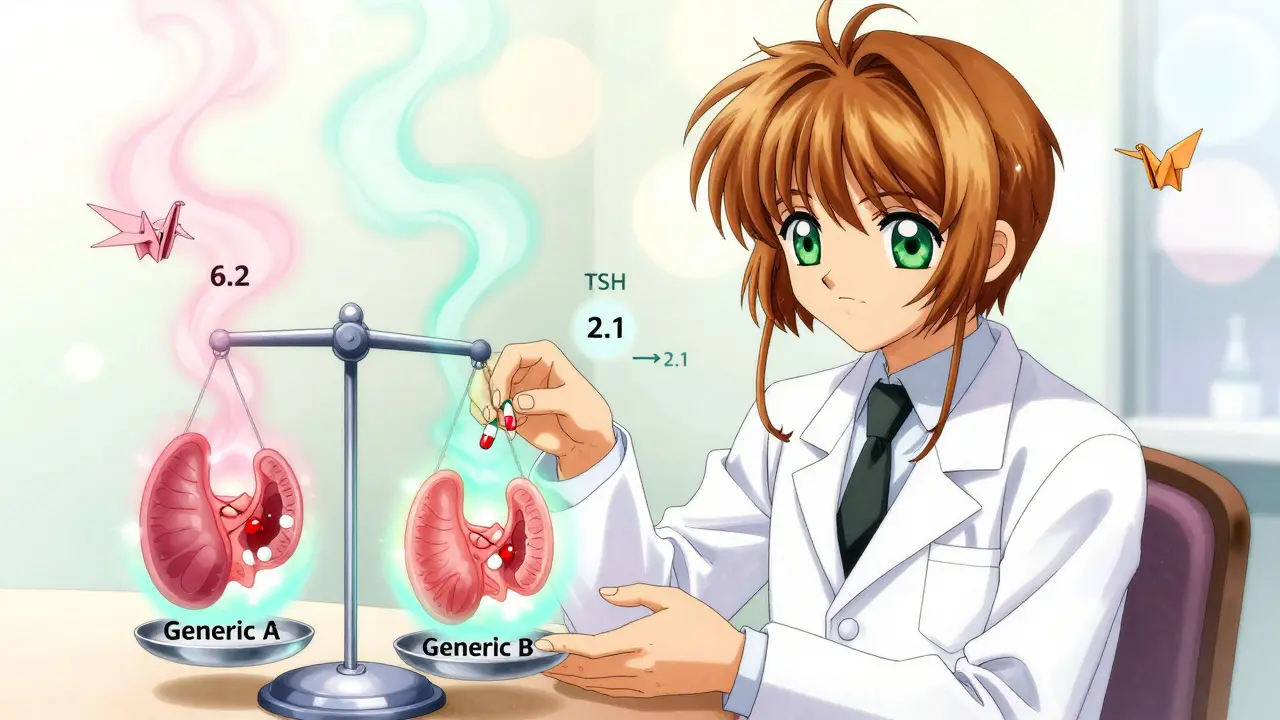
Levothyroxine is another classic example. Patients on this thyroid hormone often feel fine until they switch generics. Then they get tired, gain weight, or feel depressed. Why? Because the body is sensitive to tiny changes in thyroid hormone levels. One patient reported feeling awful for three weeks after switching to a new generic-until her dose was increased by 12.5 mcg. Her TSH levels went from 6.2 (too high) back to 2.1 (normal).
It’s not about the generic being "bad." It’s about manufacturing differences. Generic manufacturers use slightly different fillers, binders, or coating materials. For most drugs, this doesn’t matter. For NTI drugs, these small changes affect how quickly or completely the drug dissolves in your gut. That’s enough to shift blood levels beyond the safe range.
What Do Doctors Do When Switching NTI Drugs?
Most primary care doctors don’t routinely check blood levels after switching generics. But specialists and pharmacists do. Here’s what typically happens:
- Warfarin: INR is checked within 7 to 14 days after the switch. If it’s more than 10% off the target range, the dose is adjusted.
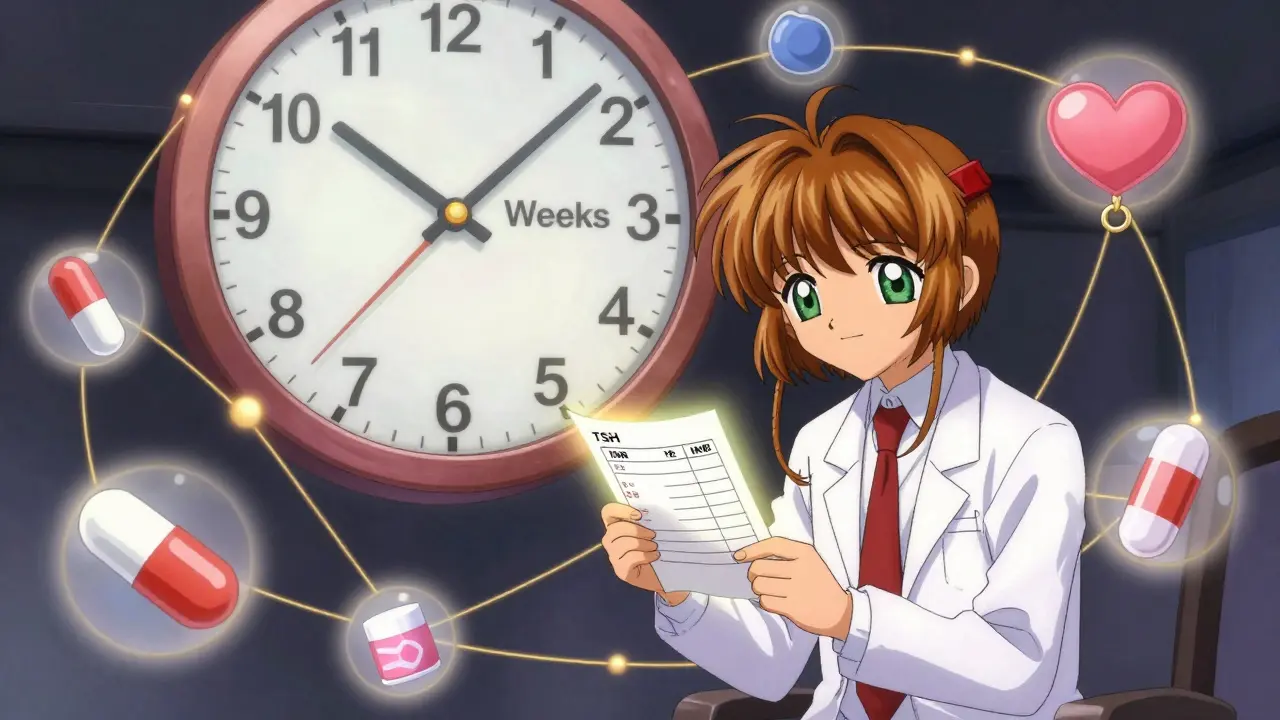
- Levothyroxine: TSH levels are retested 6 to 8 weeks after switching. A change of more than 0.5 mIU/L often triggers a dose tweak.
- Tacrolimus: Blood levels are checked within 3 to 7 days. A 20% drop or rise in concentration usually means a dose change.
- Phenytoin: Serum levels are monitored within 2 weeks. Even a 15% change can lead to seizures or toxicity.
Some hospitals and academic medical centers have formal protocols. At the University of Florida, for example, all patients switching warfarin generics get an INR check within a week. If the level is out of range, the pharmacist contacts the doctor immediately.
These aren’t just theoretical guidelines. A 2022 survey of 1,247 hospital pharmacists found that 68% had seen patients need dose adjustments after switching NTI generics. Antiepileptic drugs and warfarin were the top two culprits.
When Should You Be Concerned?
You don’t need to panic every time your pharmacy fills a generic. But if you’re on an NTI drug, pay attention to how you feel after a switch. Here are red flags:
- For levothyroxine: Unexplained fatigue, weight gain, cold intolerance, depression, or brain fog
- For warfarin: Easy bruising, nosebleeds, blood in urine or stool, dizziness
- For anti-seizure drugs: New or worsening seizures, confusion, tremors
- For tacrolimus: Fever, shaking, kidney problems, high blood pressure
If you notice any of these after a generic switch, don’t wait for your next appointment. Call your doctor. Ask for a blood test. Say: "I switched generics last week and I’m not feeling right. Can we check my levels?"
Some patients are lucky. One person on Reddit wrote: "My doctor switched me from Synthroid to generic levothyroxine with no dose change. My TSH was identical at 6 weeks." That’s great-but it doesn’t mean it’ll happen for everyone.
Why Don’t All Doctors Adjust Doses?
The FDA insists that generics are safe and equivalent. And for most drugs, they are. The agency’s stance is that the vast majority of patients don’t need dose changes after switching.
But here’s the problem: the FDA’s bioequivalence standards were designed for drugs with wide therapeutic windows-not NTI drugs. For a painkiller like ibuprofen, a 20% difference in absorption doesn’t matter. For warfarin, it does.
Many doctors aren’t trained to think about this. They assume "bioequivalent" means "identical." Pharmacists know better. That’s why academic medical centers and transplant clinics have pharmacists actively managing NTI drug switches. Community pharmacies? Not so much.
Insurance companies also play a role. Many plans push for the cheapest generic, even if it’s not the same one you were on before. You might switch from Generic A to Generic B to Generic C in a year. Each switch could mean a new adjustment. One pharmacist told me: "I’ve had patients on warfarin switched four times in six months. It’s chaos."
What Can You Do?
You can’t control what your insurance picks. But you can control how you respond.
- Know if you’re on an NTI drug. Ask your doctor or pharmacist. If you’re on warfarin, levothyroxine, or an immunosuppressant, you are.
- Ask for consistency. Say: "I’m stable on this version. Can we keep me on the same generic?" Some pharmacies will honor that request if you ask.
- Request monitoring. After any switch, ask for a blood test within the recommended time frame. Don’t wait for symptoms.
- Keep a symptom journal. Note how you feel in the first 2 to 4 weeks after a switch. That data helps your doctor decide if a dose change is needed.
- Speak up if something feels off. Your body knows when something’s wrong. Trust it.
Some patients get lucky and never need a dose change. Others need a tweak every time their pharmacy switches. That’s the reality of NTI drugs. It’s not about generics being bad-it’s about the system not being designed for precision.
What’s Changing?
The FDA is starting to catch up. In 2023, they proposed tighter bioequivalence standards for NTI drugs: 90% to 111% instead of 80% to 125%. That’s a big deal. If approved, it could mean fewer dose adjustments in the future.
Companies like Teva and Aurobindo are already making "supergenerics"-formulations with tighter controls and less variability. These aren’t brand-name drugs, but they’re closer to them in consistency.
For now, though, the responsibility falls on you and your doctor. Don’t assume a generic is a perfect copy. For NTI drugs, it’s not. And that’s why dose adjustments still happen.
Do all generic medications require dose adjustments?
No. Only medications with a narrow therapeutic index (NTI) typically need dose adjustments after switching. These include warfarin, levothyroxine, phenytoin, tacrolimus, and digoxin. For most other drugs-like statins, antibiotics, or blood pressure meds-switching to a generic doesn’t require any change in dosage.
Can I ask my pharmacy to keep me on the same generic brand?
Yes. You have the right to request a specific generic manufacturer if your insurance allows it. Tell your pharmacist: "I’ve been stable on this version. Can you fill my prescription with the same generic?" Some pharmacies will accommodate this, especially if you explain you’re on an NTI drug. If they say no, ask your doctor to write "Dispense as Written" or "Do Not Substitute" on the prescription.
How long should I wait before getting blood tests after switching generics?
Timing depends on the drug. For warfarin, check INR within 7-14 days. For levothyroxine, wait 6-8 weeks for TSH levels to stabilize. For tacrolimus or cyclosporine, test within 3-7 days. For anti-seizure drugs like phenytoin, aim for 2 weeks. Always ask your doctor for the recommended timeline based on your specific medication.
Are brand-name drugs safer than generics for NTI medications?
Not necessarily. The brand-name version isn’t inherently safer-it’s just more consistent. Many generic manufacturers now produce high-quality versions with low variability. The key is consistency: once you find a generic that works, stick with it. Switching between different generics-even if they’re all FDA-approved-is what increases risk.
What if my insurance won’t cover the brand-name drug?
If your insurance denies coverage for the brand-name version, ask your doctor to file an appeal with a letter of medical necessity. Mention that you’ve had stable control on a specific formulation and that switching has caused issues in the past. Many insurers will approve the brand if you can show documented instability after generic switches.
Final Thought
Switching to generics saves billions of dollars every year. That’s good. But when it comes to NTI drugs, saving money shouldn’t come at the cost of safety. The science is clear: for some medications, even tiny differences matter. If you’re on one of these drugs, don’t let convenience override caution. Stay informed. Ask questions. Get tested. Your body will thank you.







Elizabeth Ganak December 28, 2025
I switched from Synthroid to a generic last year and didn’t think twice-until I started feeling like a zombie. Took me three weeks to figure out it was the med. My TSH went from 1.8 to 5.9. Called my doc, got tested, and they bumped my dose by 12.5 mcg. Now I’m back to normal. Don’t assume it’s ‘just a generic’-your body notices the difference.
Also, pharmacies switch generics like they’re trading baseball cards. Mine went from Teva to Mylan to Apotex in six months. It’s insane.
Ask for the same brand. Write ‘Do Not Substitute’ on your script. It’s worth the fight.
Nicola George December 30, 2025
Oh sweet mercy, the FDA thinks 80-125% is ‘close enough’ for warfarin? That’s like saying ‘your parachute is fine as long as it opens between 500 and 2000 feet.’
Meanwhile, my pharmacist just shrugs and hands me the cheapest one. I’m pretty sure they’re running a drug roulette tournament.
Also, why do we still let insurance companies play God with our life-sustaining meds? #PharmaGreed
Raushan Richardson December 31, 2025
YES. YES. YES. I’m a nurse and I’ve seen this over and over. Patients come in confused, exhausted, depressed-all because their levothyroxine switched to a different generic and no one checked their labs.
It’s not that generics are bad. It’s that we treat them like they’re interchangeable like toilet paper. But your thyroid doesn’t care about cost savings.
Pro tip: If you’re on an NTI drug, keep a little notebook. Write down how you feel each day after a switch. Bring it to your appointment. It’s the best way to prove something’s off.
And if your doc says ‘it’s fine,’ ask for the lab. Just ask. You’ve got this.
Robyn Hays January 1, 2026
Let’s talk about the elephant in the room: the word ‘bioequivalent’ is a legal loophole dressed up as science.
It’s like saying two different brands of chocolate chip cookies are ‘equivalent’ because they both have sugar, flour, and chocolate. One melts in your mouth, the other tastes like cardboard wrapped in regret. Your gut doesn’t care about FDA paperwork-it cares about what actually dissolves in it.
And don’t get me started on how pharmacies rotate generics like they’re playing musical chairs with your endocrine system. One month it’s Teva, next month it’s Sandoz, then suddenly it’s Mylan again. No one tracks this. No one apologizes. But your body? Your body remembers.
We need a system where your ‘generic’ comes with a batch ID and a warning label: ‘May cause subtle, life-altering shifts in your physiology.’
Until then, be your own advocate. Keep records. Ask for bloodwork. Say no to the shuffle.
Liz Tanner January 2, 2026
I’ve been on tacrolimus since my kidney transplant five years ago. I’ve switched generics three times. Each time, my levels dropped. Each time, I almost got rejected. I didn’t feel sick-I just felt ‘off.’ My creatinine crept up. My doc didn’t notice until I brought up the switch.
Now I keep a printed copy of my last lab results in my wallet. I show it to the pharmacist every time I fill my script. I say: ‘I’m on a critical immunosuppressant. I need the same manufacturer. If you can’t fill it, call my doctor.’
It’s exhausting. But it’s saved my life.
If you’re on an NTI drug, do this too. Don’t wait for a crisis. Be proactive. You’re not being difficult-you’re being smart.
Kylie Robson January 3, 2026
Let’s clarify pharmacokinetic parameters here. The 80–125% AUC and Cmax range is based on log-transformed data and 90% confidence intervals under fasting conditions-standardized per the FDA’s 2001 guidance for immediate-release formulations. However, for NTI drugs, this interval is statistically non-inferior for population-level outcomes but fails to account for inter-individual variability in CYP450 metabolism, gastric pH, and P-glycoprotein expression. In patients with polymorphisms in CYP2C9 (warfarin) or UGT1A1 (levothyroxine), even minor shifts in bioavailability can trigger clinically significant deviations in therapeutic endpoints. This is why TDM (therapeutic drug monitoring) remains essential for NTI agents, regardless of regulatory equivalency claims. The system isn’t broken-it’s just being applied to a context it wasn’t designed for.
Caitlin Foster January 4, 2026
So let me get this straight: you’re telling me my life depends on whether my pharmacy got a shipment from Teva instead of Mylan? And the FDA’s like, ‘eh, it’s close enough’?!!
Meanwhile, my insurance is saving $2.37 per pill by switching me every time I refill. I’m not a lab rat. I’m a person with a thyroid.
Also, why do I have to beg for the same generic like I’m asking for a favor? I pay premiums. I deserve consistency.
Someone call the FDA. Tell them I’m not a statistic. I’m the one with the panic attack when my meds change.
Todd Scott January 5, 2026
As someone who’s worked in community pharmacy for over 20 years, I’ve seen this play out in real time. The issue isn’t generics-it’s the lack of communication between prescribers, pharmacists, and patients.
Most community pharmacists don’t have access to your full med history. We see the script, we dispense the cheapest generic, and move on. We don’t know you’ve been on the same brand for five years. We don’t know you’re on warfarin. We don’t know you’re a transplant patient.
But here’s the thing: if you tell us, we’ll help. Ask us: ‘Is this the same generic I’ve been taking?’ We can check our inventory. We can flag it. We can call your doctor if needed.
It’s not the system’s fault-it’s the silence. Speak up. We’re on your side. We just need you to say the words.
Paula Alencar January 5, 2026
It is a matter of profound ethical concern that the United States Food and Drug Administration, an institution entrusted with the safeguarding of public health, continues to uphold a bioequivalence standard that is demonstrably inadequate for drugs possessing a narrow therapeutic index. The regulatory framework, established in an era when pharmacokinetic modeling was less sophisticated and patient-centered care was not a priority, now perpetuates a systemic risk that disproportionately affects vulnerable populations-those requiring precise pharmacological control for survival.
Moreover, the commercial imperative of cost reduction, as enforced by insurance intermediaries, has transformed the dispensing of life-sustaining medications into a transactional game of chance, wherein the patient’s physiological stability is subordinated to the corporate bottom line.
It is not merely a question of clinical practice-it is a moral failure of the healthcare infrastructure. The time for incremental change has passed. We require immediate, enforceable regulatory reform, coupled with mandatory therapeutic drug monitoring protocols for all NTI medications, regardless of payer or provider setting.
Nikki Thames January 6, 2026
You people are hysterical. It’s not the generic’s fault-it’s yours. If you can’t tolerate a 20% fluctuation in drug concentration, perhaps you’re not stable to begin with. You’re clinging to brand-name drugs like security blankets because you lack discipline. Medicine isn’t about comfort. It’s about adaptation.
And don’t get me started on your ‘symptom journals.’ That’s not medicine, that’s hypochondria with a spreadsheet.
Stop treating your body like a fragile porcelain doll. It’s not broken. You’re just afraid of change.
Chris Garcia January 8, 2026
In Nigeria, we don’t have the luxury of choosing generics. We take what’s available. But here’s what I’ve learned: consistency is everything. If you find a version that works-stick with it. Even if it costs more. Even if it’s harder to get.
My cousin on levothyroxine switched to a local generic and ended up in the hospital with myxedema coma. They didn’t know it was the med. No one checked his TSH. He almost died.
It’s not about money. It’s about respect-for your body, your life, your right to be stable. In a world where healthcare is a privilege, sometimes the only power you have is refusing to let your meds be swapped like a discount coupon.
Ask. Document. Persist. Your life is worth more than a $2.50 savings.
James Bowers January 9, 2026
The FDA’s bioequivalence standards are legally binding and scientifically validated. Any suggestion that generics are unsafe for NTI drugs is anecdotal and unsupported by large-scale clinical trials. The burden of proof lies with those claiming harm-not with regulators to preemptively restrict access to cost-effective therapeutics.
Moreover, therapeutic drug monitoring is a clinical tool, not a regulatory requirement. If physicians fail to order appropriate labs, that is a failure of clinical judgment-not a flaw in generic drug policy.
Patients who experience adverse effects post-switch should be evaluated individually, not used to justify broad regulatory overreach or stigmatization of generic pharmaceuticals.