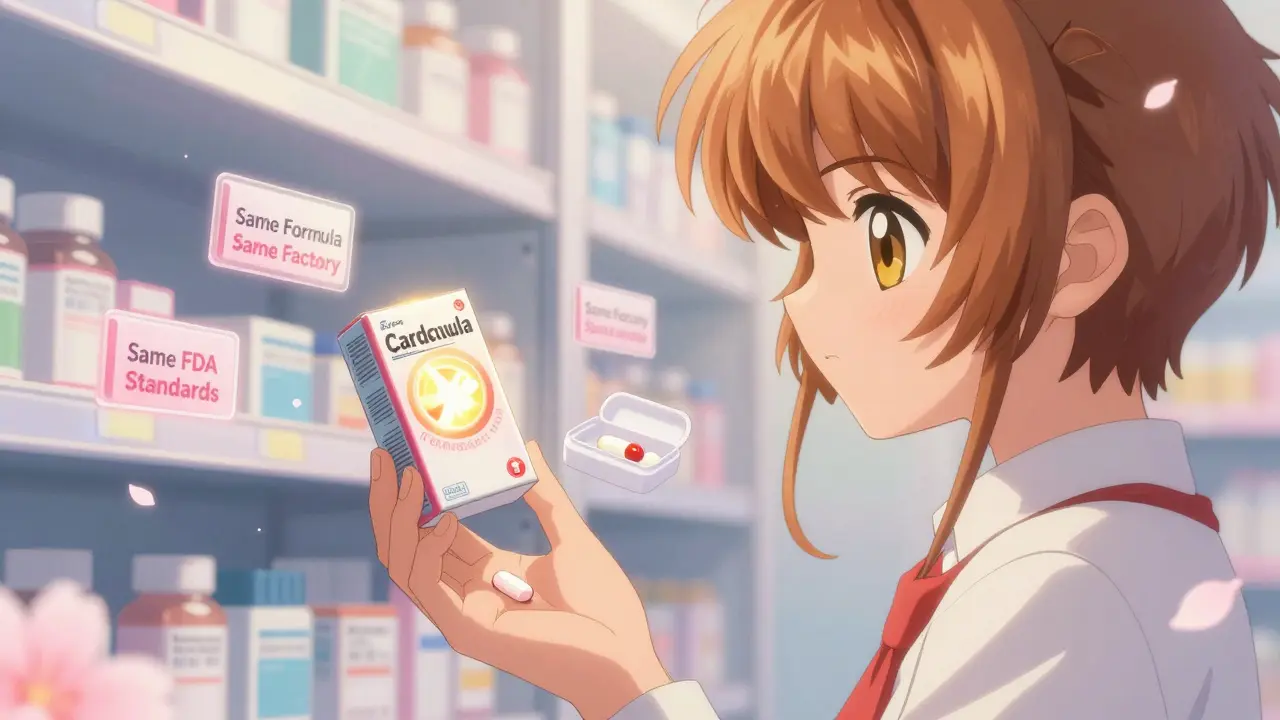
When you walk into a pharmacy and see a pill that looks nothing like the one your doctor prescribed, it’s natural to wonder: Is this the same thing? What if it doesn’t work as well? These questions come up every day-especially when a brand-name drug suddenly has a cheaper version on the shelf with a plain white label. That’s where authorized generics come in. And the truth? They’re not just similar to the brand. They’re the exact same drug.
What Exactly Is an Authorized Generic?
An authorized generic isn’t a copy. It’s not a knockoff. It’s the original brand-name drug, made in the same factory, with the same ingredients, and the same manufacturing process-just without the brand name on the box. The U.S. Food and Drug Administration (FDA) defines it clearly: it’s the same product, same active ingredient, same inactive ingredients, same strength, same shape, same everything. The only difference? The label says nothing about the brand.
Here’s how it works: When a drug’s patent expires, the original company can choose to launch its own generic version. They don’t need to go through the usual generic approval process. Why? Because they’re not making a new drug-they’re just selling the same one under a different name. This is different from traditional generics, which are made by other companies and must prove they work the same way through bioequivalence studies. Authorized generics skip that step because they’re literally the same pill.
Why Do Authorized Generics Exist?
You might think: If the brand company already made the drug, why would they make a cheaper version of it? It’s a business move. Once a patent expires, other companies can start making their own generics. That drives prices down. But the original brand company doesn’t want to lose all its customers. So they launch their own authorized generic. It lets them stay in the game, keep some market share, and still make money-even if it’s at a lower price.
This strategy became common after the Hatch-Waxman Act of 1984, which opened the door for generics. By the 2020s, about 20-25% of brand-name drugs had an authorized generic version available after patent expiry. In 2022, there were 387 authorized generics on the U.S. market. The market value hit $18.7 billion that year, growing nearly 10% annually since 2018.
Are Authorized Generics Really the Same as Brand Name Drugs?
Yes. Completely. And here’s why that matters.
Traditional generics must prove they’re bioequivalent to the brand. That means their blood levels-how much of the drug gets into your system-must fall within 80-125% of the brand’s levels. That’s a wide range. It’s legal. But it’s not perfect. Some patients notice differences-especially with drugs that have a narrow therapeutic window, like seizure medications or thyroid pills.
Authorized generics don’t have that problem. They’re not just close. They’re identical. Same active ingredient. Same fillers. Same coating. Same manufacturing line. Same FDA inspections. Same quality control. The FDA holds them to the exact same standards as the brand. In fact, many are made on the same machines in the same building.
A 2018 study in the PMC journal looked at over 5,000 patients who switched from brand-name drugs to generics. The researchers used authorized generics as the gold standard for comparison. Why? Because they’re the closest thing to the brand. The results? No meaningful difference in hospital visits, emergency room trips, or medication adherence. The only tiny uptick in ER visits for authorized generics? Likely due to confusion at the pharmacy, not the drug itself.

What About Patient Experiences?
Real people have tried them. And most say they work just fine.
The Asthma and Allergy Foundation of America surveyed 1,245 people who switched from brand-name Singulair to its authorized generic. 87% said there was no change in effectiveness. Only 8% noticed minor differences-and those were linked to the dispenser design, not the medicine inside.
On GoodRx, users gave authorized generics an average rating of 4.6 out of 5. 92% said they’d recommend them to a friend. Kaiser Permanente tracked 8,342 patients using authorized generics. Their adherence rate? 94%. The brand-name version? 92%. Statistically, no difference.
On Reddit’s r/pharmacy, some users complained about pharmacists mislabeling authorized generics as “different” or “less effective.” That’s not the drug’s fault. It’s a communication issue. Pharmacists aren’t always trained to explain that an authorized generic isn’t a generic-it’s the brand in disguise.
Cost Differences: What You’ll Actually Pay
Price is the biggest reason people choose generics. Authorized generics usually cost 15-30% less than the brand. That’s a big savings. But they’re often 10-20% more expensive than traditional generics. Why? Because they’re not competing with other generic makers-they’re competing with the brand.
Insurance plans treat authorized generics like traditional generics. That means lower copays. Some plans even put them in the same tier as the brand, so your out-of-pocket cost might be identical. But if you’re paying cash, you’ll usually pay less for the authorized generic than the brand-and sometimes less than the traditional generic, depending on the pharmacy’s pricing.
For example, if brand-name Lipitor costs $120 a month, the authorized generic might be $85. A traditional generic could be $70. But if your insurance covers the brand at $20 copay, you might pay $20 for the authorized generic too. Always check with your pharmacy.
Are There Any Downsides?
Not in quality. But there are a few practical quirks.
First, availability. Not every brand has an authorized generic. Only about one in five do. And they’re often launched right when the patent expires-so if you wait too long, the brand might disappear from shelves, and only traditional generics remain.
Second, confusion. Some patients get confused when their prescription changes from a colorful pill to a plain white one. They think something’s wrong. But if the active ingredient name, strength, and dosage form are the same, it’s the same drug.
Third, switching. If you’ve been on a brand for years and your doctor suddenly switches you to a generic without explaining it’s an authorized one, you might worry. But if it’s an authorized generic, there’s no medical reason to be concerned. The only reason to stick with the brand is if you’re emotionally attached to the packaging or your doctor’s habit.

What Experts Say
Dr. Janet Woodcock, former director of the FDA’s drug center, put it plainly: “Authorized generics are the brand product without the brand name on the label-they are identical in every way.”
The American College of Clinical Pharmacy agrees. Their 2021 statement says authorized generics are “therapeutically equivalent” to brand-name drugs because they’re “exactly the same drug product.”
Dr. Aaron Kesselheim, who led the major 2018 study, said: “The identical formulation of authorized generics makes them the most appropriate comparator when evaluating generic drug performance.”
Some experts, like Dr. Randall Stafford, warn that having too many versions of the same drug-brand, authorized generic, multiple traditional generics-can cause confusion in the system. But that’s a pharmacy or insurance issue, not a drug quality issue.
What Should You Do?
If your doctor prescribes a brand-name drug, ask: “Is there an authorized generic?”
If your pharmacist gives you a plain-label pill, ask: “Is this the authorized generic?”
Don’t assume it’s a traditional generic. Don’t assume it’s weaker. If it’s authorized, it’s the same thing.
Check your insurance formulary. If the authorized generic is in the same tier as the brand, you might pay the same price. But if you’re paying cash, you’ll almost always save money.
If you’ve had bad experiences with traditional generics in the past-like stomach upset, weird side effects, or the drug just not working-try the authorized generic. It’s more likely to work the same way as the brand because it’s the same formula.
And if you’re unsure? Call your pharmacist. They can tell you if what you’re getting is an authorized generic. No judgment. No pressure. Just facts.
Bottom Line
Authorized generics aren’t “almost as good.” They’re just as good. Period. They’re the same drug. Made the same way. Tested the same way. Held to the same standards. The only difference is the label-and the price.
For patients, that means more savings without compromise. For the system, it means better access to medicines without sacrificing quality. And for the FDA, it’s proof that the system works: when you have transparency, competition, and identical products, patients win.
Next time you see a plain-labeled pill, don’t hesitate. Ask. Know. Use it. Your wallet-and your health-will thank you.
Are authorized generics the same as brand-name drugs?
Yes. Authorized generics are identical to their brand-name counterparts in active ingredients, strength, dosage form, manufacturing process, and quality standards. The only difference is the absence of the brand name on the label. They are made in the same facility, using the same formula, and are subject to the same FDA inspections.
Why are authorized generics sometimes more expensive than traditional generics?
Authorized generics are often priced higher than traditional generics because they’re sold by the original brand manufacturer. They don’t face the same level of price competition from multiple generic makers. Traditional generics come from several companies competing to offer the lowest price. Authorized generics are priced to compete with the brand, not the other generics-usually 15-30% below brand, but 10-20% above traditional generics.
Can I trust an authorized generic if it looks different from the brand?
Yes. The appearance-color, shape, or imprint-can differ because the brand name and logo are removed. But the active ingredient and formulation are unchanged. The FDA requires that all versions, including authorized generics, meet the same dissolution and absorption standards. If the prescription label matches the brand in strength and active ingredient, it’s the same medicine.
Do insurance plans cover authorized generics the same as brand-name drugs?
Most insurance plans treat authorized generics like traditional generics-meaning lower copays than the brand. Some plans may place them in the same tier as the brand, so your cost could be identical. Always check your plan’s formulary or call your insurer to confirm coverage and cost before filling your prescription.
How do I know if my medication is an authorized generic?
Ask your pharmacist. Authorized generics are often labeled with the brand name followed by “(authorized generic)” or the manufacturer’s name. You can also check the drug’s National Drug Code (NDC) on the FDA’s website or ask your doctor to specify “authorized generic” on the prescription. Some pharmacy apps also flag authorized generics in the prescription details.
Are authorized generics available for all brand-name drugs?
No. Only about 20-25% of brand-name drugs have an authorized generic version available after patent expiration. The original manufacturer must choose to launch one. Some companies do, others don’t. If you’re looking for an authorized generic and can’t find one, it may not exist for that drug.
Do authorized generics have the same side effects as the brand?
Yes. Because they contain the exact same ingredients, including inactive ones, the side effect profile is identical. Any differences in tolerability reported by users are typically due to packaging, pill size, or psychological factors-not the drug’s chemistry. If you had no issues with the brand, you should expect the same experience with the authorized generic.





Hadi Santoso December 15, 2025
Man, I switched my blood pressure med to the authorized generic last year and didn’t notice a thing. My pharmacist even had to point out it was the same pill, just no fancy logo. Saved me like $40 a month. Why do people think it’s different? The FDA doesn’t lie.
Also, the pill looks weird now. Used to be blue with a stripe, now it’s just a white oval. Looks like something my dog coughed up, but it works.
Arun ana December 17, 2025
Wow, this is super helpful 😊 I never knew authorized generics were the exact same drug. In India, we just assume all generics are cheap copies. This changes everything. Thanks for explaining it so clearly!
Kayleigh Campbell December 18, 2025
So let me get this straight - the pharma giants make the exact same pill, slap a $120 price tag on it with a cool logo, then turn around and sell the identical thing for $85 with a plain label just to keep their monopoly alive?
Wow. The capitalism is strong with this one. 🤡
Also, my thyroid med switched to an authorized generic and I didn’t even notice until my mom asked why my pill looked like a Tic Tac. Turns out, my body doesn’t care about branding. Neither should you.
Kim Hines December 20, 2025
I’ve been on the same medication for 12 years. Switched to the authorized generic last month. No side effects. No change. Just cheaper. I don’t understand why anyone would pay more unless they’re emotionally attached to the packaging.
Elizabeth Bauman December 20, 2025
Wait - so the government lets Big Pharma sell the same drug under two names? One expensive, one cheap? That’s not competition, that’s fraud. And don’t tell me the FDA’s got it under control - they’re just corporate lapdogs. I’ve seen the reports. They approve everything. Even the pills that make people hallucinate.
They’re hiding the truth. You think your pill is safe? Ask yourself - who really owns the factory?
Ron Williams December 21, 2025
My dad’s on an authorized generic for his cholesterol med. He used to freak out every time the pill changed color. Now he just laughs and says, ‘If it’s the same stuff, why am I paying extra for a logo?’
He’s 74. He gets it. Maybe we should all take a lesson from him.
Aditya Kumar December 21, 2025
Too long. Didn’t read.
James Rayner December 22, 2025
I had a friend who swore her anxiety meds stopped working after switching to generic... then she found out it was the authorized one. She cried. Not because it didn’t work - because she felt guilty for doubting it. Turns out, her real issue wasn’t the pill - it was the fear of change. We’re weird like that.
Also, I just Googled my med’s NDC. It’s the same as the brand. I’m switching tomorrow. No more $110 copays.
anthony epps December 22, 2025
So if it’s the same, why do some people say they feel different on it? Is it all in their head?
Dan Padgett December 24, 2025
Man, this reminds me of when I first tried Nigerian street food after eating only fast food back home. Thought it’d be weird. Turned out it was the same ingredients, just cooked better and cheaper. Same thing here - same medicine, no fancy wrapper. Why pay more for a brand name like it’s a sneaker?
Also, the FDA’s got your back. Trust the science, not the marketing.
Dave Alponvyr December 25, 2025
Stop paying for brand-name placebo packaging. You’re not buying medicine - you’re buying a logo. Get the authorized generic. Your wallet will thank you. And your doctor? They’ll probably nod like they’ve been waiting for you to figure this out for years.
Cassandra Collins December 27, 2025
Okay but what if the authorized generic is secretly made in China? I heard the FDA doesn’t inspect those factories. And what if the inactive ingredients are different? Like, what if they put fluoride in it? Or microchips? I read on a forum that some generics have tracking devices. I’m not paranoid - I’m informed. 🕵️♀️