Every year, 60,000 children under the age of five end up in emergency rooms because they accidentally swallowed medicine. That’s not a rare accident-it’s a daily crisis. One in five of those cases involve pills that looked like candy. Another one in four happens when a parent leaves medication out for just a minute while answering the door or checking on another child. This isn’t about being careless. It’s about how easy it is to forget how smart and fast kids can be.
Why Your Child’s Cabinet Isn’t Safe
Most parents think if the medicine is in a cabinet, it’s out of reach. But children as young as 24 months can open standard cabinet latches. A 2022 study from the Journal of Pediatric Health Care found that 62% of toddlers can unlock a cabinet in under 30 seconds. Even child-resistant caps aren’t foolproof. Express Scripts’ 2023 analysis showed half of kids under five can open those bottles in under a minute. That’s faster than you can say “I’ll be right back.” The bathroom is the most common storage spot-41% of parents keep meds there. But bathrooms are high-traffic zones for kids. They’re curious, they’re climbing, and they’ve seen you take your pills every morning. A pill bottle on the counter while you brush your teeth? That’s a target.What Actually Works: Locked, High, and Out of Sight
The gold standard isn’t just “high up.” It’s locked, out of sight, and above counter height. Safe Kids Worldwide recommends storing all medications in a cabinet or drawer that’s at least 36 inches off the ground. But height alone only stops 72% of access. Add a lock, and that jumps to 98%. The CDC’s Up and Away campaign, launched in 2012, made this simple rule: Up and Away. Not just out of reach. Not just in a drawer. Not just behind a closed door. Up and away-meaning locked and unreachable, even if your child climbs onto a chair. For homes, a basic lockbox costs less than $30. Look for one made of hardened plastic or steel, at least 6 inches by 4 inches by 2 inches, so it fits a few prescription bottles. Brands like Med-Tek have 4.3 out of 5 stars on Amazon based on over 1,200 reviews, with users reporting 92% effectiveness. That’s far better than relying on a high shelf, which only works 38% of the time.What About Refrigerated Medicines?
Insulin, some antibiotics, and other temperature-sensitive drugs need to stay cold. But your fridge door? That’s a kid magnet. The FDA says most solid medications are fine between 59° and 77°F at 35%-65% humidity. If your meds don’t need refrigeration, don’t keep them in the fridge. If they do, store them in the back of the fridge, on the top shelf, inside a locked container. Some lockboxes are designed specifically for refrigerators-small, sturdy, and with a latch that won’t pop open if the door slams. Seattle Children’s Hospital recommends these for households with young kids.Travel Is the Biggest Risk
The CDC found a 31% spike in pediatric poisonings during holidays. Why? Because routines break. Medications get tossed into a purse, a suitcase, or a hotel drawer. A 2024 Reddit thread with over 1,200 comments from parents showed that 87% had at least one near-miss while traveling. The CDC’s 2024 update introduced “Travel Safety Kits”-portable lockboxes designed to fit in hotel safes or carry-on bags. These are now the new standard. Keep one in your car, your diaper bag, and your overnight case. Even if you’re only gone for a night, don’t skip this.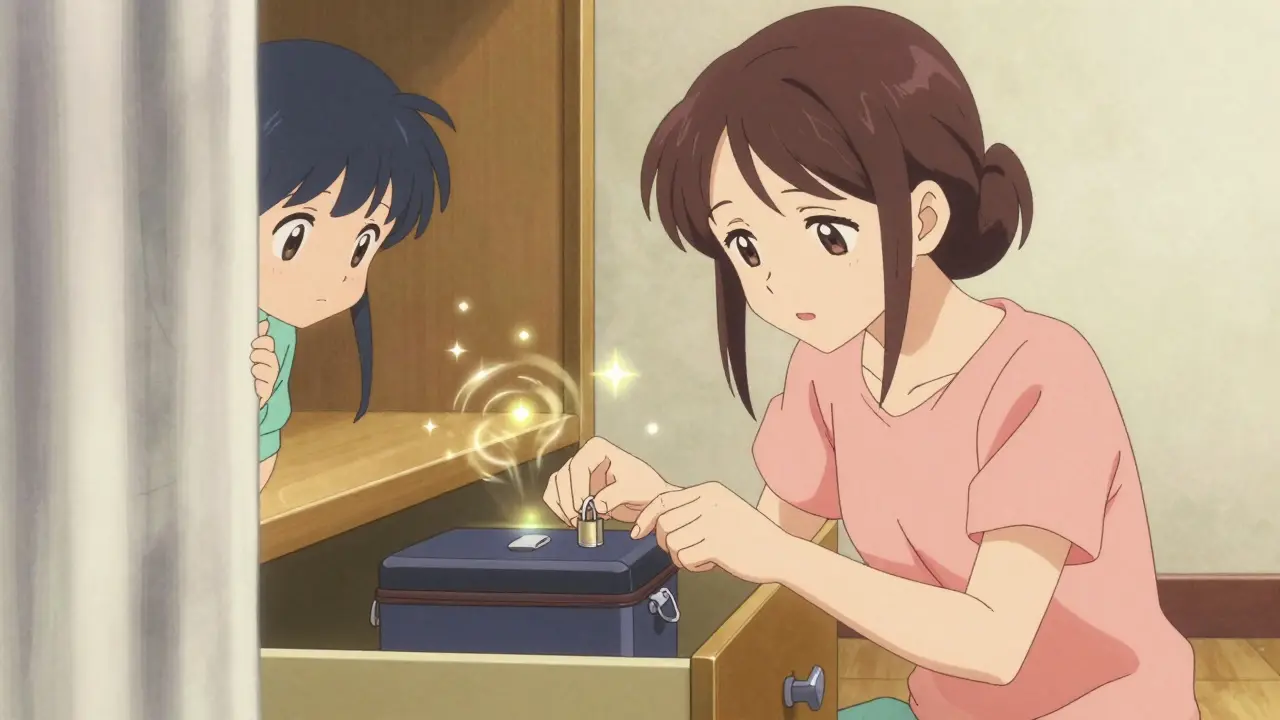
Grandparents and Visitors Don’t Know the Rules
Express Scripts’ 2024 survey found that 76% of grandparents leave medications unlocked when grandchildren visit. Why? “My grandchild knows not to touch medicine.” That’s the dangerous myth. Kids don’t understand the word “medicine.” They understand “chewy,” “sweet,” or “funny-tasting.” A chewable Tums looks like a SweeTart. Aspirin looks like Skittles. A 2022 study from Children’s Mercy Hospital showed a 17% rise in ingestions of medications that mimic candy. That’s not a coincidence-it’s design. Always lock up meds-even if you’re just dropping off your kid for an hour. Don’t assume someone else knows the rules. Leave a note: “Medication in locked box on top shelf.”Emergency Medications Need Special Handling
What about epinephrine auto-injectors or asthma inhalers? You can’t lock them away if you need them in a crisis. Seattle Children’s Hospital recommends a “medication triage system”:- Emergency meds (EpiPen, inhaler, Narcan): Store in a quick-access location-like a wall-mounted lockbox near the front door or kitchen. It should open in under 3 seconds.
- Daily meds (antibiotics, ADHD pills): Locked box on a high shelf.
- Occasional meds (painkillers, antihistamines): Locked box in a closet or bedroom drawer.
Teenagers and Prescription Misuse
It’s not just toddlers. Teens are the second-largest group for accidental and intentional medication misuse. The National Association of Pediatric Nurse Practitioners found that households using a monitored system-where teens log each dose with adult verification-reduced misuse by 67%. If you have a teenager, consider a smart lockbox with a digital log. Some models send alerts to your phone when opened. But don’t rely on tech alone. Talk to your teen. Explain why the lock is there. Make it a conversation, not a rule.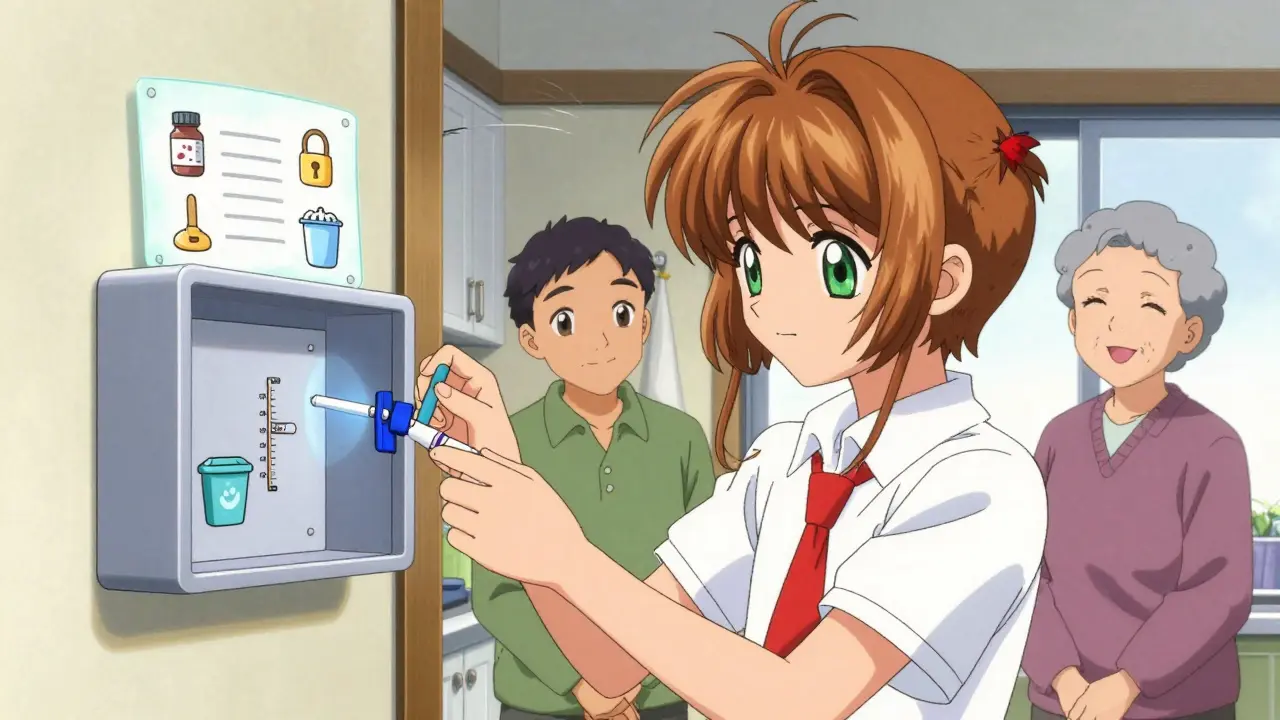
Dispose of Old Meds the Right Way
Don’t flush pills. Don’t toss them in the trash. The FDA says the safest way is to mix them with something unappetizing-like coffee grounds or cat litter-then seal them in a container before throwing them out. Better yet: Use a drug disposal kiosk. As of 2023, 78% of U.S. communities have permanent drop-off locations at pharmacies. CVS, Walgreens, and many local police stations offer them. No questions asked. No charge. Just drop, lock, and go.The Two-Minute Rule
The CDC’s most important advice? Never leave medication unattended for more than two minutes. That’s not a suggestion-it’s a rule based on real data. Children can open cabinets in 90 seconds. A child who’s been watching you take your pills every morning knows exactly where they are. Make a habit: Open the lockbox. Take the pill. Close the lockbox. Put the pill in your mouth. Then swallow. No delays. No distractions. No “I’ll just put this down for a sec.”Costs of Getting It Wrong
Each emergency room visit for a child who swallowed medicine costs an average of $3,217. Multiply that by 60,000 visits a year, and you get over $67 billion in medical costs and lost work time. That’s not just money-it’s trauma. Panic. Long-term health effects. Sometimes, death. The good news? Locked storage cuts those numbers by 89%, according to the National Safety Council. That’s 53,700 fewer ER visits every year.Final Checklist
- Store all medications in a locked container, not just a cabinet.
- Keep it above counter height (at least 36 inches).
- Use a dedicated lockbox-not a purse, not a nightstand.
- Lock up even when visitors are over-especially grandparents.
- Use a travel lockbox when away from home.
- Keep emergency meds accessible but secured-don’t lock them away if you need them fast.
- Dispose of old pills at a pharmacy drop-off, not in the trash.
- Practice the Two-Minute Rule every time you give medicine.
- Teach teens the reason behind the lock-not just the rule.
Medication safety isn’t about fear. It’s about routine. It’s about treating every pill like a loaded gun-because to a child, it is.



Sam Pearlman February 19, 2026
Okay but let’s be real-how many of us actually lock our meds? I’ve seen moms leave OTC stuff on the counter while they’re scrolling TikTok. Kids aren’t dumb. They’re observational. If you’re not locking it, you’re just playing Russian roulette with a chewable Tylenol.
And don’t get me started on the ‘I’ll just put it down for a sec’ thing. That sec turns into a minute, then a bathroom break, then a Zoom call. Kids don’t wait for permission. They just grab.
Also-why is no one talking about how candy-shaped pills are literally designed to trick kids? That’s not negligence, that’s corporate malpractice.
Brenda K. Wolfgram Moore February 19, 2026
This is one of the most important posts I’ve read all year. The two-minute rule alone should be mandatory in every parenting handbook. I used to think my cabinet was enough-until my 3-year-old got into my blood pressure pills. We were lucky. Others aren’t.
I bought a lockbox last month. It cost $27. It’s on the top shelf of my closet. No more panic. No more guessing. Just routine. And honestly? It’s made me feel like a better parent.
Carrie Schluckbier February 20, 2026
Let’s not pretend this is about child safety. This is about corporations and government pushing fear to sell you $30 lockboxes while they ignore the real issue: pharmaceutical companies marketing chewable pills to look like candy.
Who approved this? Who let them design aspirin to look like Skittles? Why isn’t the FDA banning this? Why aren’t we suing? This isn’t parenting failure-it’s a product design crisis.
And don’t tell me about ‘personal responsibility.’ The same companies that make these pills also lobby against childproof packaging laws. This is systemic. Lockboxes are a Band-Aid on a hemorrhage.
Liam Earney February 22, 2026
I just want to say-I’m Irish, and I’ve lived in three countries, and I’ve never seen this level of obsession with locking things up. In Europe, we just… keep meds in a drawer. Kids don’t go for pills. They go for cookies. And if they do take something? Well, they’re usually fine. We don’t need a $30 box to teach them not to touch medicine.
Also, the CDC’s numbers-are they even reliable? I’ve seen studies that say 80% of these ‘accidents’ happen because the child was already sick and the parent didn’t realize they’d taken a double dose. It’s not about access-it’s about oversight.
Maybe we’re overcomplicating this? Maybe we’re just scared?
guy greenfeld February 23, 2026
Think about it: we treat medicine like a weapon because we’ve been conditioned to believe that children are little predators. But what if the real danger isn’t the child? What if it’s the narrative that says we must lock everything up to be good parents?
This isn’t safety. This is control. We’ve turned parenting into a surveillance state. Every pill, every bottle, every drawer-monitored, locked, logged.
And for what? To avoid a 0.01% chance of death? Or to satisfy a culture that equates vigilance with virtue?
Maybe the answer isn’t a lockbox. Maybe it’s trust. Maybe it’s teaching kids what medicine is-before they ever see a bottle.
Adam Short February 25, 2026
British here. We don’t do this. We don’t lock our meds. We don’t have ‘travel safety kits.’ We just… keep them in a cupboard. And guess what? Our kids don’t die from aspirin.
Y’all are turning a simple safety tip into a full-blown cult. A $30 box? A ‘two-minute rule’? This isn’t parenting-it’s performance art.
My mum never locked her pills. My sister took one once. She threw up. We laughed. We moved on. Life went on.
Maybe stop treating children like ticking time bombs and start treating them like humans?
Jonathan Ruth February 26, 2026
Lockboxes are great but here’s the real issue-most parents don’t even know their meds are a risk. I had a friend who kept Adderall in her purse. Her 4-year-old got into it. She didn’t even realize it was dangerous until the ER.
And don’t get me started on grandparents. My grandma leaves her blood pressure pills on the coffee table. She says ‘they’re just little pills.’
Education first. Lockboxes second. We need public service announcements. Not just Reddit posts.
Also-why are we still using child-resistant caps? They’re a joke. My nephew opened one in 12 seconds. With his teeth.
Oliver Calvert February 26, 2026
As a pharmacist, I’ve seen this firsthand. The biggest risk isn’t the bottle-it’s the routine. People take meds in front of kids. They leave them on the sink. They say ‘this is for Mommy’s headache’ like it’s a storybook.
Here’s what works: keep meds in a locked box on a high shelf. But also-never take them in front of kids. Don’t say ‘medicine.’ Say ‘vitamins’ or ‘special pills.’
And if you’re traveling? Always carry a lockbox. Even if you’re only gone for a night. The hotel drawer is not safe.
Also-dispose of old pills properly. Flushing them? That’s pollution. Tossing them? That’s a hazard. Use a drop-off. It’s free. It’s easy. Do it.
Kancharla Pavan February 27, 2026
This is why modern parenting is broken. We have turned every small risk into a moral imperative. We lock our meds, we track our kids’ screens, we monitor their sleep, we count their steps. We are raising a generation of children who are terrified of their own homes.
Where is the balance? Where is the trust? Where is the belief that children can learn without being policed every second?
My grandfather never locked his pills. My mother never locked hers. We grew up. We learned. We didn’t die.
Maybe the problem isn’t the medicine. Maybe it’s the fear.
PRITAM BIJAPUR February 27, 2026
❤️ This is so important. I just bought a smart lockbox for my meds after reading this. It sends me a notification every time it’s opened. My 6-year-old asked why it was locked. I told him: ‘Because some things are not for little hands. Even if they look like candy.’
He said: ‘So like candy? But not for me?’
And I said: ‘Yes. Exactly.’
That moment? Priceless. We don’t need fear. We need clarity.
Also-use drop-off kiosks. I dropped 12 bottles last week. Felt like a hero. 🙌
Prateek Nalwaya March 1, 2026
What if we stopped treating medicine like a secret and started treating it like a tool? Teach kids what pills are. Show them the difference between vitamins and painkillers. Let them hold an empty bottle. Ask them why it’s locked.
Knowledge beats fear. Curiosity beats secrecy.
I started showing my 5-year-old my insulin pen. Not to scare him. To explain. Now he asks, ‘Is that your medicine?’ instead of trying to open the drawer.
Maybe the real solution isn’t a lockbox-it’s a conversation.
Agnes Miller March 1, 2026
lol i just realized i keep my anxiety meds on my nightstand. whoops.
im gonna get a lockbox tomorrow. also i had no idea about the travel thing. i always just toss em in my purse. yikes.
Geoff Forbes March 2, 2026
Ugh. Another performative parenting post. Lockboxes? CDC guidelines? Please. If you’re that worried about your kid, maybe don’t have one? Or move to a cabin in the woods? This isn’t safety-it’s anxiety dressed up as wisdom.
Also-why is every solution a product? Lockbox. Travel kit. Smart device. We’ve turned parenting into a consumer sport.
Next up: ‘The 7-Step Protocol for Not Letting Your Toddler Touch a Spoon.’
Philip Blankenship March 3, 2026
My wife and I started doing the two-minute rule after our neighbor’s kid got into his grandma’s diabetes meds. Kid was fine. Grandma was in tears for weeks.
Now we have a system. Emergency meds: wall box near the kitchen. Daily meds: locked high shelf. Occasional: closet drawer.
And we tell visitors. No shame. Just ‘Hey, meds are locked. Don’t leave anything out.’
It’s not about fear. It’s about respect. For the kid. For the medicine. For the fact that accidents happen in seconds.
And yeah-it’s a pain. But so is an ER visit.
Linda Franchock March 5, 2026
So let me get this straight-we’re supposed to lock up medicine like it’s a nuclear launch code… but it’s totally fine to leave a 12-year-old alone with a bottle of Advil in the car? 😑
Also, grandparents? Yeah, they’re the worst. My mom left her pills on the counter last Thanksgiving. My niece ate three. We had to drive to the ER at midnight.
She said: ‘But they looked like jelly beans!’
So now I bring my own lockbox to every family gathering. And I don’t even care if it’s awkward.
Because I’d rather be awkward than bury my niece.