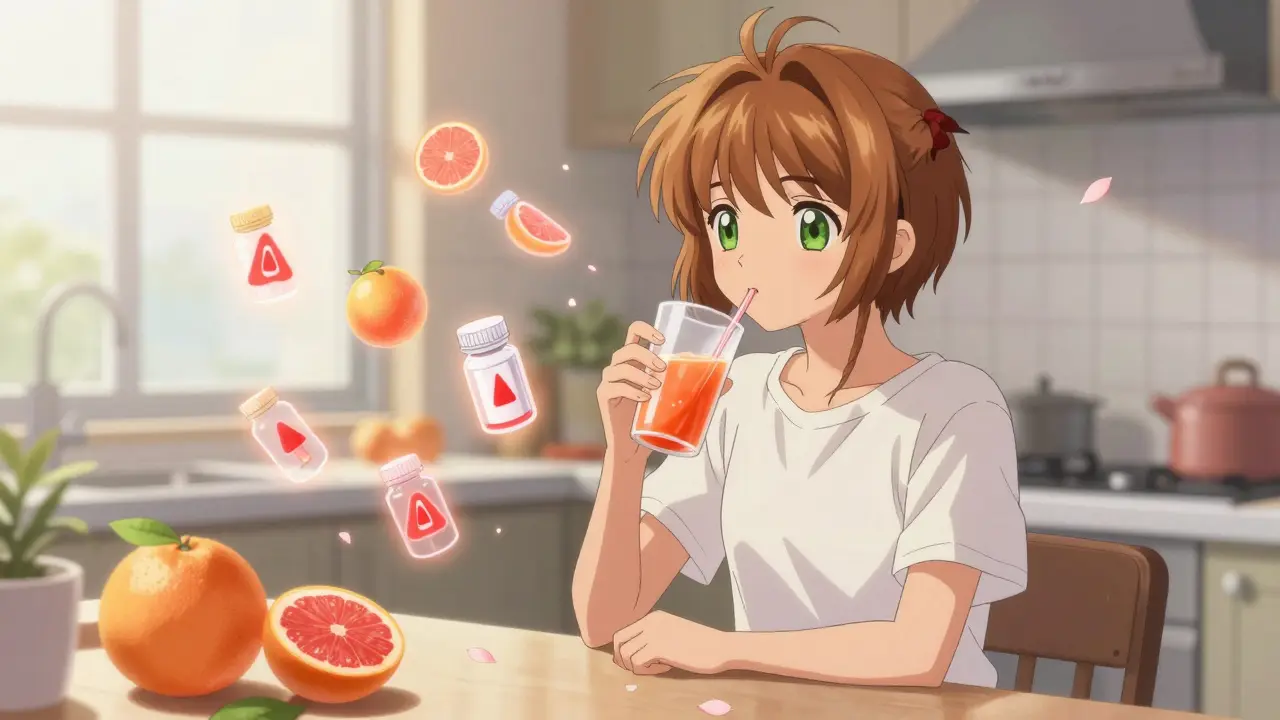
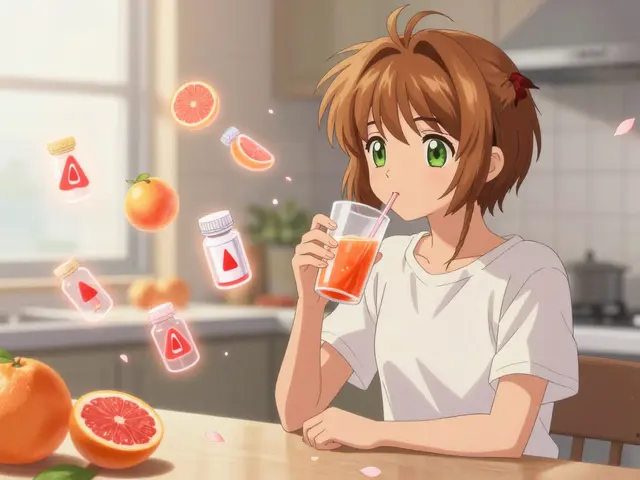
Every morning, millions of people reach for a glass of grapefruit juice - it’s refreshing, packed with vitamin C, and feels like a healthy start to the day. But for a surprising number of people taking common medications, that glass could be doing more harm than good. You might not realize it, but grapefruit juice doesn’t just change the flavor of your breakfast - it can turn your medicine into a dangerous overdose. And it’s not just about grapefruit. The same risk applies to Seville oranges, pomelos, and even some citrus-based supplements. This isn’t a myth. It’s a well-documented, clinically proven interaction that affects over 85 medications - and about 43 of them carry serious, sometimes deadly, risks.
How Grapefruit Juice Messes With Your Meds
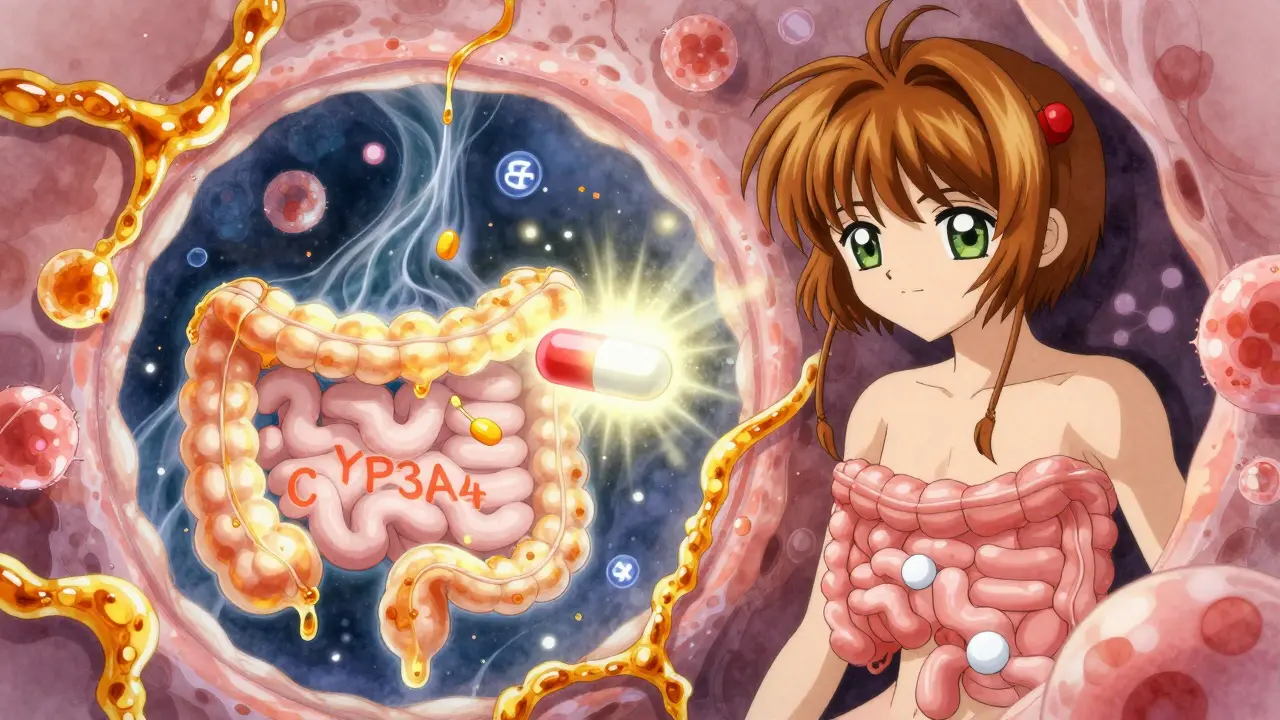
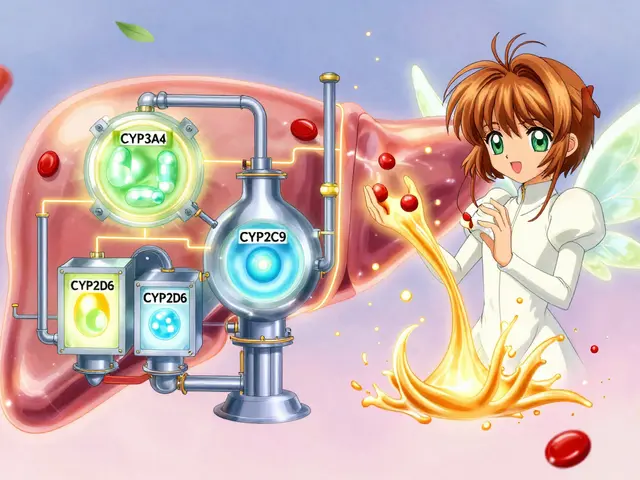
The problem starts in your gut. When you swallow a pill, your body doesn’t just absorb it whole. Many drugs are broken down by an enzyme called CYP3A4, which lives in the lining of your small intestine. This enzyme acts like a gatekeeper - it breaks down a portion of the drug before it even enters your bloodstream, keeping the dose under control. Grapefruit juice doesn’t just pass through. It shuts down CYP3A4. The culprits? Furanocoumarins - natural chemicals in grapefruit, especially bergamottin and 6',7'-dihydroxybergamottin. These compounds bind to the enzyme permanently, like superglue. Your body can’t fix it right away. It takes about 72 hours for your gut to grow new enzymes and restore normal function.
That means if you drink grapefruit juice at 8 a.m. on Monday, and take your pill at 8 a.m. on Wednesday, you’re still at risk. The enzyme is still knocked out. And here’s the scary part: once that gatekeeper is gone, your body absorbs way more of the drug than it should. A single 200 mL glass (about 6.8 fluid ounces) can boost drug levels by up to 8 times. For some people, that’s the difference between a safe dose and a toxic one.
Which Medications Are Most at Risk?
Not all drugs are affected the same way. Some are completely safe. Others? Not even close. The biggest red flags show up in five main categories:
- Statins - These cholesterol-lowering drugs are among the most common culprits. Simvastatin and lovastatin see their blood levels jump by over 300%. That increases the risk of rhabdomyolysis - a condition where muscle tissue breaks down and can lead to kidney failure. Atorvastatin has a moderate risk. But pravastatin, fluvastatin, and rosuvastatin? They’re safe. They don’t rely on CYP3A4.
- Calcium channel blockers - Used for high blood pressure and angina. Felodipine? Its levels can spike by 800%. Nifedipine jumps 110%. Amlodipine? No effect. The difference comes down to how each drug is processed.
- Benzodiazepines - Sedatives like midazolam and triazolam. Oral midazolam sees a 515% increase in absorption. That means extreme drowsiness, slowed breathing, or even coma.
- Immunosuppressants - Drugs like cyclosporine and tacrolimus, used after organ transplants. Grapefruit juice can push blood levels into toxic ranges, risking kidney damage or rejection.
- Antiarrhythmics - Amiodarone, used for irregular heartbeats, can increase by 80%. That raises the risk of dangerous heart rhythms.
And here’s something most people don’t know: some drugs do the opposite. Theophylline (for asthma) and itraconazole (an antifungal) actually show lower blood levels with grapefruit juice. The reason? Grapefruit also blocks OATP transporters - proteins that help absorb certain drugs. So while CYP3A4 inhibition raises levels, OATP inhibition can lower them. It’s messy. Unpredictable. And that’s why doctors say: if you’re unsure, skip it.
It’s Not Just Juice - It’s Everything
Many people think the risk is only from juice. That’s wrong. Fresh grapefruit fruit? Same risk. Frozen concentrate? Same. Even grapefruit-flavored sodas or candies can contain enough furanocoumarins to cause problems. And it doesn’t matter if it’s white or pink grapefruit - white has 20-50% more of the harmful compounds. Seville oranges (used in marmalade) and pomelos? They’re just as dangerous. But sweet oranges and tangerines? Safe. No furanocoumarins. You can drink those without worry.
Even one glass a week can be enough to trigger an interaction. You don’t need to binge. The enzyme doesn’t bounce back quickly. And it doesn’t matter when you take the juice - before, with, or after your pill. The damage is done in the gut, and it lasts for days.
Who’s Most at Risk?
It’s not just about what you take - it’s about who you are. Older adults are at the highest risk. Why? Because they’re more likely to be on five or more medications. Nearly 42% of U.S. adults over 65 take five or more prescriptions. That’s a recipe for hidden dangers. The American Geriatrics Society includes grapefruit interactions in their 2023 Beers Criteria - a list of potentially unsafe medications for seniors.
People with liver or kidney disease are also more vulnerable. Their bodies already struggle to clear drugs. Add grapefruit juice? The risk multiplies. And genetics play a role too. Some people naturally have more CYP3A4 enzymes in their gut. Studies show those individuals can experience 8-fold increases in drug levels - while others see almost no change. A 2023 study even linked a specific gene variant (CYP3A4*22) to higher interaction severity. That means two people on the same drug, drinking the same juice, could have completely different outcomes.
What Do Doctors and Pharmacists Say?
Dr. David Bailey, the Canadian researcher who discovered this interaction in 1989, says bluntly: “One whole grapefruit or 200 mL of juice can precipitate life-threatening adverse effects.” The European Medicines Agency estimates grapefruit interactions cause 85 serious adverse events and 12 deaths each year in Europe alone. In the U.S., the FDA now requires warning labels on 21 high-risk medications - including simvastatin, felodipine, and cyclosporine.
But here’s the gap: only 37% of pharmacists consistently warn patients. A 2021 study found that 65% of patients were told about the interaction - but only 28% could correctly name which of their own meds were risky. And get this: 47% of patients on high-risk drugs still consume grapefruit, even after being warned. Among those over 65? That number jumps to 63%.
Pharmacists report that many patients think, “I’ve been drinking it for years - nothing happened.” But that’s the problem. The damage isn’t always immediate. A single interaction might not cause a crisis. But over time? It stacks up. And when combined with other drugs or health issues? That’s when things go sideways.
What Should You Do?
If you take any prescription medication, here’s what to do:
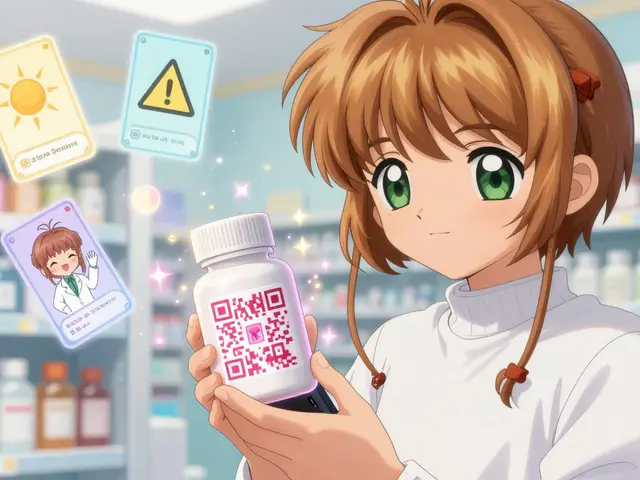
- Check your labels. Look for the grapefruit warning. It’s now required on 19% of prescription labels in the U.S. - up from 12% in 2015.
- Ask your pharmacist. Don’t assume they’ll tell you. Ask: “Does any of my medication interact with grapefruit?”
- Read the list. If you take statins, blood pressure meds, anti-rejection drugs, or sedatives - assume grapefruit is off-limits unless told otherwise.
- Switch if needed. Many alternatives exist. For example, switch from simvastatin to pravastatin. From felodipine to amlodipine. From midazolam to lorazepam. Your doctor can help.
- Wait 72 hours. If you accidentally drank grapefruit juice, don’t take your pill for at least three days. Better safe than sorry.
There’s no safe middle ground. You can’t time it. You can’t dilute it. You can’t “just have a little.” The science is clear: avoid it completely if you’re on a high-risk medication.
What’s Changing Now?
Things are moving. Drug interaction software now flags grapefruit in 18% of all food-drug alerts. Electronic health records include 128 specific grapefruit interaction alerts. Pharmaceutical companies are reformulating drugs - like extended-release felodipine - to reduce the interaction risk. Researchers are even working on CRISPR-edited grapefruit that removes furanocoumarins. But those are years away.
For now, the safest advice remains unchanged: if your medication has a grapefruit warning, skip it. No exceptions. No compromises. Your body doesn’t have a reset button. Once the enzyme is shut down, you’re at risk for days.
It’s not about being paranoid. It’s about being informed. Millions of people take meds safely. But for those who don’t know this risk - it’s a silent danger. And it’s entirely preventable.
Can I have grapefruit juice if I take my medication at night and juice in the morning?
No. The enzyme inhibition lasts up to 72 hours. Even if you take your pill 12 hours after drinking juice, your gut enzymes are still blocked. The interaction isn’t about timing - it’s about how long the enzyme stays inactive. Avoid grapefruit entirely if you’re on a high-risk medication.
Does orange juice or lemon juice cause the same interaction?
No. Regular oranges, tangerines, lemons, and limes do not contain furanocoumarins and are safe. Only grapefruit, Seville oranges, and pomelos carry this risk. So if you’re avoiding citrus for medication reasons, you can still enjoy orange juice or lemon water.
I’ve been drinking grapefruit juice for years with my meds - why is this a problem now?
It’s not necessarily new - but your body changes. As you age, your liver and kidneys process drugs less efficiently. You may start taking new medications. You might be on more than one drug, which increases the chance of dangerous combinations. What felt fine a decade ago might now be risky. The science hasn’t changed - your situation has.
Are there any benefits to grapefruit juice interactions?
Not for patients. While researchers are exploring whether the mechanism could one day be used to boost drug absorption (like for certain cancer drugs), that’s still experimental. For everyday use, the risks far outweigh any theoretical benefit. The goal is safety - not enhancement.
How do I know if my medication is affected?
Check the medication guide that comes with your prescription - it’s required by the FDA to mention grapefruit if there’s a risk. You can also ask your pharmacist directly. Online databases like the University of Liverpool’s Medicines Interaction Checker are reliable. But never rely on a Google search alone - misinformation is common.



Steph Carr February 17, 2026
So let me get this straight - I’ve been drinking grapefruit juice with my blood pressure med for 12 years and now you’re telling me my kidneys are just one glass away from throwing a tantrum? 🤯 I thought this was a health food. Turns out it’s just nature’s little trap for people who don’t read the tiny print. Also, why is this not on every single bottle like ‘WARNING: DO NOT MIX WITH WATER’? This is wild.
Prateek Nalwaya February 18, 2026
I come from a family where breakfast without grapefruit is like coffee without caffeine - unthinkable. But now I’m sitting here wondering if my dad’s kidney transplant was almost sabotaged by a fruit. My aunt took cyclosporine and swore by her pink grapefruit. She’s fine now, but… I think we got lucky. Maybe it’s time to switch to oranges. Or just accept that our breakfast rituals are slowly becoming medical liabilities.
Philip Blankenship February 20, 2026
I’m just here to say I read this whole thing while eating a grapefruit. Like… I knew it was risky but I didn’t know it was *this* risky. I take simvastatin. I’ve been drinking this stuff since college. I’m not even mad. Just… impressed. The science here is nuts. 72 hours? That’s longer than my last relationship. And the fact that your gut enzyme just… dies and doesn’t come back for days? That’s not biology. That’s a horror movie. I’m switching to orange juice tomorrow. No exceptions. No ‘but I like the taste’ arguments. My liver says no.
Adam Short February 21, 2026
This is why Britain banned grapefruit juice from NHS prescriptions years ago. We knew. We saw it coming. You Americans think everything’s fine until someone dies. And then you write a 2000-word essay about it. Meanwhile, in the UK, we just say ‘don’t do it’ and move on. No drama. No ‘it’s complicated.’ Just: don’t mix. Simple. Effective. You’re welcome.
Logan Hawker February 23, 2026
The CYP3A4 inhibition mechanism is fascinating, but let’s be real - this is just another example of pharmacokinetic bioavailability being hijacked by phytochemicals with no regulatory oversight. The furanocoumarins act as irreversible suicide inhibitors of the cytochrome P450 system, effectively creating a pharmacological bottleneck. And yet, the FDA only mandates labeling on 21 drugs? That’s laughable. We need a full reclassification of citrus-derived compounds as Class III drug-interaction hazards. Also, why isn’t this on the FDA’s priority list? Because Big Pharma profits from polypharmacy, obviously.
Sam Pearlman February 25, 2026
Wait, so if I drink grapefruit juice and take my pill 72 hours later, I’m still at risk? Then why does the article say ‘avoid it completely’? Why not just say ‘take your pill on Thursday if you drank it Monday’? This feels like fearmongering. I’ve done this for years. Nothing happened. Maybe it’s just people who are bad at math? Or maybe the real issue is that doctors don’t know their own patients’ habits? Just saying.
Linda Franchock February 25, 2026
I’m a nurse. I’ve seen three people end up in the ER because they thought ‘I only had a little.’ One guy took simvastatin and drank grapefruit juice every morning for 8 years. He didn’t feel anything. Then one day? Muscle pain. Kidney failure. ICU. He’s 71. He didn’t know his meds were on the list. No one told him. So yes - this is real. And no, it’s not ‘paranoia.’ It’s negligence. Please, if you’re on meds, ask your pharmacist. Not your friend. Not Google. Your pharmacist. They’re paid to know this stuff.
Agnes Miller February 27, 2026
I just wanted to say I’ve been on cyclosporine for 15 years and I’ve never had a problem with grapefruit. I drink it every day. But I also have a genetic test that showed I have the CYP3A4*22 variant so maybe I’m just lucky? Or maybe I’m the exception? I don’t know. I just know I’m not giving up my juice. My body’s fine. Maybe the warnings are too broad?
Jonathan Ruth February 28, 2026
This article is 100% correct but also 100% unnecessary. People who take meds and drink grapefruit juice are idiots. That’s it. No science needed. Just common sense. If your pill says ‘avoid grapefruit’ and you ignore it, you’re not a victim. You’re just someone who didn’t read the label. And if you’re over 65 and still doing it? You’re not vulnerable. You’re negligent. Stop blaming the fruit. Blame the person who didn’t care enough to look.
James Lloyd March 2, 2026
The most underrated part of this whole thing? The fact that some drugs go the *other* way - like theophylline and itraconazole. Grapefruit juice *lowers* their levels. So now we have this weird paradox: the same fruit can make one drug toxic and another useless. That’s not just biology. That’s poetic. Nature doesn’t care if you’re on blood pressure meds or asthma meds. It just does what it does. And we’re the ones trying to fit square pegs into round holes with our prescriptions. Maybe we’re overcomplicating medicine. Maybe the answer isn’t more warnings - it’s simpler, better drug design.
John Haberstroh March 2, 2026
I just tried to explain this to my grandma. She said, ‘I’ve been drinking this since I was 18. I’ve had two heart attacks. I’m still here. So what’s the problem?’ I couldn’t argue. She’s 84. She’s fine. But then I looked up her meds - felodipine. And she’s been having grapefruit juice with it for 60 years. I don’t know if she’s lucky, genetically immune, or just living on borrowed time. But I’m not touching it. Not even for her.