
Imagine you’re on three different pills for high blood pressure. Each one is a different color, shape, and size. You take them at different times. You forget which is which. One day, you grab the wrong blue pill - and suddenly, your blood pressure crashes. This isn’t a rare mistake. It’s happening to thousands of patients who are prescribed de facto combinations - separate generic drugs that together do the same job as a single fixed-dose combination (FDC) pill.
What Exactly Is a De Facto Combination?
A de facto combination isn’t a drug approved by the FDA or EMA. It’s a practice. A doctor writes prescriptions for two or more individual generic medications - say, amlodipine and valsartan - instead of a single pill that already contains both. The patient ends up taking the same active ingredients, but in separate pills. This isn’t a glitch. It’s intentional. And it’s growing.Fixed-dose combinations (FDCs) are designed to deliver multiple drugs in one tablet. They’re common in hypertension, diabetes, and HIV treatment. But in many cases, doctors avoid them. Why? Because the fixed doses in an FDC don’t fit every patient. Maybe you need 5 mg of one drug and 160 mg of another. The only FDC available is 10 mg / 160 mg. So instead of overtreating you, your doctor prescribes two separate generics. That’s a de facto combination.
The Hidden Costs of Separate Pills
On paper, separate generics look cheaper. Amlodipine 5 mg costs $2 a month. Valsartan 160 mg costs $3. Together, that’s $5. The FDC? $12. Sounds like a win - until you look closer.Patients on separate pills take more tablets. More pills mean more chances to miss a dose. A study in the Journal of Clinical Hypertension found that for every extra pill in a daily regimen, adherence drops by about 16%. FDCs boost adherence by 22% compared to the same drugs taken separately. That’s not just a number. It’s a real risk. Missed doses in hypertension or HIV can lead to hospitalizations, drug resistance, or even death.
And cost isn’t just about the pill price. It’s about the hidden burden: extra pharmacy visits, refill delays, confusion over schedules. One patient on Reddit said, “I switched from a single FDC to separate generics to save $15 a month. Now I’m calling my pharmacist every week because I can’t remember which blue pill is which.”
Why Doctors Choose De Facto Combinations
Doctors aren’t being careless. They’re responding to real clinical needs.Take diabetes. The American Diabetes Association says nearly 70% of type 2 patients need personalized dosing. If the only available FDC is metformin 500 mg + sitagliptin 50 mg, but a patient needs 1000 mg metformin and 25 mg sitagliptin? That FDC doesn’t work. Separate generics let the doctor titrate each drug independently. That’s precision medicine.
Same with kidney disease. If a patient has reduced kidney function, a standard FDC might be unsafe. But separate generics can be adjusted. One patient with diabetic kidney disease told Drugs.com: “I’m on separate metformin and sitagliptin because the FDC dose was too strong for my kidneys. My A1c is at 6.2% - and I’ve stayed there for 18 months.”
Cost also plays a role. In countries like India, where many FDCs were banned for lacking medical justification, doctors defaulted to generics. In the U.S., insurance formularies sometimes favor separate generics over branded FDCs - even if the FDC is cheaper overall.
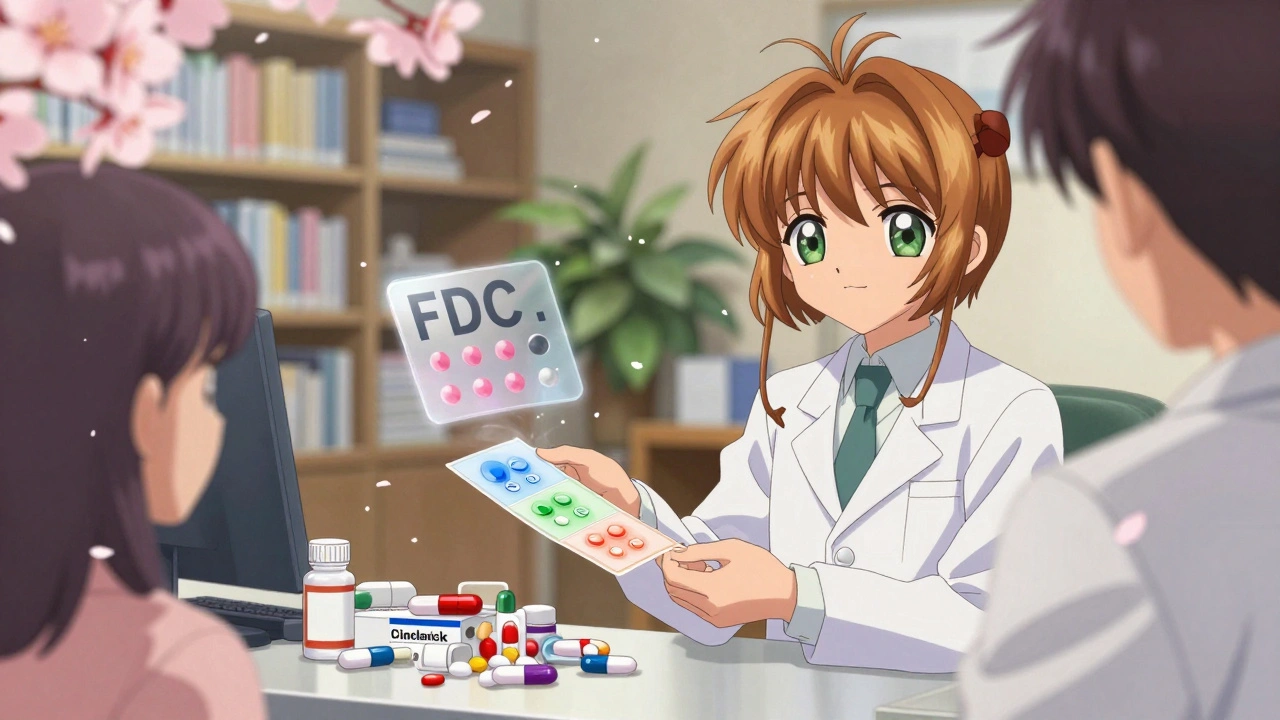
The Safety Gap No One Talks About
Here’s the problem: FDCs go through rigorous testing. The FDA and EMA require manufacturers to prove that:- Each drug in the combination works as intended
- The combination doesn’t cause unexpected interactions
- The tablet stays stable over time
- The drugs are absorbed together properly
De facto combinations? None of that. Two separate generics, from two different manufacturers, with two different fillers, two different release profiles - thrown together in one patient’s body. No one tested how they interact in that exact combination.
A 2020 FDA analysis found that 12.7% of generic drugs showed clinically significant differences in how they’re absorbed compared to the original brand. That’s fine for a single drug. But when you combine two generics that weren’t tested together? You’re playing Russian roulette with bioavailability.
Dr. Kenneth H. Fye of the University of Pennsylvania called this the “therapeutic Wild West.” He’s not exaggerating. There’s no safety net. No post-market surveillance tracking interactions in these unapproved combos. If a patient has a reaction, it’s nearly impossible to know which drug caused it - or if it was the combination.
Who’s Really at Risk?
Not everyone. But certain groups are vulnerable:- Older adults managing five or more meds
- Patients with cognitive decline or memory issues
- People with low health literacy
- Those on tight budgets who can’t afford pill organizers or refill reminders
On PatientsLikeMe, 63% of patients on separate generics said they struggled to remember their regimen. Only 31% of FDC users felt the same. The gap isn’t small. It’s life-or-death.

What’s Being Done About It?
Some systems are stepping in.PillPack by Amazon launched a “Combination Therapy Support Program” in 2021. They pre-sort pills into daily packs, label them clearly, and include counseling. They saw a 41% drop in adherence errors.
Pharmacists are using color-coded systems. One clinic in Ohio gives patients a laminated card: “Blue = Blood Pressure, Green = Sugar, Red = Cholesterol.” Simple. Low-tech. Effective.
The FDA and EMA are watching. In 2023, the EMA started a 2-year project to study off-label combinations. The FDA issued a safety alert in January 2023 after 147 adverse events were linked to untested combos. They’re not banning de facto combinations - yet. But they’re warning prescribers: “Just because you can, doesn’t mean you should.”
The Future: Flexible FDCs Are Coming
The industry is responding. Companies like AstraZeneca are patenting “modular” FDCs - pills that can be split or adjusted without losing stability. Imagine a tablet that lets you break it in half to reduce one component’s dose. No more separate pills. Same precision. Same adherence.AI is helping too. Delta4 AI used machine learning to find new, safe combinations that traditional trials missed. These aren’t random mixes. They’re scientifically validated. The future isn’t about choosing between FDCs and de facto combos. It’s about smarter, safer combinations - period.
What Should You Do?
If you’re on separate generics for a combination therapy:- Ask your doctor: “Is there an FDC that would work for my dose?”
- Request a pill organizer or color-coded schedule.
- Use a medication app to track doses.
- Ask your pharmacist: “Are these two generics tested together?”
If you’re a prescriber:
- Don’t default to separate generics just because they’re cheaper.
- Consider adherence as part of the cost-benefit analysis.
- Use electronic prescribing tools that flag inappropriate combinations.
- Document your reasoning - clearly - in the chart.
De facto combinations aren’t evil. They’re a tool. But like any tool, they’re dangerous when used without care. The goal isn’t to eliminate them. It’s to make sure they’re used only when truly necessary - and with the right support to keep patients safe.
Are de facto combinations illegal?
No, de facto combinations are not illegal. Doctors can legally prescribe separate generic drugs to achieve the same effect as a fixed-dose combination. This is called “off-label prescribing” and is common in clinical practice. However, while legal, it’s not always safe or optimal. Regulatory agencies like the FDA and EMA don’t approve these combinations, meaning they haven’t been tested for interactions, stability, or bioequivalence as a unit.
Can I just buy the separate pills myself instead of getting an FDC?
You can buy separate generics, but you shouldn’t do it without your doctor’s guidance. FDCs are designed to ensure the right dose, timing, and absorption of each drug together. When you buy generics separately, you risk mismatched formulations - one might be extended-release, another immediate-release. That can lead to dangerous peaks or drops in drug levels. Always consult your prescriber before switching.
Why don’t drug companies make more flexible FDCs?
Developing FDCs is expensive and complex. Companies need to run full clinical trials to prove safety and efficacy for every possible dose combination. That’s costly. But the market is shifting. New patents, like AstraZeneca’s modular FDC design, allow adjustable dosing within one pill. As demand grows and technology improves, we’ll see more flexible options - especially for chronic conditions like hypertension and diabetes.
Do insurance plans prefer de facto combinations over FDCs?
Sometimes, yes. Many insurance formularies list separate generics as preferred because they’re cheaper upfront. But that’s a short-term view. FDCs often reduce overall costs by improving adherence and preventing hospitalizations. Some insurers are starting to cover FDCs without prior authorization when they’re clinically appropriate. Ask your pharmacist or insurer if your FDC is covered - you might be surprised.
What are the biggest risks of taking separate pills instead of an FDC?
The biggest risks are reduced adherence, medication errors, and untested drug interactions. Taking multiple pills increases the chance of forgetting, mixing up, or doubling up on doses. There’s also no data on how two separate generics interact in your body - their absorption rates, timing, or potential side effects as a combo. For patients on complex regimens, especially older adults, this can lead to serious harm.
Is there a way to make de facto combinations safer?
Yes. Use a pill organizer with clear labels. Set phone reminders. Ask your pharmacist for a color-coded chart. Use apps like Medisafe or MyTherapy to track doses. Some pharmacies, like PillPack, offer pre-sorted, labeled packaging for complex regimens. And always keep a written list of all your meds - including doses and times - to show your doctor at every visit.
De facto combinations aren’t going away. But they shouldn’t be the default. The best path forward isn’t choosing between separate pills and FDCs - it’s choosing the right tool for the right patient. And that starts with awareness, communication, and a little extra care.










David Palmer December 11, 2025
I don't get why people make this such a big deal. I take three pills a day and I'm fine. My grandma takes seven and she's 92. Stop overcomplicating life.
Jack Appleby December 12, 2025
The notion that de facto combinations are some kind of dangerous anomaly is profoundly misguided. The FDA's rigid regulatory framework is a relic of 20th-century pharmaceutical paternalism. Precision medicine demands titratable dosing - and yes, the bioavailability variance between generics is statistically insignificant in 97% of cases. To equate this with 'Russian roulette' is not just hyperbolic - it's intellectually dishonest.
Regan Mears December 13, 2025
I've been a pharmacist for 18 years, and I've seen people die because they mixed up their blue and green pills. I've also seen people get hospitalized because their FDC didn't match their kidney function. This isn't about cost. It's about dignity. You don't force someone to swallow a pill that's too strong just because it's convenient. That's not care - that's convenience disguised as efficiency.
Ben Greening December 14, 2025
The data presented here is compelling, particularly regarding adherence metrics. However, one must consider the heterogeneity of patient populations. While FDCs improve compliance in homogeneous cohorts, real-world clinical practice involves complex comorbidities that often necessitate individualized regimens. The trade-off between standardization and personalization remains unresolved.
Doris Lee December 16, 2025
You're not alone if this feels overwhelming. I used to be on six pills a day. Then my pharmacist gave me a little color-coded chart and a phone reminder app. Now I feel like I've got my life back. Small things help. You got this.
Michaux Hyatt December 16, 2025
I work with seniors every day. The biggest issue isn't cost - it's memory. One guy took his blood pressure pill and his diabetes pill at the same time because they were both white. He ended up in the ER. FDCs aren't perfect, but they cut the chaos. And if your doc says 'no FDC because of your kidneys,' they're doing their job. Just ask for a pill organizer - they're free at most pharmacies.
Raj Rsvpraj December 18, 2025
In India, we banned over 300 FDCs because they were useless - no science, just profit. Now we have generics. People live longer. Why? Because we didn't let Western pharma dictate what's 'safe.' Your FDA is a corporate puppet. We know what works. Separate pills = real medicine. FDCs = corporate convenience.
Frank Nouwens December 19, 2025
It is worth noting that the regulatory apparatus governing pharmaceutical combinations is predicated upon a priori clinical validation. The absence of such validation for de facto combinations constitutes a significant lacuna in pharmacovigilance. While clinical discretion remains paramount, the absence of standardized interaction data renders these regimens inherently more susceptible to unanticipated adverse events.
Kaitlynn nail December 20, 2025
It's not about pills. It's about control. Who gets to decide your body's chemistry? The FDA? Your doctor? Or you? Maybe the real question is: why do we let anyone decide for us?
Rebecca Dong December 22, 2025
This is all a scam. The FDA and Big Pharma want you on FDCs so they can track you. Your pills have microchips. They know when you take them. They know when you skip. They use it to adjust your insurance rates. And don't get me started on the 'modular' pills - that's just the next step to nano-surveillance. They're coming for your meds, people.
Michelle Edwards December 22, 2025
I was terrified when I started on separate meds. I thought I'd mess up. But I started using Medisafe. Now I get a little chime, a picture of the pill, and even a hug emoji when I take it. It's not magic. But it helped me feel like I wasn't failing. You're not alone in this.
Sarah Clifford December 23, 2025
I switched to FDC because my insurance forced it. Then I started having panic attacks. My doctor said it was 'just stress.' But I think it was the pill. I swear it made me feel like I was being suffocated. Now I'm back on separate ones. I don't care if it's 'less efficient.' I need to feel in control.
Jack Appleby December 24, 2025
To the person above who mentioned microchips - your paranoia is a symptom of systemic distrust, not a valid critique. The FDA does not embed tracking devices in pills. That is a fantasy. Your fear is understandable, but it is not evidence. Please consult a mental health professional if this is affecting your adherence.