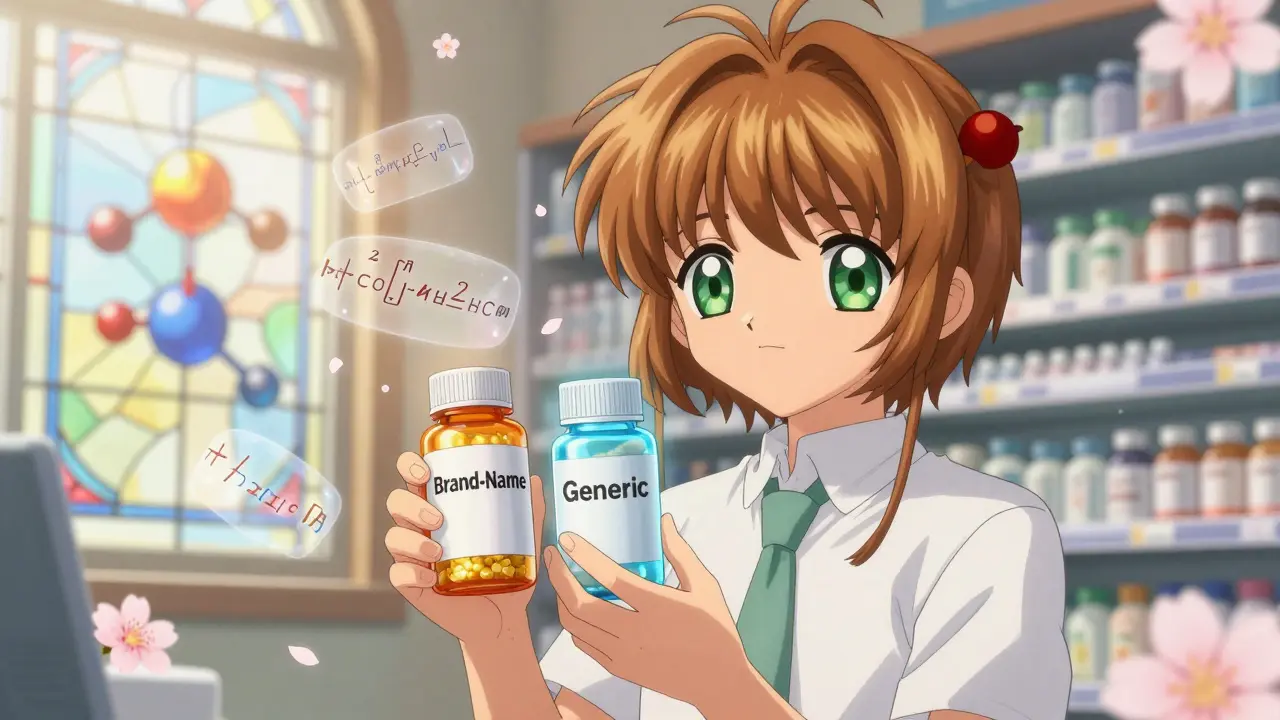
When your doctor talks about switching from a brand-name drug to a cheaper version, you might hear the words generic or biosimilar. At first glance, they sound the same-both are cheaper, both are approved by the FDA, and both promise to do the same job as the original. But they’re not the same. And choosing the wrong one-or misunderstanding the difference-could affect your treatment, your out-of-pocket costs, and even your peace of mind.
What’s the Real Difference Between Generics and Biosimilars?
Generics are copies of small-molecule drugs. Think of them like a photocopy of a simple drawing. The original drug, say, atorvastatin (Lipitor), is made from a few chemicals mixed in a lab. A generic version uses the exact same chemicals, in the exact same amounts, and works the exact same way in your body. The FDA requires generics to prove they’re bioequivalent-meaning your body absorbs them at the same rate and to the same extent as the brand-name drug. That’s why you can swap a generic for a brand-name pill without any fuss.
Biosimilars are different. They’re copies of biologic drugs-complex proteins made from living cells, like bacteria or hamster ovary cells. These aren’t chemicals. They’re tiny, intricate molecules that fold into 3D shapes, and even tiny changes in how they’re made can change how they work. A biosimilar isn’t an exact copy. It’s a highly similar version. Think of it like a hand-sketched copy of a photograph-you can get really close, but you can’t replicate every single pixel.
Because of this, biosimilars need way more testing. While a generic might need one small study to prove it works the same in your bloodstream, a biosimilar requires dozens of tests: lab analyses, animal studies, and clinical trials to prove it’s just as safe and effective. The FDA calls this the totality of evidence. It’s not just about whether the drug works-it’s about whether it works the same way every time, across thousands of patients.
Cost Savings: Generics Save More, But Biosimilars Are Still a Big Deal
Generics are the kings of cost-cutting. On average, they cost 80-85% less than the brand-name drug. If your cholesterol pill used to cost $300 a month, the generic might be $45. That’s a huge difference, especially if you’re paying out of pocket.
Biosimilars don’t save as much-typically 15-20% less than the original biologic. That might sound underwhelming until you realize what they’re replacing. Biologics like Humira (adalimumab) or Herceptin (trastuzumab) can cost $20,000 to $30,000 a year. A 20% savings means $4,000-$6,000 saved annually. That’s life-changing money for people with autoimmune diseases or cancer.
And here’s the kicker: there are over 11,000 approved generic drugs in the U.S. But only 46 biosimilars as of 2023. Why? Because making a biosimilar is 50 times more expensive than making a generic. It takes $100-250 million and 8-10 years to develop one. Generics? Around $2-3 million and 3-4 years. That’s why generics are everywhere, and biosimilars are still catching up.
Can You Switch Automatically? It Depends
With generics, you often don’t even know you’ve switched. In 49 states, pharmacies can substitute a generic for a brand-name drug without asking your doctor-unless your doctor specifically wrote "dispense as written." It’s automatic, simple, and legal.
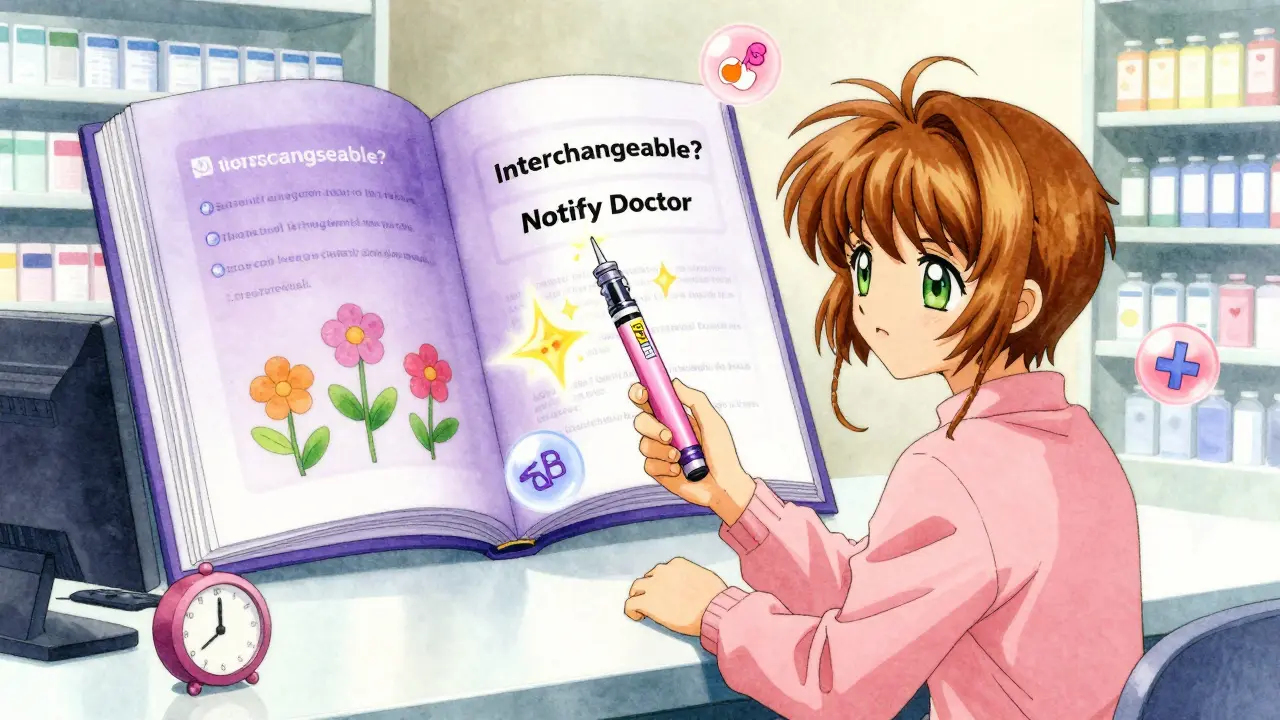
Biosimilars? Not so much. Only biosimilars that are labeled interchangeable can be swapped at the pharmacy without your doctor’s permission. And even then, 28 states require the pharmacist to notify your doctor within 72 hours. Right now, only a handful of biosimilars have interchangeable status-like Semglee (insulin glargine) and Cyltezo (adalimumab). The rest? You need a new prescription.
This matters because if you’re used to getting a certain brand, and your insurance switches you to a biosimilar without telling you, you might feel uneasy. And that anxiety? It’s real. Studies show some patients worry the new drug won’t work as well-even when the science says it will.

When Are Biosimilars the Only Option?
You can’t make a generic version of a biologic. It’s impossible. The molecule is too complex. That’s why biosimilars exist in the first place.
Biologics treat conditions that small-molecule drugs can’t touch: rheumatoid arthritis, Crohn’s disease, psoriasis, certain cancers, and multiple sclerosis. These drugs target specific proteins in your immune system. They’re given by injection or IV. They’re expensive. And they’re life-changing.
For example, if you have HER2-positive breast cancer, trastuzumab (Herceptin) is a standard treatment. There’s no generic. But there are biosimilars-like Ogivri and Herzuma. They’ve been studied in over 10,000 patients. No difference in survival rates. No increase in side effects. Same outcome. But now, the treatment costs $10,000 less per year.
Same goes for adalimumab (Humira). Used by millions for autoimmune conditions. Now, biosimilars like Amjevita and Cyltezo are available. Real-world data from over 38,000 patients shows no meaningful difference in how well they control disease activity.
What About Safety? Are Biosimilars Riskier?
A common fear is that because biosimilars aren’t exact copies, they might cause more side effects-especially immune reactions. That’s called immunogenicity. It’s a valid concern.
But here’s what the data says: the FDA’s own safety database shows biosimilars have the same rate of adverse events as the original biologics. For infliximab (Remicade), the rate of serious side effects was 0.15 per 100 patient-years for the brand. For its biosimilar, it was 0.12. Not statistically different.
And when it comes to switching back and forth between a biosimilar and the reference drug? Studies in rheumatoid arthritis patients show no increased risk of flare-ups or side effects-even after multiple switches.
Still, some conditions require extra caution. For drugs with a narrow therapeutic index-where even small changes in blood levels can cause harm-doctors may be more hesitant. But for the vast majority of biologics used today, the evidence is clear: biosimilars are safe.
What Do Doctors and Experts Say?
Major medical groups support biosimilars. The American College of Rheumatology says switching from Humira to a biosimilar is safe and effective. The American Society of Clinical Oncology says biosimilars are transforming cancer care by making treatments affordable.
But here’s the gap: many primary care doctors don’t feel confident prescribing them. A 2023 survey found only 58% of non-specialists felt "very confident" in using biosimilars. Compare that to 89% for generics. Why? Because biosimilars are newer, more complex, and the paperwork is harder. Prior authorizations take longer. Insurance forms are confusing. And the FDA’s Purple Book (which tracks biosimilars) is harder to navigate than the Orange Book (for generics).
Patients aren’t immune to confusion either. A 2022 survey found 42% of patients were worried about biosimilar efficacy. One patient on Reddit said their elderly mother mixed up the pen devices for insulin biosimilars and accidentally gave herself the wrong dose. Simple things-like a different label, a different color, or a different injector-can cause real problems if not explained.
How to Make the Right Choice for You
Here’s how to cut through the noise:
- Ask your doctor: Is there a generic available? If you’re taking a pill for high blood pressure, diabetes, or depression, there’s almost always a generic. Use it. It’s safe, proven, and saves you money.
- If you’re on an injection or IV biologic, ask: Is there a biosimilar? If you’re on Humira, Enbrel, or Herceptin, there likely is. Ask if it’s interchangeable. Ask if your insurance covers it. Ask about cost differences.
- Don’t assume cheaper means worse. A generic for metformin isn’t "less effective" than Glucophage. A biosimilar for adalimumab isn’t "weaker" than Humira. The science says otherwise.
- Know your insurance rules. Some plans push biosimilars hard because they save money. Others require step therapy-you have to try the brand first. Know your formulary.
- Speak up if you’re nervous. If you’ve been on a biologic for years and your doctor suggests switching, it’s okay to say, "I’m worried. Can we talk about the data?" Most doctors appreciate the question.
The Bottom Line
Generics and biosimilars aren’t competitors-they’re complementary tools. Generics are the workhorses of affordable medicine. Biosimilars are the breakthroughs making once-unthinkable treatments accessible.
If you’re on a pill, go generic. It’s the smartest, safest choice.
If you’re on an injection for a chronic condition, ask about the biosimilar. The science is solid. The savings are real. And with more interchangeable products coming online every year, the path to affordable care is getting clearer.
It’s not about choosing between cheap and safe. It’s about choosing the right tool for the job-and knowing that both options can keep you healthy without breaking you financially.
Are biosimilars safe to use instead of brand-name biologics?
Yes. The FDA requires biosimilars to prove they have no clinically meaningful differences in safety, purity, or potency compared to the original biologic. Over 120 studies involving more than 50,000 patients show no increased risk of side effects or reduced effectiveness. Real-world data from Medicare and hospital systems confirms this.
Can I switch from a brand-name drug to a generic without my doctor’s approval?
In 49 U.S. states, pharmacists can automatically substitute a generic for a brand-name drug unless your doctor writes "dispense as written." This is standard practice and backed by decades of evidence showing generics are just as effective.
Why are biosimilars more expensive than generics?
Biosimilars are made from living cells, not chemicals. Manufacturing them requires complex processes, strict temperature controls, and years of testing to prove they’re highly similar to the original. This costs $100-250 million per product. Generics are made from simple chemical synthesis and cost $2-3 million to develop.
Are there any conditions where biosimilars shouldn’t be used?
There’s no blanket restriction. But for drugs with a narrow therapeutic index-where small changes in dosage can cause harm-some doctors prefer to stick with the original until more long-term data is available. Even then, approved biosimilars have shown no increased risk in clinical use.
How do I know if my insurance covers a biosimilar?
Check your plan’s formulary online or call your insurer. Many plans now prefer biosimilars because they’re cheaper. Some require prior authorization or step therapy. Ask your pharmacist or doctor to help you navigate this-they’re used to it.
Will switching to a biosimilar change how I take my medication?
Sometimes. Biosimilars may come in different pens, syringes, or packaging than the original. You might need new training on how to use the device. Always ask your pharmacist or nurse to walk you through the switch. Don’t assume it’s the same.







Nikki Brown December 26, 2025
People still don’t get it-biosimilars aren’t ‘kinda sorta’ the same. They’re rigorously tested, FDA-approved, and just as safe. If you’re scared of them, you’re scared of science. 🤦♀️
Peter sullen December 26, 2025
It is imperative to underscore, with the utmost clinical precision, that the pharmacokinetic and pharmacodynamic profiles of biosimilars, when evaluated via the totality of evidence paradigm, demonstrate non-inferiority in terms of therapeutic equivalence, immunogenicity, and safety outcomes when compared to their reference biologics. This is not conjecture-it is evidence-based medicine.
Steven Destiny December 28, 2025
Stop being cowards. If your insurance switches you to a biosimilar, you don’t get to whine. The data is in. People have been on these for a decade. You’re not special. Take the damn shot and stop wasting everyone’s time.
Fabio Raphael December 29, 2025
I’ve been on Humira for 7 years and switched to Amjevita last year. I was terrified. But my doctor walked me through it, and honestly? No difference. My joints still feel the same. I just saved $5,000 a year. I wish more people knew this wasn’t a gamble-it’s a gift.
Amy Lesleighter (Wales) December 30, 2025
generic = cheap and works
biosimilar = expensive but still cheaper than brand and works
stop overthinking it. your body doesn’t care about the label.
Becky Baker January 1, 2026
Why are we letting foreign companies make our life-saving drugs? America used to make these. Now we’re just buying them from India and China like we’re at a flea market. This isn’t progress-it’s surrender.
Rajni Jain January 2, 2026
I’m from India and we’ve been using biosimilars for over 10 years here. My mom uses one for rheumatoid arthritis-she’s fine. The cost difference lets people like us live. Don’t fear what saves lives.
Natasha Sandra January 3, 2026
OMG I just switched to Semglee and I’m crying 😭💸 I used to spend $1,200/month on insulin. Now it’s $200. I can finally afford to eat groceries too. Thank you science!! 🙏💖
Erwin Asilom January 4, 2026
The most common misconception is that biosimilars are ‘weaker.’ They’re not. They’re equivalent. The real issue is communication-patients need clear, consistent education from pharmacists and providers. Without that, fear spreads faster than misinformation.
Sumler Luu January 5, 2026
I respect that some people feel uneasy switching. I used to be one of them. But after talking to my rheumatologist and reading the studies, I realized my fear wasn’t about the drug-it was about losing control. Once I accepted that the science was solid, I felt better.
sakshi nagpal January 6, 2026
It’s fascinating how the same logic that accepts generics-simple molecules, identical chemistry-is rejected for biosimilars, despite the fact that the latter undergo far more complex testing. The inconsistency in public trust reveals more about our biases than about the science.
Sandeep Jain January 6, 2026
my cousin got switched to a biosimilar and her doctor never told her it was different. she thought it was the same brand. she got scared when the pen looked different. they need better labeling. simple stuff.
roger dalomba January 7, 2026
Wow. A 15% discount on a $30k drug. What a steal. Next you’ll tell me the moon landing was real.
Brittany Fuhs January 8, 2026
Why are we letting Big Pharma play us? Biosimilars are supposed to lower prices-but they’re still $20k. If we had real drug pricing reform, we wouldn’t need to cheer over 20% off a life-saving drug. This isn’t progress. It’s damage control.
Sophia Daniels January 8, 2026
Let’s be real-biosimilars are the last gasp of Big Pharma trying to keep profits alive while pretending they care. They’re not saving you money. They’re just making you feel guilty for wanting the original. Meanwhile, the CEO’s yacht just got a new gold trim. 🚤💸