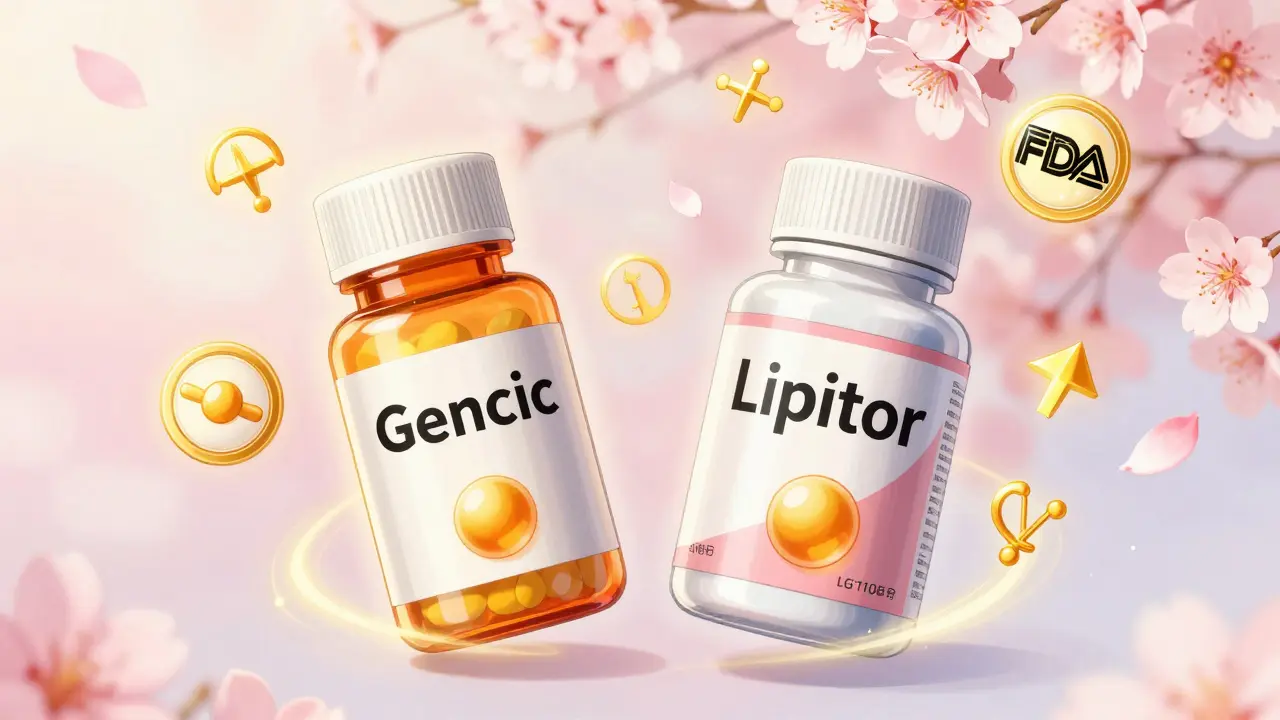
More than 9 out of 10 prescriptions filled in the U.S. are for generic drugs. Yet, many people still hesitate - wondering if they’re getting the same medicine, or just a cheaper version that might not work as well. The truth? For most people, generics are just as safe and effective as brand-name drugs. But there are exceptions. And if you’re taking something like warfarin, levothyroxine, or an epilepsy medication, those exceptions matter.
What Exactly Is a Generic Drug?
A generic drug is the exact same medicine as its brand-name counterpart - same active ingredient, same dose, same way it’s taken (pill, injection, inhaler, etc.). The FDA requires that generics deliver the same amount of medicine into your bloodstream at the same speed as the brand. That’s called bioequivalence. It’s not a close match. It’s a legal requirement. The difference? Generics don’t have to pay for the original research. Brand-name companies spend an average of $2.6 billion to develop a new drug, including years of clinical trials. Once the patent expires, other companies can make the same drug without repeating all that work. They only need to prove it works the same way. That’s why generics cost 80% to 85% less. For example, when Lipitor (atorvastatin) went generic, the price dropped from $130 a month to under $1. That’s not a marketing gimmick. That’s the cost of removing patent protection and letting competition kick in.Are Generics Really the Same?
Yes - and no. The active ingredient? Identical. The strength? Same. The way it’s absorbed? Within the FDA’s strict 80-125% range. A 2016 JAMA study looked at over 2,000 bioequivalence tests and found generics varied from brand-name drugs by only 3.5% on average. That’s less than the natural variation your body has from day to day. But the pills? They look different. That’s by law. Generic manufacturers can’t copy the shape, color, or logo of the brand-name drug - it’s a trademark issue. So if your metformin used to be blue and now it’s white, it’s still metformin. Same active ingredient. Same effect. The catch? Inactive ingredients. These are the fillers, dyes, and binders that hold the pill together. They don’t treat your condition, but they can affect people with allergies or sensitivities. If you’re allergic to red dye #40, and your new generic has it while your old one didn’t, you might have a reaction. That’s rare, but it happens.When Generics Might Not Be the Best Choice
Not all drugs are created equal when it comes to generics. There’s a small group called narrow therapeutic index (NTI) drugs. These are medications where even tiny changes in blood levels can cause serious problems - too little and the drug doesn’t work; too much and you get side effects. Common NTI drugs include:- Warfarin (blood thinner)
- Levothyroxine (thyroid hormone)
- Phenytoin, carbamazepine (seizure meds)
- Lithium (mood stabilizer)
Cost: The Biggest Advantage
Let’s talk money. In 2022, Americans saved $1.67 trillion over 10 years by using generics instead of brand-name drugs. That’s $77 billion saved by Medicare alone. For many people, choosing a generic isn’t just smart - it’s the only way to afford their medication. GoodRx data shows the average savings on generics is 82.5%. A 30-day supply of lisinopril (for high blood pressure) costs $4 as a generic. The brand-name version? Over $60. For insulin, the difference can be $500 a month. Medicare Part D beneficiaries say cost is the #1 reason they choose generics. And it’s not just individuals - hospitals and health systems use generics to cut costs and stretch budgets. Some hospitals get over 95% of their prescriptions filled with generics.
Who Makes Generic Drugs?
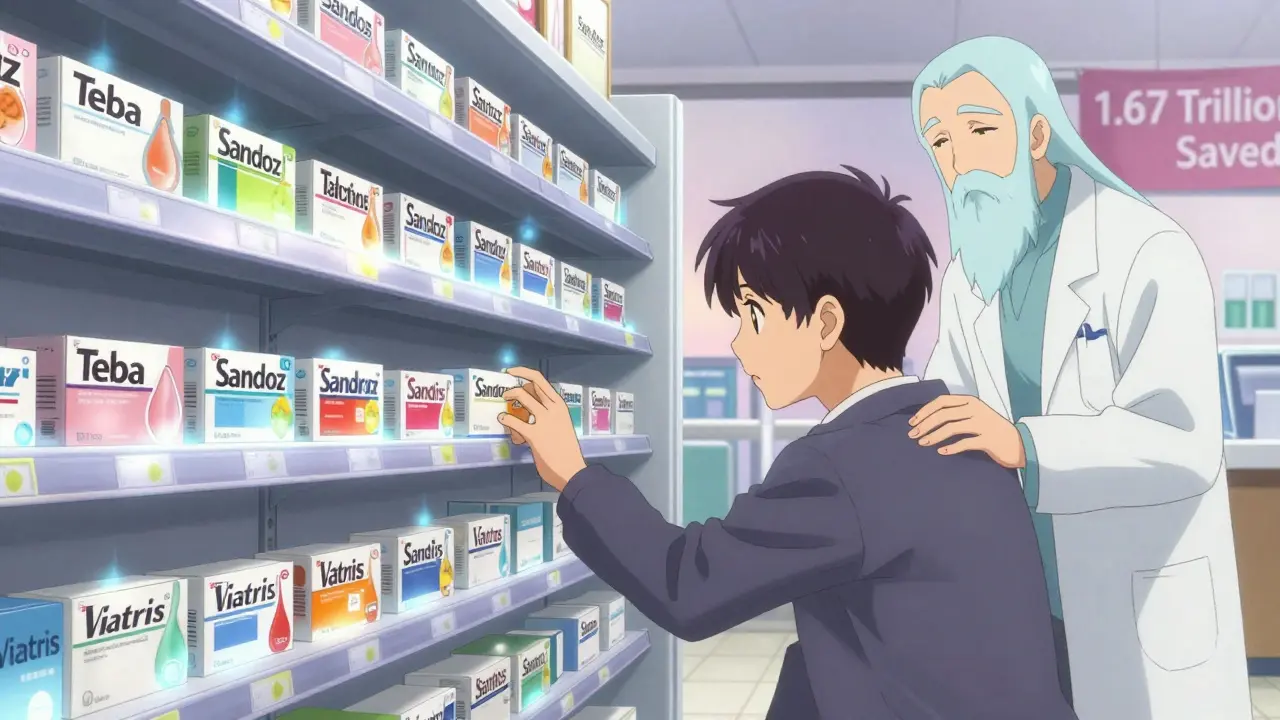
You might think generics are made in shady labs overseas. Some are. But many are made in the U.S. and in countries with strict quality controls. The top generic manufacturers include Teva, Sandoz (part of Novartis), and Viatris (which merged Mylan and Pfizer’s generics division). These companies produce thousands of generic drugs - from simple antibiotics to complex inhalers. The FDA inspects all manufacturing facilities - domestic and foreign - the same way. But a 2023 GAO report found 18% of foreign facilities had at least one inspection issue, compared to 8% of U.S. ones. That doesn’t mean they’re unsafe. It means they had minor paperwork or cleaning issues. Still, it’s why some doctors prefer generics made in the U.S. or EU for NTI drugs.What About Biosimilars?
Biosimilars are the generic version of biologic drugs - complex medicines made from living cells, like Humira, Enbrel, or insulin. They’re not exact copies like traditional generics. They’re highly similar, with no clinically meaningful differences. As of 2023, the FDA has approved 35 biosimilars. But they only make up 2.3% of the total biologics market. Why? Because they’re still expensive - $10,000 to $20,000 a year - even though they’re cheaper than the brand. Insurance companies are slow to cover them, and doctors are cautious. But the savings are real. When Humira’s patent expired in 2023, biosimilars entered the market. Within months, the price dropped by 30-50%. That’s a $6,000-$10,000 annual savings for patients.What You Should Do
If you’re on a regular medication, here’s what to do:- Ask your pharmacist: “Is there a generic version?” If yes, ask if they have it in stock.
- Check your prescription. If your doctor wrote “dispense as written,” that means no substitution. Otherwise, the pharmacist can switch you to generic.
- For NTI drugs (thyroid, blood thinners, seizure meds), ask your doctor: “Should I stick with one manufacturer?” If so, ask your pharmacist to always give you the same one.
- Use GoodRx or your pharmacy’s price checker. Sometimes the brand is cheaper than the generic - especially if you have coupons or insurance.
- Don’t panic if your pill looks different. Check the name on the bottle. If it’s the same active ingredient, it’s the same drug.
Common Myths Busted
- Myth: Generics are made in inferior factories. Fact: The FDA inspects all plants the same way. Many brand-name drugs are made in the same facilities as generics.
- Myth: Generics take longer to work. Fact: Bioequivalence studies prove they enter your bloodstream at the same rate.
- Myth: If I feel worse on a generic, it’s because it’s weaker. Fact: Sometimes it’s your body adjusting. Sometimes it’s a change in inactive ingredients. Talk to your doctor before switching back.
What’s Changing in 2026?
The FDA’s new GDUFA III rules aim to cut generic approval times from 14 months to 10. They’re also pushing harder to approve complex generics - like inhalers, eye drops, and topical creams - which used to take years to match the brand. Drug shortages? Still a problem. In 2022, there were 178 active shortages of generic drugs, mostly due to manufacturing issues or raw material shortages. But the trend is upward: more generics, more competition, lower prices. The Congressional Budget Office predicts generics will save the U.S. healthcare system another $1.7 trillion by 2032. Biosimilars could add $100 billion of that.Bottom Line
For most people, generic drugs are the smart, safe, and affordable choice. They’re not second-rate. They’re the same medicine, just without the brand name and the marketing budget. But if you’re taking a narrow therapeutic index drug - thyroid, blood thinner, seizure med - consistency matters. Stick with the same manufacturer. Talk to your doctor. Don’t let a pharmacy switch you without warning. The goal isn’t to avoid generics. It’s to use them wisely. And for millions of Americans, that means taking the medicine they need - without choosing between rent and refills.Are generic drugs as effective as brand-name drugs?
Yes, for the vast majority of medications. The FDA requires generics to have the same active ingredient, strength, dosage form, and bioequivalence as the brand-name version. Studies show they work the same way in the body. A 2016 JAMA review of over 2,000 studies found generics varied from brand-name drugs by only 3.5% on average - well within the FDA’s acceptable range of 80-125%.
Why are generic drugs so much cheaper?
Brand-name drug companies spend an average of $2.6 billion to develop a new drug, including years of clinical trials and marketing. Generic manufacturers don’t have to repeat that research. They only need to prove their version works the same way. That cuts costs dramatically. Once patents expire, multiple companies can make the same drug, driving prices down - sometimes to less than $1 per pill.
Can I switch between different generic brands?
For most drugs, yes - and it’s safe. But for narrow therapeutic index (NTI) drugs like warfarin, levothyroxine, or seizure medications, switching between different generic manufacturers can cause problems. Even small differences in how the drug is absorbed can affect your health. If you’re on one of these, ask your doctor to write "dispense as written" or ask your pharmacist to always fill your prescription with the same manufacturer.
Why do generic pills look different from brand-name ones?
By law, generic manufacturers can’t copy the exact shape, color, or logo of brand-name drugs - that’s protected by trademark. So generics look different, even though they contain the same active ingredient. The difference is only cosmetic. Check the drug name on the bottle, not the pill’s appearance.
Are there any risks with generic drugs?
The main risks are rare. Some people may react to inactive ingredients like dyes or fillers in generics. For NTI drugs, switching manufacturers can sometimes cause changes in how the drug works. Also, drug shortages are more common with generics due to manufacturing issues or supply chain problems. But overall, generics are as safe as brand-name drugs - and rigorously tested by the FDA.
How do I know if my generic is made in the U.S.?
The FDA doesn’t require labels to say where a drug is made. But you can ask your pharmacist. Some pharmacies track this, especially for high-risk medications. You can also check the FDA’s website or contact the manufacturer directly. Most major generic makers have facilities in both the U.S. and abroad.
Can I trust generic drugs from overseas?
Yes, if they’re FDA-approved. The FDA inspects all manufacturing facilities - whether in the U.S., India, China, or elsewhere - using the same standards. A 2023 GAO report found 18% of foreign facilities had inspection issues, compared to 8% in the U.S. That doesn’t mean they’re unsafe - most issues are minor paperwork or cleaning problems. But if you’re on a critical medication, you can ask your doctor or pharmacist about the manufacturer’s origin.
What’s the difference between generic and biosimilar drugs?
Generics are exact copies of small-molecule drugs, like aspirin or metformin. Biosimilars are highly similar versions of complex biologic drugs, like Humira or insulin, which are made from living cells. Biosimilars aren’t exact copies - they’re very close, with no clinically meaningful differences. They’re more expensive than traditional generics but still cheaper than the brand. As of 2023, 35 biosimilars have been approved in the U.S.




Arlene Mathison January 19, 2026
Just switched my levothyroxine to generic last month and my energy’s through the roof. No more brain fog, no more 3 p.m. crashes. I used to think generics were ‘pharma’s trick’ - turns out I was the one being scammed by marketing.
My pharmacist even gave me a free pill organizer. That’s service.
Also, my cat now respects me more. Probably because I’m not yelling at the TV anymore.
clifford hoang January 21, 2026
They say generics are ‘just as good’… but have you seen the FDA inspection reports? 😏
Same factory in India that made the baby formula that killed 100 kids? Yeah. That one.
They don’t test for ‘bioequivalence’ - they test for paperwork compliance. And guess what? The FDA’s budget got cut by 40% since 2015. So who’s really watching the lab? 🤔
And don’t even get me started on the ‘inactive ingredients’ - those are the real toxins. Dyes. Fillers. Gluten. They’re hiding it in plain sight.
Wake up, sheeple. This isn’t medicine. It’s a controlled substance delivery system.
Also, I heard the moon landing was faked. Coincidence? I think not. 🌕💊
Emily Leigh January 21, 2026
Ugh. Another ‘generics are fine’ post. Like, wow. Groundbreaking. You could’ve just said ‘drugs are drugs’ and saved us all 10 minutes.
I mean… I get it. You’re trying to sound smart. But honestly? I stopped reading after ‘bioequivalence.’
Also, my pill looks different now. I’m pretty sure it’s trying to hypnotize me. Why is it purple? Who decided purple? Who even ARE you?
Also, why does my insurance only cover the generic that makes me feel like I swallowed a rock? 🤷♀️
Carolyn Rose Meszaros January 23, 2026
My grandma takes generic warfarin and she’s 89 and still dancing at weddings. 🎉
She doesn’t even know what ‘bioequivalence’ means - but she knows her blood tests are stable. And that’s all that matters.
Also, she calls her pills ‘the little blue ones’ even though they’re white now. 😂
Point is: if it works, it works. Don’t overthink it. Just check with your doc, keep track, and don’t panic when the color changes.
Also, I love that you included GoodRx. That app saved my rent last year. 🙏
Greg Robertson January 24, 2026
Great breakdown. I’ve been on generic lisinopril for 5 years and never had an issue.
My pharmacist always switches me between Teva and Sandoz, and my BP’s been rock solid.
I do wonder though - why do some pharmacies seem to prefer one brand over another? Is it just cost, or is there something else going on?
Also, thanks for mentioning biosimilars. I’ve been meaning to ask about those for my dad’s RA meds.
Keep up the good work. This is the kind of info we actually need.
Nadia Watson January 24, 2026
It is imperative to recognize that the pharmaceutical landscape in the United States is profoundly influenced by structural economic incentives, which often prioritize corporate profitability over patient-centered care.
While the FDA’s regulatory framework for generic drugs is ostensibly rigorous, the increasing reliance on overseas manufacturing facilities - particularly in jurisdictions with less transparent governance - raises legitimate concerns regarding supply chain integrity.
Moreover, the normalization of generic substitution without patient consultation constitutes a subtle erosion of informed consent.
One must also consider the sociopolitical implications of cost-driven healthcare decisions, wherein individuals are compelled to choose between medication and basic sustenance - a moral failure of systemic proportions.
Therefore, while generics may be pharmacologically equivalent, their sociological impact demands critical reflection.
Let us not confuse affordability with equity.
Yours in thoughtful stewardship,
Nadia
Courtney Carra January 26, 2026
Okay but… why do generics always taste like chalk? 😑
I don’t care if they’re ‘bioequivalent’ - my tongue knows the difference.
Also, I switched to a generic version of my anxiety med and now I feel like I’m living inside a fog machine.
Is it the drug? Or is it the ‘filler’ they put in there to make it cheaper? I swear I can taste the corporate greed.
And why is the pill shaped like a tiny UFO? Who approved that design? 🛸
Also, I’m pretty sure my pharmacist is laughing at me. I can feel it.
thomas wall January 27, 2026
It is a profound disgrace that the American public has been conditioned to accept pharmaceutical mediocrity as acceptable.
When a nation allows its citizens to take drugs manufactured in facilities with documented sanitation violations - while the original innovators bear the burden of decades of research - we are not practicing medicine.
We are practicing economic surrender.
And to suggest that a pill made in a factory with 18% inspection violations is ‘just as safe’ as one made under the same brand name is not only scientifically irresponsible - it is morally bankrupt.
Europe does not tolerate this. Japan does not tolerate this.
Why do we?
Where is the dignity?
Where is the pride?
Where is the leadership?
And why, pray tell, are we so eager to be the world’s pharmaceutical dumping ground?
Paul Barnes January 28, 2026
Correction: The FDA’s acceptable bioequivalence range is 80–125%, not 80–120%.
Also, the 2016 JAMA study analyzed 2,000+ bioequivalence studies, not ‘over 2,000 tests.’
And Lipitor’s generic price didn’t drop to ‘under $1’ - it dropped to $1–$4 depending on pharmacy and dose.
These inaccuracies undermine credibility.
Otherwise, solid piece.
pragya mishra January 28, 2026
Why are you all talking about pills like they’re magic? In India, we get generics for 10 rupees. No one cares about color or manufacturer. We just take them. You Americans make everything complicated.
My uncle took generic warfarin for 12 years. He’s alive. He’s fine.
Stop overthinking. Just take the pill.
Also, why are you so scared of Indian factories? We make 40% of the world’s generics. You use them. You just don’t know it.
Wake up. It’s medicine. Not a conspiracy.
Manoj Kumar Billigunta January 29, 2026
Hey, I’m from India too. My brother works at a generic drug plant in Hyderabad.
They test every batch. Clean rooms. FDA inspectors come twice a year.
They don’t cut corners. They just don’t spend money on fancy logos.
My mom takes generic metformin. Her sugar’s perfect. She’s 70.
Don’t listen to the fear stuff. The science is solid.
And if you’re worried about color? Just ask the pharmacist. They’ll tell you the name on the bottle is what matters.
Keep taking your meds. You’re doing fine.
Andy Thompson January 29, 2026
Generics? Yeah, right. That’s what the deep state wants you to believe.
They’re not ‘equivalent’ - they’re designed to be slightly off so you need more. Then you get hooked. Then they upsell you the ‘premium’ version.
And who owns the big generic companies? Big Pharma.
Same people.
Same CEOs.
Same boardrooms.
It’s all one big game.
And now they’re pushing biosimilars? HA. That’s just Phase 2.
They’re not saving you money - they’re just moving the goalposts.
And don’t get me started on the 5G pills. 🤫
They’re watching you. Always.
Check your blood. Check your pills. Check your soul.
sagar sanadi January 30, 2026
So you’re telling me a pill that costs $1 can do the same thing as one that costs $60?
Then why do I feel like I’m on vacation when I take the brand?
And why do all the commercials for generics show old people smiling while holding a white pill?
That’s not medicine. That’s propaganda.
Also, I switched once. My head hurt for a week.
So no. I don’t believe you.
And I’m not your guinea pig.
kumar kc February 1, 2026
Generics are fine. But don’t switch NTI drugs. Period.
Warfarin? Stick with one.
Thyroid? Stick with one.
Seizure meds? Don’t even think about it.
That’s it.
Done.
Stop overcomplicating.
Thomas Varner February 2, 2026
Okay, so I switched my levothyroxine to the cheapest generic on GoodRx…
Then my TSH went from 2.1 to 6.8.
So I switched back to the brand.
TSH is 2.3 again.
So… what’s the deal?
Is it the manufacturer? The filler? The moon phase?
My doctor says ‘it happens.’
But I’ve been stable for 8 years on the same brand.
Now I’m paranoid every time I refill.
Also, my pill is now green. Why green? Who picked green?
And why does the pharmacy keep changing it?
Can we just… not?
Also, I miss my blue pill.
Arlene Mathison February 3, 2026
Wait - you switched back to brand? Same thing happened to me last year.
I thought I was crazy. Then I found out my pharmacy had switched me to a different generic - same name, different maker.
I called my endocrinologist. She said: ‘Ask for the brand that starts with ‘T.’’ Turns out it’s Teva.
Now I tell the pharmacist: ‘Teva only.’ No questions.
My TSH’s perfect again.
So yeah - generics are fine. But consistency matters.
Don’t let them switch you without telling you.
And if your pill changes color? Ask. Always ask.