
When you’re living with chronic pain, every day feels like a battle. Opioids might have helped at first, but now you’re worried about addiction, tolerance, or side effects. You’ve seen ads for CBD oil promising relief without the high. Maybe you’ve even tried it. But did it work? And if not, why? The truth about cannabinoids and pain isn’t found in marketing slogans or Reddit threads-it’s buried in conflicting studies, regulatory confusion, and real-world experiences that rarely match the hype.
What Are Cannabinoids, Really?
Cannabinoids are chemical compounds from the cannabis plant that interact with your body’s endocannabinoid system-a network of receptors that helps regulate pain, mood, sleep, and inflammation. The two most studied are THC (tetrahydrocannabinol) and CBD (cannabidiol). But there are others: CBG (cannabigerol), CBN (cannabinol), and more. Each acts differently. THC binds to CB1 receptors in the brain and nervous system, which is why it causes psychoactive effects. CBD doesn’t bind strongly to these receptors. Instead, it influences them indirectly, which is why it doesn’t get you high.
That’s why people assume CBD is safer. But safety doesn’t automatically mean effectiveness. In 2025, a Yale study found that CBG, a lesser-known cannabinoid, showed the strongest ability to block a key protein involved in peripheral pain signaling. That’s promising-but it was done in a lab, not on humans. Meanwhile, a University of Bath analysis of 16 clinical trials found that CBD performed no better than placebo for pain relief. So what’s going on?
The Evidence Is Mixed-And It Depends on the Type of Pain
Not all pain is the same. And not all cannabinoids work the same way for every kind of pain. The clearest evidence exists for neuropathic pain-nerve damage caused by diabetes, shingles, or multiple sclerosis. Health Canada approved Sativex, a 1:1 THC:CBD spray, specifically for this use. A patient in a 2023 Leafly testimonial reported cutting their daily oxycodone dose from 120mg to 30mg after switching to a THC:CBD tincture, with better pain control and fewer side effects.
But for lower back pain, arthritis, or fibromyalgia? The data is thin. A 2015 JAMA review found moderate-quality evidence supporting cannabinoids for chronic pain overall-but that was mostly based on studies using whole-plant extracts or THC-dominant products. The CDC’s 2023 position is blunt: there’s limited evidence cannabinoids work for most types of acute or chronic pain, except possibly neuropathic pain.
Harvard Medical School put it plainly: there’s no high-quality human study proving CBD alone relieves pain. Animal studies look good. Human trials? Not so much. One 2023 systematic review found three studies showed no benefit from CBD, and one had mixed results. Meanwhile, a Sage Publications study suggested medicinal cannabis might improve pain interference and quality of life-but that’s not the same as eliminating pain.
Dosing? There’s No Standard
If you’ve bought CBD oil, you’ve probably seen labels saying “1000mg CBD per bottle.” But here’s the problem: that number might mean nothing. The University of Bath tested 24 commercial CBD products and found that 70% didn’t contain the amount of CBD they claimed. Some had zero. Others had more than double. And many contained trace THC-enough to cause a failed drug test or unwanted psychoactive effects.
There are no official dosing guidelines for pain. Clinicians typically recommend starting low: 10-20mg of CBD or 2.5-5mg of THC. Increase slowly over weeks. But without standardized products, how do you know what you’re getting? A 2023 Amazon review summed it up: “Used this daily for six weeks for arthritis. No difference compared to placebo.” Another user on Reddit reported 30% relief from fibromyalgia after two weeks-but that’s one person’s experience.
And then there’s CBG. The Yale study suggests it could be more effective than CBD for pain, without the high. But it’s not available in most retail products yet. Pharmaceutical-grade CBG is still in early research. If you’re buying CBG oil online, you’re likely paying for a marketing buzzword, not a proven treatment.
Safety: It’s Not All Natural and Harmless
Cannabinoids are often marketed as “natural” and “safe.” But natural doesn’t mean risk-free. The JAMA review found increased short-term side effects: dizziness (9.2% vs 5.6% in placebo), dry mouth (6.6% vs 2.5%), and nausea (5.4% vs 4.0%). At high doses, CBD has been linked to liver toxicity, especially when taken with other medications.
Drug interactions are a real concern. Cannabinoids are metabolized by the same liver enzymes (CYP450) that process blood thinners, antidepressants, seizure meds, and many others. Taking CBD with warfarin? That could raise your risk of bleeding. With antidepressants? It might amplify side effects.
And then there’s THC. Even small amounts can cause anxiety, paranoia, or impaired coordination. For older adults or those with heart conditions, that’s not worth the risk. Plus, if you’re subject to workplace drug testing, even trace THC from a “broad-spectrum” product could get you fired.
Why Do So Many People Swear It Works?
If the science is so mixed, why do so many users report relief? The answer lies in the placebo effect, the power of hope, and the limitations of current pain science.
Chronic pain isn’t just physical-it’s emotional, psychological, and deeply personal. Anxiety and stress make pain worse. CBD doesn’t eliminate pain, but it might reduce anxiety. That’s why 28% of positive CBD reviews mention “reduced anxiety” and 22% say “improved sleep.” Better sleep and less stress can make pain feel more manageable-even if the pain itself hasn’t changed.
Also, many people switch from opioids to cannabinoids not because the latter is stronger, but because it feels safer. The opioid crisis-80,000+ overdose deaths in the U.S. in 2023-has pushed people to seek alternatives, even unproven ones. A 2019 study showed medical cannabis laws were initially linked to lower opioid deaths, but that effect faded over time. That suggests people are substituting, not necessarily improving outcomes.

What About Medical Cannabis Programs?
As of 2023, 38 U.S. states, D.C., and three territories have medical cannabis programs. But federal law still classifies cannabis as Schedule I-meaning it’s supposed to have no medical use and high abuse potential. That’s why research is so limited. The FDA has issued 147 warning letters to companies making illegal pain claims about CBD products.
Canada and the Netherlands have more regulated systems. In Canada, patients can buy government-tested, labeled cannabis products. In the U.S., you’re buying from a patchwork of unregulated dispensaries and online sellers. Product quality varies wildly. One batch might be pure CBD. The next might be laced with synthetic cannabinoids or heavy metals.
What’s Next?
Phase III clinical trials are underway. GW Pharmaceuticals is testing a THC:CBD combination for cancer pain. Columbia University is studying CBD for chronic low back pain. Results are expected between 2024 and 2025. If one of these studies shows clear benefit, the FDA could approve a cannabinoid-based pain medication by 2027.
Meanwhile, researchers like Mohammad-Reza Ghovanloo at Yale are pushing for better-quality studies. Dr. Chris Eccleston at the University of Bath is blunt: “CBD presents consumers with a big problem... It’s touted as a cure for all pain but there’s a complete lack of quality evidence.”
The bottom line? Don’t expect CBD to replace your pain meds. Don’t assume THC is a magic bullet. And don’t trust products that don’t come with a Certificate of Analysis from an independent lab.
What Should You Do?
If you’re considering cannabinoids for pain:
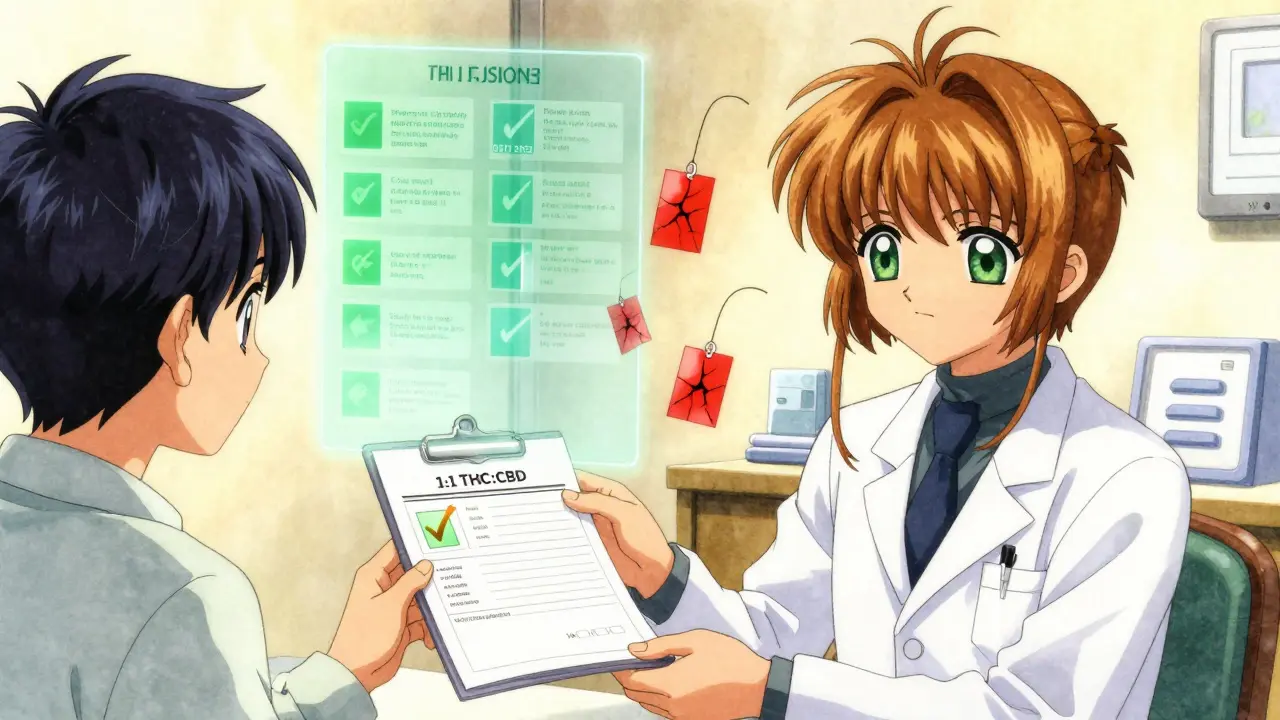
- Start with low doses of a 1:1 THC:CBD product if you’re in a state with legal medical cannabis and under a doctor’s care.
- Avoid standalone CBD products for pain-they’re unlikely to help, based on current evidence.
- Ask for third-party lab reports. Look for tests showing cannabinoid content, pesticides, heavy metals, and THC levels.
- Don’t stop your prescribed medications without talking to your doctor.
- Track your pain levels, sleep, and mood daily. If you don’t see improvement after 4-6 weeks, stop.
- Be aware of drug interactions. Tell your pharmacist what you’re taking.
There’s no magic pill. But if you’re looking for a safer alternative to opioids, and you’re willing to navigate a messy, unregulated market, a carefully chosen cannabinoid product-used under medical supervision-might offer some relief. Just don’t expect miracles.
Can CBD oil really help with chronic pain?
Current evidence doesn’t support CBD alone as an effective treatment for most types of chronic pain. Multiple clinical trials, including a 2023 University of Bath analysis of 16 studies, found CBD performed no better than placebo. While some users report relief, this is likely due to reduced anxiety or improved sleep-not direct pain reduction. The FDA has not approved CBD for pain management.
Is THC better than CBD for pain?
Yes, for certain types of pain-especially neuropathic pain. THC directly activates cannabinoid receptors involved in pain signaling. Products like Sativex, a 1:1 THC:CBD spray, are approved in Canada for MS-related pain and cancer pain. Studies show THC-containing products are more consistently effective than CBD alone. But THC causes psychoactive effects and isn’t suitable for everyone.
What’s the best way to take cannabinoids for pain?
Tinctures and sprays are preferred for pain because they offer precise dosing and faster absorption than edibles. Topicals may help localized pain like arthritis but don’t enter the bloodstream enough to affect systemic pain. Smoking or vaping carries lung risks. Start with low doses (2.5-5mg THC or 10-20mg CBD) and increase slowly under medical guidance.
Are cannabinoid products regulated in the U.S.?
No, not reliably. While medical cannabis is legal in 38 states, federal law still bans it. The FDA has issued over 140 warning letters to companies making false pain claims about CBD. Independent testing found 70% of retail CBD products mislabel their CBD content. Some contain illegal levels of THC or contaminants. Always ask for a Certificate of Analysis from a third-party lab before buying.
Can cannabinoids replace opioids?
Not as a direct replacement. Opioids are more effective for acute and severe pain. Some patients report reducing opioid use after switching to THC:CBD combinations, but this should only be done under medical supervision. Abruptly stopping opioids can cause dangerous withdrawal. Cannabinoids may help reduce opioid doses in some cases, but they are not a substitute for comprehensive pain management.
Is CBG the next big thing for pain relief?
Early lab research from Yale in January 2025 shows CBG has strong potential to block pain-signaling proteins without causing a high. But this is preliminary-no human trials have been done yet. CBG products on the market today are not pharmaceutical-grade and may not contain enough active compound to matter. Don’t rush to buy CBG oil expecting miracles. It’s promising, but still years away from proven use.





Janelle Moore December 18, 2025
They’re hiding the truth. CBD is just a cover for Big Pharma to control the narrative. You think they want you to heal? No. They want you dependent on their overpriced, FDA-approved nonsense. I’ve seen people go off opioids and live pain-free with pure CBD oil-then the FDA cracks down. Coincidence? Nah. The government’s scared of natural cures. I got my oil from a guy in Oregon who sources from a farm that’s been in his family since the 70s. No lab report? Doesn’t matter. I trust my gut. And my pain’s been gone for 3 years.
mary lizardo December 19, 2025
The notion that unregulated, poorly characterized plant extracts constitute a viable therapeutic modality is not merely scientifically indefensible-it is an affront to evidence-based medicine. The cited Yale study, while intriguing, remains preclinical; extrapolating its findings to human clinical practice constitutes a gross misrepresentation of the scientific method. Moreover, the conflation of anecdotal reports with empirical data undermines public trust in legitimate pain management protocols. One must ask: if efficacy were demonstrable, why has no cannabinoid-based analgesic achieved FDA approval outside of Sativex? The answer is simple: the data does not support it.
jessica . December 20, 2025
they dont want you to know the truth. CBD is a weapon. they pump it full of glyphosate and then sell it to you as ‘natural’ while the CDC pushes opioids because they get kickbacks from big pharma. i read a guy on 4chan who said the FDA banned hemp in 1937 because it could replace plastic and paper. now they’re letting it back in but only if you buy it from their approved brands. you think that’s a coincidence? think again. i only buy from farmers who grow it with their bare hands in the mountains. no lab tests. no paperwork. just truth.
Ryan van Leent December 22, 2025
Been using THC oil for lower back pain for 2 years. Not cured it but it lets me sleep. No more Vicodin. My doc says it’s fine as long as I don’t drive stoned. I started with 5mg, now I’m at 15mg at night. No liver issues. No paranoia. Just quiet. People say CBD doesn’t work? Maybe. But THC does. And if you’re too scared to try it, that’s your problem. Don’t lecture people who are actually trying to feel better.
Adrienne Dagg December 22, 2025
OMG I tried CBD for my fibro and it was a GAME CHANGER 😭 I used to cry every night from pain now I just chill and watch Netflix 🌿✨ My sister says it’s placebo but I feel it in my bones 💪 I’m not even lying. I went from 8/10 pain to 3/10. And my anxiety? Gone. I swear by it. If you don’t believe me, try it. What’s the worst that happens? You waste $30? I’d take that over another opioid any day 💖
Connie Zehner December 22, 2025
You think you’re the only one who’s tried this? I’ve been on every kind of cannabinoid known to man. CBD? Useless. THC? Makes me paranoid as hell. CBG? I bought a bottle labeled ‘250mg CBG’-turned out to be 12mg and a bunch of vegetable oil. I’ve had 3 different lab tests done. None match the label. I’m not stupid. I know they’re lying. But here’s the thing-my pain gets worse every time I take something that’s supposed to help. I think they’re dosing it with something else. Something that makes you dependent. Or worse. I’m not saying it’s the government. I’m saying it’s the system. And you’re all just pawns.
My cousin died last year from a ‘natural’ supplement. Said it was ‘pure CBD.’ Turned out it had fentanyl in it. I don’t trust anything anymore. Not even the ones that say ‘third-party tested.’
Monte Pareek December 24, 2025
Let me break this down real simple for anyone still confused. If you have nerve pain-MS, shingles, diabetic neuropathy-THC:CBD blends like Sativex work. Period. That’s not opinion. That’s Canadian and EU regulatory approval backed by double-blind trials. For lower back pain? Arthritis? Fibro? CBD alone? Probably not. But that doesn’t mean nothing works. It means you need to be smarter. Don’t buy some random gummy off Amazon. Go to a licensed dispensary in your state. Ask for a COA. Ask for the strain. Ask for the terpene profile. Talk to the budtender like they’re your pharmacist. And if they can’t answer, walk out. Also-start at 2.5mg THC, 5mg CBD. Wait 90 minutes. Don’t take more. Do this for 2 weeks. Track your pain on a scale. Sleep quality. Mood. If nothing changes? Stop. No guilt. No shame. But if you feel even a little better? That’s progress. This isn’t magic. It’s medicine. And like any medicine, you gotta use it right. Don’t let the scam artists win. Educate yourself. Your body deserves better than hype.
Kelly Mulder December 25, 2025
It is profoundly disingenuous to equate anecdotal testimonials with clinical efficacy. The placebo effect, when amplified by emotional desperation and unregulated product marketing, constitutes not a therapeutic intervention but a public health hazard. The assertion that CBG is ‘promising’ based on in vitro studies is misleading; such preliminary findings are routinely contradicted in subsequent human trials. The FDA’s 147 warning letters are not bureaucratic overreach-they are necessary safeguards. Consumers are not being protected. They are being exploited. And those who peddle false hope under the banner of ‘natural healing’ are, in effect, committing medical malpractice by omission. The only ethical path forward is rigorous, transparent, peer-reviewed research-and until such time, the responsible course is abstinence.