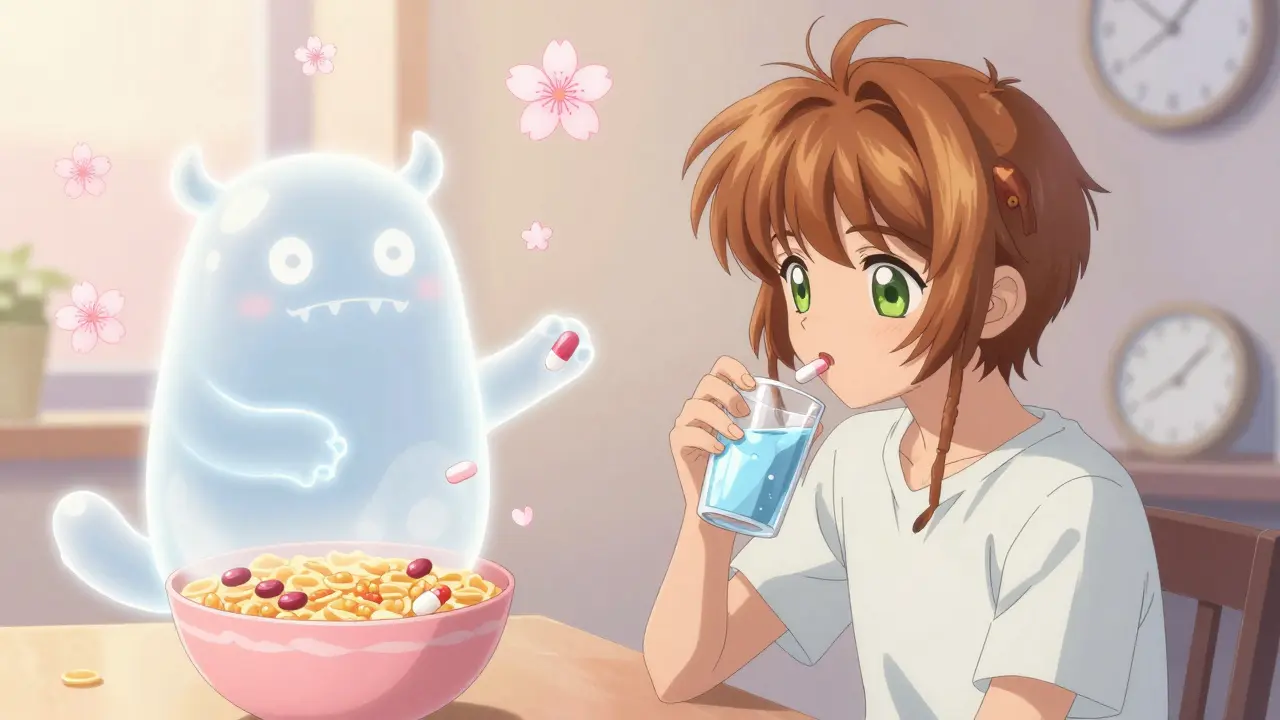
When you're sick and prescribed an antibiotic, you want it to work. But what if something in your fridge is quietly sabotaging it? It’s not the sugar in your cereal or the salt in your soup-it’s the milk, yogurt, or cheese you eat with your pill. The calcium in dairy products doesn’t just help your bones; it can also lock up your antibiotic before your body even gets a chance to use it.
Why Dairy Interferes with Certain Antibiotics
The problem isn’t that dairy is bad. It’s that calcium, magnesium, and other minerals in milk and yogurt chemically bind to certain antibiotics, forming a solid clump your gut can’t absorb. This isn’t a myth or old wives’ tale-it’s basic chemistry. Back in the 1960s, scientists first noticed that patients taking tetracycline weren’t getting better, even when they took the full dose. The culprit? Milk. The calcium in milk latched onto the antibiotic molecules, creating an insoluble complex that passed right through the digestive system without entering the bloodstream. This same reaction happens with fluoroquinolones like ciprofloxacin and levofloxacin. Studies show that when you take ciprofloxacin with milk, your body absorbs up to 70% less of the drug. With yogurt, that number jumps to 92%. That’s not a small drop-it’s the difference between treating an infection and letting it grow stronger.Which Antibiotics Are Most Affected?
Not all antibiotics play nice with dairy. The big two troublemakers are:- Tetracyclines: This group includes tetracycline, doxycycline, and minocycline. Tetracycline itself is the most sensitive-dairy can slash absorption by up to 90%. Doxycycline is a bit more forgiving, but still needs space between it and milk.
- Fluoroquinolones: Ciprofloxacin, levofloxacin, and moxifloxacin are all affected. Even a small glass of milk can reduce ciprofloxacin levels by half.
Other drugs like bisphosphonates (used for osteoporosis) and some iron supplements react the same way. But penicillins (like amoxicillin), macrolides (like azithromycin), and cephalosporins? They’re fine with dairy. No timing needed.
How Long Should You Wait?
Timing isn’t optional-it’s the only thing that works. You can’t just avoid dairy all day. You need to space it out.- For tetracyclines: Take the pill at least 1 hour before eating dairy, or wait 2 hours after. Some experts recommend 3 hours for maximum safety, especially with older tetracycline formulations.
- For fluoroquinolones like ciprofloxacin: Wait 2 hours before dairy, and then wait another 4 to 6 hours after taking the pill. That’s because these drugs stay active in your gut longer and keep binding to calcium.
Why the difference? Tetracyclines bind quickly and are absorbed fast. Fluoroquinolones linger, so the window for interference is wider. If you take your ciprofloxacin at 8 a.m. with a glass of water, don’t have yogurt with your lunch at noon. Wait until after dinner-or better yet, save your yogurt for bedtime.
It’s Not Just Milk
Many people think only cow’s milk is the problem. It’s not. Any food or drink with added calcium can cause the same issue:- Fortified plant milks (almond, soy, oat)
- Cheese, cottage cheese, ice cream
- Calcium-fortified orange juice
- Calcium supplements (even Tums or Rolaids)
One patient in a 2023 study kept getting recurrent UTIs because she took her ciprofloxacin with her morning glass of calcium-fortified orange juice. She thought it was healthy. Her pharmacist found the culprit in 30 seconds.
What Happens If You Don’t Separate Them?
Taking dairy with these antibiotics doesn’t just make the drug less effective-it can make things worse.- Treatment failure: Your infection doesn’t clear. A sinus infection turns into pneumonia. A UTI comes back worse.
- Antibiotic resistance: If the drug doesn’t kill all the bacteria, the survivors multiply. They become stronger. That’s how superbugs form.
- Longer illness: You’re sick longer. You might need a second round of antibiotics-or even hospitalization.
One study found that 22% of failed UTI treatments were linked to dairy timing mistakes. Another showed that patients who followed the 2-hour rule had a 98% success rate. Those who didn’t? Only 72% got better.
Real Stories, Real Consequences
On Reddit, a nurse shared how a patient with Lyme disease stayed sick for weeks-until they realized she was drinking milk with every doxycycline dose. After switching to water and waiting two hours after meals, her symptoms vanished in days. A Drugs.com user wrote: “My UTI kept coming back. My pharmacist said, ‘Did you eat yogurt after your pill?’ I said yes. He told me to wait four hours. I did. It worked.” These aren’t rare cases. A 2022 survey found that 43% of patients given tetracyclines or fluoroquinolones got no clear instructions about dairy. That’s not negligence-it’s a systemic gap in patient education.What Should You Do?
Here’s your simple, no-fluff plan:- Check your prescription label. If it’s tetracycline, doxycycline, ciprofloxacin, or levofloxacin, dairy timing matters.
- Take the pill with a full glass of water, on an empty stomach.
- Wait at least 1 hour before eating anything with dairy or calcium.
- Wait 2 hours after taking tetracyclines before having dairy. Wait 4 to 6 hours after fluoroquinolones.
- Don’t assume plant-based milk is safe. Check the label for added calcium.
- If you’re unsure, ask your pharmacist. They’re trained for this.
It’s not about being perfect. It’s about being smart. One mistake can undo days of treatment.
What’s Changing?
The FDA now requires clearer warnings on antibiotic packaging. Apps like Medisafe and MyMeds send alerts if you enter a dairy-interacting drug. Newer versions of ciprofloxacin (like Cipro XR) are designed to be less affected by calcium-but they cost 14 times more than the generic version. Researchers are working on calcium-resistant tetracycline derivatives. But those won’t be available until 2026 or later. Until then, timing is your best-and only-tool.The science is clear: calcium binds to these antibiotics. Your body can’t absorb the bound form. No magic workaround. No exception for organic milk or Greek yogurt. Just time and water.
Can I drink milk with doxycycline if I wait an hour?
It’s not recommended. While doxycycline is less affected by calcium than older tetracyclines, studies still show a 30-50% drop in absorption when taken with dairy-even with a 1-hour gap. The safest approach is to wait 2 hours after taking doxycycline before eating or drinking anything with calcium.
What if I accidentally take my antibiotic with yogurt?
Don’t panic. One mistake won’t ruin your entire course. But don’t repeat it. Skip your next dairy meal and go back to the recommended timing. If you’re on a short course (like 5-7 days), you might still get enough of the drug to work. But if your symptoms don’t improve, contact your doctor-you may need a different antibiotic or a longer course.
Are all plant-based milks unsafe with antibiotics?
Only if they’re fortified with calcium. Check the nutrition label. If it says “calcium carbonate” or “tricalcium phosphate” and lists more than 10% of the daily value per serving, treat it like dairy. Plain, unfortified almond or oat milk without added calcium is safe.
Can I take my antibiotic with a meal that doesn’t have dairy?
Yes, but only if the meal doesn’t contain calcium-rich foods. Avoid fortified cereals, cheese on toast, or calcium-fortified orange juice. Stick to plain toast, eggs, fruit, or lean meat. Water is always the safest drink.
Why do some people say they took dairy with their antibiotic and it worked?
Some infections are mild and your immune system can handle them even with lower drug levels. Also, some people take the antibiotic at night and dairy at breakfast-there’s enough time between doses. But that’s luck, not science. For serious infections like pneumonia, UTIs, or Lyme disease, the risk of failure is real. Don’t gamble with your health.





Nancy Kou December 19, 2025
Just took doxycycline this morning and had oat milk in my coffee. Checked the label-fortified with calcium carbonate. Crap. Now I’m paranoid I’ve doomed my sinus infection to come back worse. Thanks for the wake-up call.
Dev Sawner December 21, 2025
It is imperative to note that the chelation phenomenon between divalent cations and tetracycline-class antibiotics is a well-documented pharmacokinetic interaction, first elucidated in the seminal work of Levy et al., 1967. The formation of insoluble complexes in the gastrointestinal lumen results in a marked reduction in bioavailability, often exceeding 80% in controlled clinical settings. This is not anecdotal; it is biochemistry.
Hussien SLeiman December 22, 2025
Oh wow, so now I’m supposed to become a human pharmacy schedule? Wait two hours before yogurt, four before cheese, six before fortified soy milk, and don’t even think about taking your pill with breakfast unless you want to be the guy who gave MRSA to his entire office. Meanwhile, my cousin took amoxicillin with a milkshake and still beat his strep throat. So maybe this whole thing is just Big Pharma’s way of selling more pills? Or maybe people just get better because their immune systems work? I mean, come on. We’ve been drinking milk with antibiotics since the 70s.
Ashley Bliss December 23, 2025
People are dying because they think ‘it worked for me’ is science. You don’t get to opt out of chemistry because you like your morning smoothie. This isn’t a preference-it’s a biological fact. Your body doesn’t care if you’re ‘organic’ or ‘plant-based’ or ‘spiritual.’ Calcium binds. Period. And if you’re one of those people who say ‘I’ve never had a problem,’ you’re just lucky. Luck isn’t a medical strategy.
Moses Odumbe December 24, 2025
Bro. I took cipro with a smoothie and it was fine 😅 But now I’m gonna wait 4 hours just in case. Also, plant milk? I thought almond milk was just water with nuts. Nope. It’s calcium soup now. 🤯
Emily P December 25, 2025
Does this apply to antacids too? I take Tums for heartburn and I’m on doxycycline right now. I didn’t realize they were in the same category.
Vicki Belcher December 26, 2025
This is such an important post! 🙌 I used to take my antibiotics with yogurt because I thought it was ‘good for my gut.’ Turns out I was killing the very thing I was trying to help. I’ve started using a little app that reminds me to wait 2 hours. Small changes, big results. You got this!
Jedidiah Massey December 28, 2025
It’s fascinating how the bioavailability of fluoroquinolones is so exquisitely sensitive to divalent cation chelation. The pharmacodynamic implications are nontrivial-subtherapeutic concentrations in the interstitial fluid directly correlate with selective pressure favoring resistant strains. The clinical literature is unequivocal. And yet, we still have patients who believe ‘natural’ means ‘immune to pharmacokinetics.’
Alana Koerts December 29, 2025
So you're telling me I can't have my morning cereal with milk and my pill? Wow. What a shock. I'm sure this is why no one gets better anymore. Also, I've been doing this for years and I'm fine. Maybe your doctor is just bad?
William Storrs December 29, 2025
Hey, if you’re taking antibiotics, you’re already doing something brave. Don’t beat yourself up if you messed up once. Just reset. Drink water. Wait the two hours. You’re not failing-you’re learning. And you’re not alone. We’ve all been there. Keep going.
Nina Stacey December 29, 2025
i just took my doxy with a banana and a glass of almond milk i thought it was unsweetened but maybe it had calcium i dont know i didnt check the label im so dumb but im gonna do better next time
Dominic Suyo December 31, 2025
This is why modern medicine is a joke. You give someone a drug that requires a PhD in nutrition to take correctly, then act surprised when they don’t follow it. The real problem? Doctors don’t explain this shit. They just hand you a script and say ‘take it.’ Meanwhile, your pharmacist is sitting there like, ‘Ma’am, your orange juice has more calcium than your milk.’
Kevin Motta Top December 31, 2025
In India, we’ve always taken antibiotics with rice and dal. No one worries about calcium. Maybe cultural diet patterns affect how these interactions play out? Or maybe the doses are lower? Just wondering.
Chris porto January 1, 2026
It makes sense. Calcium and antibiotics both want to bind to things. If they bind to each other, neither can do their job. It’s like two people trying to hold hands while both are holding a rope. One of them has to let go. In this case, your body loses the antibiotic. Simple physics.
Aadil Munshi January 1, 2026
Interesting how you call it ‘sabotage’ like dairy has intent. It’s just chemistry. But you’re right-people treat milk like it’s holy water. I once had a patient refuse to stop her soy milk because ‘it’s vegan.’ I said, ‘Ma’am, your soy milk is basically a calcium trap with a label.’ She cried. Then she took her pill with water. Got better in 3 days.
Nancy Kou January 3, 2026
Update: I waited 3 hours and had yogurt for lunch. No symptoms worsening. Still scared, but I’m doing better.
Dev Sawner January 4, 2026
While anecdotal improvement may be observed, the pharmacokinetic parameters remain unchanged. Absorption is not binary; it is a continuous function of concentration gradient and chelation kinetics. One meal does not negate systemic underexposure. Clinical outcomes are population-based, not individual.
William Storrs January 5, 2026
You’re doing great. Progress over perfection. That’s the mindset. Keep it up.
Ashley Bliss January 7, 2026
It’s not about ‘feeling better.’ It’s about killing every last bacterium. If you leave even 1% alive, you’re breeding monsters. Your ‘I’m fine’ is someone else’s antibiotic-resistant nightmare.
Vicki Belcher January 9, 2026
Thank you for sharing your update! 🌟 Small steps lead to big wins. You’re not just healing your body-you’re helping others learn too.
Dominic Suyo January 9, 2026
So now we’re blaming patients for doctors being lazy? Classic. The system failed them. Not the other way around.
Aadil Munshi January 11, 2026
And yet, in the real world, people take meds with food because they’re tired, hungry, or confused. Maybe the answer isn’t more rules-it’s simpler packaging, clearer labels, and pharmacists actually talking to patients. Not just posting long Reddit essays.
Nina Stacey January 12, 2026
my pharmacist just called me to check in and gave me a little card with the timing rules. i printed it and taped it to my fridge. its so simple. why didnt anyone do this before
Nancy Kou January 13, 2026
My doctor didn’t mention any of this. I’m glad I read this.
Vicki Belcher January 14, 2026
This is why pharmacists are heroes. They see the mistakes before the damage is done.
Kevin Motta Top January 14, 2026
My grandmother took penicillin with tea and milk for 40 years. Never had an issue. Maybe it’s not universal?
Dev Sawner January 14, 2026
Penicillins lack the molecular structure required for chelation with divalent cations. Their absorption is unaffected by calcium. The absence of interaction in penicillin is not evidence of a general principle-it is evidence of molecular specificity.
Dominic Suyo January 16, 2026
So now we’re doing molecular biology on Reddit? Congrats. You just turned a simple warning into a textbook chapter. Meanwhile, the patient still doesn’t know what to eat for breakfast.
Jedidiah Massey January 17, 2026
The cognitive dissonance is palpable. Patients expect precision in dosing, yet reject precision in timing. The pharmaceutical industry has failed to deliver user-centric education-not because it’s impossible, but because it’s not monetized.
William Storrs January 17, 2026
It’s okay to be confused. The system is messy. Just take the pill with water, wait two hours, and you’re ahead of 80% of people. That’s enough.
Ashley Bliss January 18, 2026
There’s no ‘ahead of 80%’. There’s only ‘effective’ and ‘ineffective’. You don’t get a participation trophy for nearly killing yourself.
William Storrs January 19, 2026
And you don’t help anyone by making them feel guilty. You help them by showing up with a plan. I’ve been there. I’m here now. That’s all that matters.
Nina Stacey January 20, 2026
my cousin got hospitalized because she took cipro with calcium-fortified orange juice and now she has a 6 month antibiotic course. i just saved my mom from that by reading this. thank you
Nancy Kou January 20, 2026
Thank you for sharing your story. I’m not alone.
Vicki Belcher January 22, 2026
You’re not alone. We’re all learning together. 💪
Moses Odumbe January 22, 2026
So if I take my pill at 8am, can I have yogurt at 1pm? Or do I need to wait until dinner?
Dev Sawner January 24, 2026
Fluoroquinolones exhibit prolonged gastrointestinal retention and sustained binding potential. A 4-hour window is the minimum; 6 hours is recommended to ensure full clearance of unbound drug from the intestinal lumen. The 1-hour rule applies only to tetracyclines, which are rapidly absorbed.
William Storrs January 26, 2026
Just wait until dinner. You’ve got this.
Nancy Kou January 26, 2026
Done. Took my pill at 8am. Ate yogurt at 7pm. Felt like a science experiment. But I did it.
William Storrs January 28, 2026
That’s exactly what progress looks like.
Aadil Munshi January 28, 2026
So what about calcium supplements? If I take a vitamin with calcium at night, and my antibiotic at night too… is that bad?
Dev Sawner January 29, 2026
Concurrent administration of calcium supplements with tetracyclines or fluoroquinolones results in near-complete inhibition of absorption. These should be separated by a minimum of 3 hours, and ideally 6 hours, to mitigate chelation. Timing is non-negotiable.
William Storrs January 29, 2026
Take your vitamins in the morning. Your antibiotics at night. Easy.
Emily P January 30, 2026
So if I take my pill at night, can I have dairy the next morning?
Dev Sawner January 31, 2026
Yes. The drug is fully absorbed and eliminated within 8–12 hours. Morning dairy poses no interference if the antibiotic was taken the previous evening.
Emily P January 31, 2026
Thank you. That makes so much sense now.
Alana Koerts February 2, 2026
So basically if you’re dumb you get sick. If you’re smart you follow rules. What a revelation.
Dominic Suyo February 4, 2026
And if you’re rich, you get the fancy slow-release version that doesn’t care. The rest of us? We get to play pharmacy roulette.
William Storrs February 5, 2026
It’s not about being smart. It’s about being informed. And now you are. That’s everything.
Nancy Kou February 5, 2026
My doctor didn’t say a word. I’m never trusting another script without checking.
Vicki Belcher February 6, 2026
Ask your pharmacist next time. They’re the real MVPs.
Ashley Bliss February 6, 2026
They’re not MVPs. They’re the last line of defense against a broken system. And you’re lucky they’re even there.
Moses Odumbe February 7, 2026
Just got my cipro. I’m drinking water. No dairy. No jokes. I’m taking this seriously now.
William Storrs February 8, 2026
That’s the spirit. You’re going to be fine.
Nina Stacey February 9, 2026
im printing this out and putting it in my pillbox
Vicki Belcher February 11, 2026
That’s brilliant. You’re setting yourself up for success. 💙
Hussien SLeiman February 12, 2026
So you’re telling me I have to plan my entire day around my pill? What if I’m at work? What if I’m traveling? What if I’m hungry and the only thing around is a yogurt cup? You’re not solving a problem-you’re creating a new one. This isn’t medicine. It’s a cult.
Dominic Suyo February 14, 2026
Exactly. You don’t need a PhD in pharmacology to take a pill. You need a system that doesn’t make you feel like a criminal for eating breakfast.
Dev Sawner February 14, 2026
The system does not exist because it is not economically incentivized. The cost of patient education is externalized. The burden is placed on the individual. This is not a failure of compliance-it is a failure of infrastructure.
William Storrs February 16, 2026
You’re right. The system sucks. But you can still do the right thing today. One pill. One glass of water. One hour. That’s your power right there.
Ashley Bliss February 17, 2026
It’s not about ‘power.’ It’s about survival. Your ‘one hour’ could be the difference between a clean bill of health and a lifelong battle with resistant bacteria. Choose wisely.
William Storrs February 18, 2026
And that’s why we keep talking. So no one has to learn this the hard way.