
When you start a new medication, your doctor explains the benefits. But they rarely talk about what to do when things go wrong. What if you feel dizzy every morning? Or your skin breaks out? Or you can’t sleep for days? You might think, “It’s probably normal.” Or worse - you stay quiet because you don’t know how to speak up. The truth is, speaking up about medication side effects isn’t just helpful - it’s a critical part of keeping drugs safe for everyone.
Why Your Voice Matters
Drug companies test medicines on thousands of people before they hit the market. But even the largest clinical trials miss rare side effects. That’s because real life is messy. People take multiple drugs. They have different diets, health conditions, and genetics. A side effect that shows up in 1 out of 10,000 patients won’t show up in a trial of 5,000. That’s where you come in.The FDA’s MedWatch system collects reports from patients and doctors to catch these hidden dangers. In 2022 alone, over 2.2 million reports came in. One of those reports could have saved someone else. For example, a nurse reported a rare blood clot condition after the Johnson & Johnson COVID-19 vaccine. That report led to a warning within 15 days - and changed how doctors use the shot.
But here’s the problem: only 1% to 10% of serious side effects get reported. Most patients don’t know they can report directly to the FDA. Many assume their doctor handles it. Some are afraid they’ll be dismissed. Others think, “It’s just fatigue - everyone gets that.” But if 100 people feel the same way and never speak up, the FDA never sees the pattern.
What Counts as a Side Effect Worth Reporting
You don’t need to be a doctor to know when something’s off. The FDA defines a serious adverse event as any reaction that:- Causes death
- Is life-threatening
- Leads to hospitalization
- Causes permanent disability
- Results in a birth defect
- Requires medical intervention to prevent serious harm
But you don’t have to wait for something life-threatening. If you experience a side effect that’s not listed in the drug’s说明书 (patient information leaflet), report it. Even if it’s mild. For example, many people taking Paxlovid (for COVID-19) reported a strange metallic taste - nicknamed “Paxlovid mouth.” It wasn’t serious, but it was unexpected. Thousands of reports helped doctors understand how common it was - and gave patients reassurance.
Also report if a side effect gets worse over time. Fatigue that starts mild but turns into exhaustion after three weeks? That’s worth noting. Nausea that only happens after you eat? Document it. The more detail, the better.
How to Report: Your Step-by-Step Guide
You have two main paths: talk to your provider first, then report - or report directly. Here’s how to do both.Step 1: Tell Your Doctor
Always start here. Your doctor needs to know what’s happening. Say something like: “I’ve been feeling [symptom] since I started [medication]. It’s affecting my daily life. Can we figure out if this is related?” Don’t apologize for bringing it up. This is your right.If they brush you off - “That’s common” - ask: “Can we report this to the FDA?” If they don’t know how, you’re not alone. Many providers don’t either. But now, every prescription drug label in the U.S. has a toll-free number: 1-800-FDA-1088. You can use that number yourself.
Step 2: Report Directly to the FDA
You don’t need permission. You don’t need a doctor’s note. You can report as a patient. Here’s how:- Go to www.fda.gov/medwatch and download Form 3500.
- Or call 1-800-FDA-1088. They’ll mail you the form or take the report over the phone.
- Fill out the form. You need:
- Drug name (exact brand or generic)
- When you started and stopped taking it
- What happened (describe symptoms clearly)
- When the symptom started
- Your age and gender
- Your contact info (optional but helpful)
You don’t need to know if the drug caused it. The FDA just needs to know it happened. They’ll investigate. Reports from patients are especially valuable because they capture real-world experiences - not just what happens in a clinic.
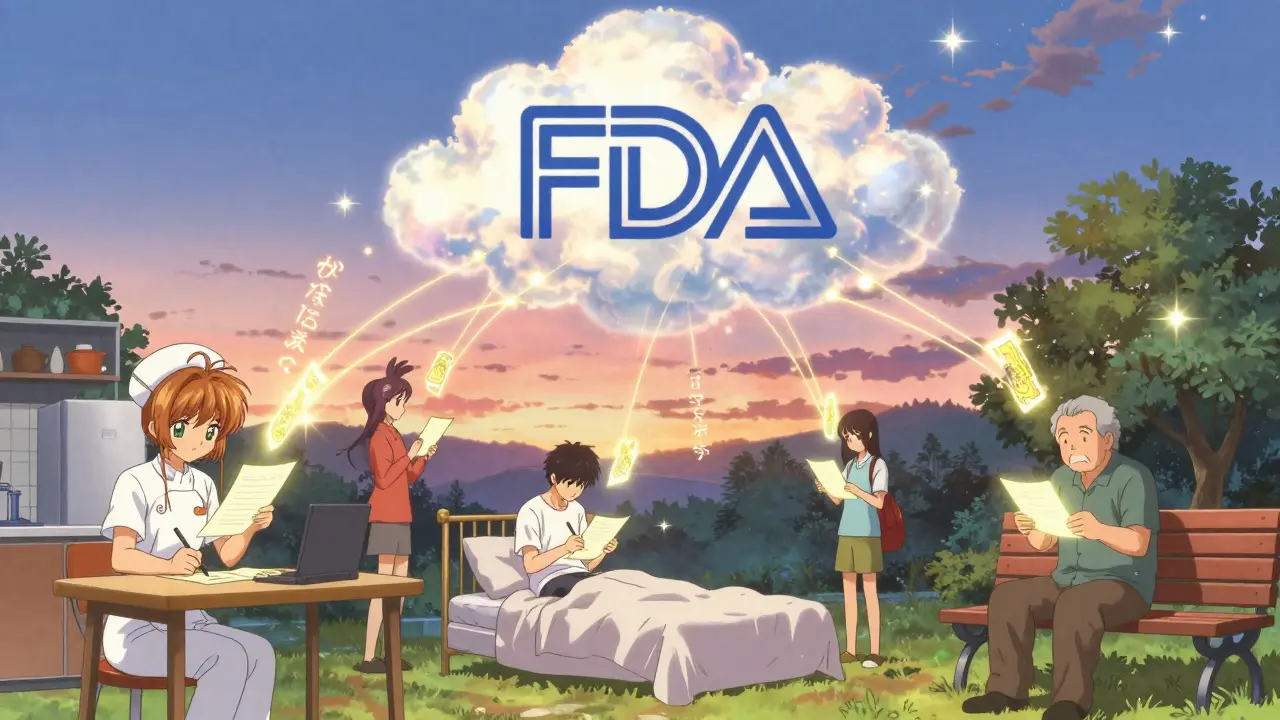
Barriers to Reporting - And How to Overcome Them
Many people don’t report because they believe:- “My doctor will report it.” - False. Only 3.2% of community pharmacists report side effects. Doctors are overloaded. They may not even know how.
- “It’s not serious enough.” - The FDA says: report anything unexpected. Mild side effects add up. They reveal patterns.
- “I’ll get ignored.” - You won’t. The FDA doesn’t track who you are. Your report is anonymous unless you choose to share your name.
- “I don’t know how.” - The form takes 10-15 minutes. The phone line is staffed by trained professionals who guide you.
One 2023 study found 72% of patients didn’t know they could report. That’s a system failure - not your fault. But now you know.
What Happens After You Report
Your report goes into a database with millions of others. The FDA doesn’t respond individually - but they do analyze trends. If 50 people report the same rare reaction, the FDA may issue a safety alert. If a drug causes more harm than benefit, it can be pulled.Some reports lead to label changes. Others help doctors warn future patients. One 2022 report from a patient about severe muscle pain after a statin drug helped update guidelines for monitoring muscle enzyme levels. That change could prevent harm for thousands.
And here’s the quiet win: when you report, you help others like you. You’re not just protecting yourself - you’re protecting the next person who takes that same pill.

What’s Changing - And What’s Coming
The system is slowly getting better. Since 2022, every prescription drug label must include the 1-800-FDA-1088 number. That’s helped increase direct patient reports by 18%.In 2023, the FDA started testing AI tools in electronic health records. These tools scan patient notes for phrases like “feeling weird on this med” or “can’t sleep since I started X.” In pilot tests, they found 27% more potential side effects than traditional reporting.
By 2024, the FDA’s Sentinel Initiative will analyze data from 300 million patient records - pulling real-time signals from pharmacies, hospitals, and insurers. This means fewer people will need to report manually. But until then - your voice still matters.
Final Thought: You’re Not Just a Patient. You’re a Watchdog.
Medication safety isn’t just about science. It’s about people speaking up. You don’t need to be loud. You don’t need to be angry. You just need to be honest. Tell your doctor. Fill out the form. Call the number. It takes less time than scrolling through social media.Someone out there is taking the same drug you are. And they might be suffering silently. Your report could be the one that helps them - and thousands like them.
Can I report side effects if I’m not the patient?
Yes. Family members, caregivers, nurses, or pharmacists can report on behalf of a patient. Just indicate your relationship to the patient on the form. The FDA accepts reports from anyone who has firsthand knowledge of the reaction.
Do I need proof or lab results to report?
No. The FDA doesn’t require lab reports, imaging, or medical records. Just describe what happened - when, how long it lasted, and how it affected daily life. Even vague descriptions like “I felt like I couldn’t get out of bed” are useful if they’re new or unusual.
What if I report and nothing happens?
That’s okay. Most reports don’t lead to immediate action - but they add to the data. One report might not change anything. But 100 reports about the same side effect? That’s a signal. The FDA looks for patterns over time. Your report is part of a larger system that protects everyone.
Can I report a side effect from an over-the-counter (OTC) drug?
Yes. OTC drugs, supplements, and even herbal products can be reported. Use the same MedWatch form or call 1-800-FDA-1088. The FDA tracks reactions to all products regulated under its jurisdiction.
Will reporting get me in trouble with my doctor?
No. Reporting side effects to the FDA is a patient right, not a complaint against your provider. Doctors are encouraged to support reporting. In fact, the American Medical Association says physicians have an ethical duty to report suspected adverse reactions - even if they’re unsure.









Christopher Brown February 25, 2026
This is why America’s healthcare system is broken. You have to jump through hoops just to report a side effect. Meanwhile, Big Pharma is laughing all the way to the bank. I’ve been on five different meds in the last three years. Each one came with a new set of weird symptoms. No one listens until it’s too late. The FDA? They’re a joke. They wait for 100 reports before doing anything. By then, half the people who took it are already dead or disabled.
Stop pretending this is about safety. It’s about liability. And we’re the cannon fodder.
Sanjaykumar Rabari February 26, 2026
They are watching us. Every report you make goes into a database. Who owns that database? Who has access? I read once that the same company that makes the drug also helps run the reporting system. It’s not about safety. It’s about control. They want to know who is taking what. They want to know what you feel. They want to know if you’re angry. They want to know if you’re going to talk. This is surveillance dressed as help. Don’t be fooled.
Kenzie Goode February 27, 2026
I just want to say how much this piece moved me. I took a new antidepressant last year and felt like I was slowly dissolving. My hands shook. My thoughts turned to static. I thought I was going crazy. I didn’t report it because I was ashamed - like I was being dramatic. But reading this? I realized I wasn’t weak. I was awake.
I called 1-800-FDA-1088 last week. Took me 12 minutes. I cried after hanging up. Not because I was sad - because I finally felt like I mattered. Thank you for writing this. You gave me back my voice.
Dominic Punch February 28, 2026
Let me break this down for anyone still unsure. Reporting side effects isn’t just a nice thing to do - it’s your civic duty. Think of it like voting, but for your body. Every report is a brick in the wall that protects the next person. I’ve worked in clinical research for 15 years. I’ve seen how data gets ignored until it’s too late. The 1% who report? They’re the unsung heroes.
And yes - even if it’s just ‘weird taste’ or ‘mild dizziness’ - report it. The FDA doesn’t care if you’re a doctor. They care if you’re alive. Your experience is data. Data saves lives.
Also - if you’re a caregiver reporting for someone else? You’re doing god’s work. Keep going.
Valerie Letourneau March 1, 2026
As a Canadian, I must commend the clarity and thoroughness of this guide. While our own pharmacovigilance system operates under Health Canada, the principles remain identical: transparency, patient agency, and data integrity. I have personally submitted two reports - one regarding a herbal supplement that induced arrhythmia, another concerning an OTC pain reliever that caused prolonged vertigo.
Though the process is admittedly bureaucratic, the underlying ethos - that individual experience holds collective value - is profoundly democratic. I encourage all citizens, regardless of nationality, to participate. Not because it is easy, but because it is necessary.
Khaya Street March 2, 2026
Look, I get it. Reporting is important. But let’s be real - most of us are working two jobs, raising kids, and trying not to drown in bills. You’re telling me I should take 15 minutes to fill out a form when I can barely find time to shower?
Yeah, I’ll do it… eventually. Maybe next month. Or when I’m not on the phone with my insurance company again. This isn’t apathy - it’s exhaustion. The system should make reporting effortless. Not add another chore to the pile.
Brooke Exley March 3, 2026
OMG I JUST REPORTED MY PAXLOVID MOUTH. I THOUGHT I WAS THE ONLY ONE. I WAS SO EMBARRASSED TO SAY ‘MY TONGUE TASTES LIKE A BATTERY’ TO MY DOCTOR.
Turns out 12,000 other people felt it too. That’s wild. I didn’t know my weird little symptom could help someone else feel less alone. I’m crying. I’m proud. I’m telling everyone I know to do this. You’re not weird. You’re a scientist. Your body is data. And data changes the world.
Lisandra Lautert March 3, 2026
Incorrect use of hyphen in ‘colorful/creative’ - should be ‘colorful-creative’ per AP Style. Also, ‘说明书’ is not properly italicized or translated. And ‘1 out of 10,000’ lacks proper citation. This article is emotionally compelling but structurally sloppy.
Cory L March 3, 2026
Just reported my weird joint pain from that new cholesterol med. Took 8 minutes. Felt like I just punched a hole in the wall. Didn’t expect anything to happen. But now? I’m hooked. I’m gonna report every weird thing - the weird dreams, the tingling toes, the sudden urge to eat pickles at 3am. If this is how we fight back? Sign me up. We’re not patients. We’re sensors. And we’re wired.