
Medication Adherence Calculator
This tool calculates your medication adherence percentage based on your actual doses taken versus prescribed schedule. Understanding your adherence level helps you have more informed conversations with your provider about sustainable treatment.
Your Results
Imagine this: you’ve been prescribed a new medication to manage your blood pressure, diabetes, or chronic pain. Your doctor says it’s life-saving. You believe them. But then the side effects start-drowsiness that makes you miss work, nausea that ruins dinner with your family, or frequent bathroom trips that turn a night out into a stressful ordeal. You skip a dose. Then another. Not because you don’t care, but because you’re trying to hold onto something more important: your life.
Why Taking Pills Isn’t as Simple as It Sounds
Medication adherence isn’t just about remembering to take your pills. It’s about deciding, every single day, whether the trade-off is worth it. The World Health Organization defines adherence as how closely your actions match what you and your provider agreed on. That’s key: it’s a conversation, not a command. And in real life, that conversation often gets messy.Here’s the hard truth: about half of people with chronic conditions don’t take their meds as prescribed. Not because they’re lazy or rebellious. But because the side effects make them feel worse than the disease sometimes. A study from PatientsLikeMe found that 42% of patients with long-term illnesses intentionally changed their dosing to avoid side effects that ruined their daily routines. Drowsiness. Dry mouth. Sexual dysfunction. Gastrointestinal pain. These aren’t rare side effects-they’re common, and they directly steal from your quality of life.
And it’s not just about feeling bad. Skipping doses because you can’t afford the pills? That’s 25% of Americans. Forgetting because your regimen has five different pills at three different times a day? That drops adherence by 26% for every extra dose. A once-daily pill? You’re more likely to take it. A three-times-daily one? You’re more likely to give up.
What Happens When You Don’t Take Your Meds
It’s easy to think, “I’ll just skip one dose-it won’t matter.” But the numbers don’t lie. Non-adherence causes 125,000 deaths in the U.S. every year. It’s responsible for 10 to 25% of hospital admissions. And it costs the system between $100 billion and $289 billion annually in avoidable care.For someone with high blood pressure, skipping meds means a 2.5 times higher risk of heart attack. For someone with diabetes, it means a 28% spike in A1c levels and a 29% higher chance of nerve damage, kidney failure, or vision loss. These aren’t theoretical risks. These are real outcomes for real people who made a choice-often quietly, often alone-because the cost of taking the pill felt too high.
But here’s what most providers don’t tell you: perfect adherence isn’t always the goal. The FDA admits that rigid adherence targets can interfere with quality of life. And patient advocates say that demanding 95%+ adherence ignores the fact that people have lives to live. Sometimes, taking 80% of your pills-and keeping your energy, your dignity, your social life-is a better outcome than taking 100% and becoming a shadow of yourself.
The Real Barriers Nobody Talks About
Cost is obvious. But other barriers are invisible until you’re in the middle of them.Let’s say you’re on a diuretic for heart failure. You’re told to take it in the morning. But you’ve got a big family dinner planned for Saturday night. Do you take it and risk spending the evening in the bathroom? Or skip it and risk fluid buildup? Most people skip it. And their doctor calls it non-compliance.
Or you’re on a painkiller that makes you foggy. You’re supposed to take it every six hours. But your kid’s school play is at 7 p.m. Do you take it and miss the moment? Or hold off and feel the pain? Many choose the pain. And then they feel guilty.
These aren’t failures. They’re adaptations. And they’re happening every day. A Reddit thread with over 1,200 chronic pain patients showed that 68% deliberately reduced opioid doses before family events to be more present-even if it meant more pain later. They weren’t breaking rules. They were negotiating with their illness.
How Providers Are (Finally) Starting to Listen
The old model was: “Take your pills. That’s the rule.” The new model? “Let’s figure out what works for you.”Some doctors are now doing something called a “brown bag review”-asking patients to bring all their meds to the appointment. In 63% of cases, this uncovers adherence issues no one knew about. Maybe the patient stopped taking a pill because it made them dizzy. Maybe they’re splitting pills to save money. Maybe they’re taking two different blood pressure meds because two different doctors prescribed them.
Other changes are simple but powerful:
- Switching from daily pills to weekly injections (like methotrexate for rheumatoid arthritis) boosted adherence from 55% to 92% in one patient’s case.
- Adjusting insulin timing to match work hours increased adherence by 37% in diabetic patients.
- Using pill organizers helped some people-but only if they had the energy or memory to fill them. For others, it added stress.
And the most effective tool? Conversation. Not lectures. Not reminders. Shared decision-making. When providers ask, “What’s the hardest part about taking this?” instead of “Why aren’t you taking your meds?”-adherence improves by 24%.
What You Can Do Right Now
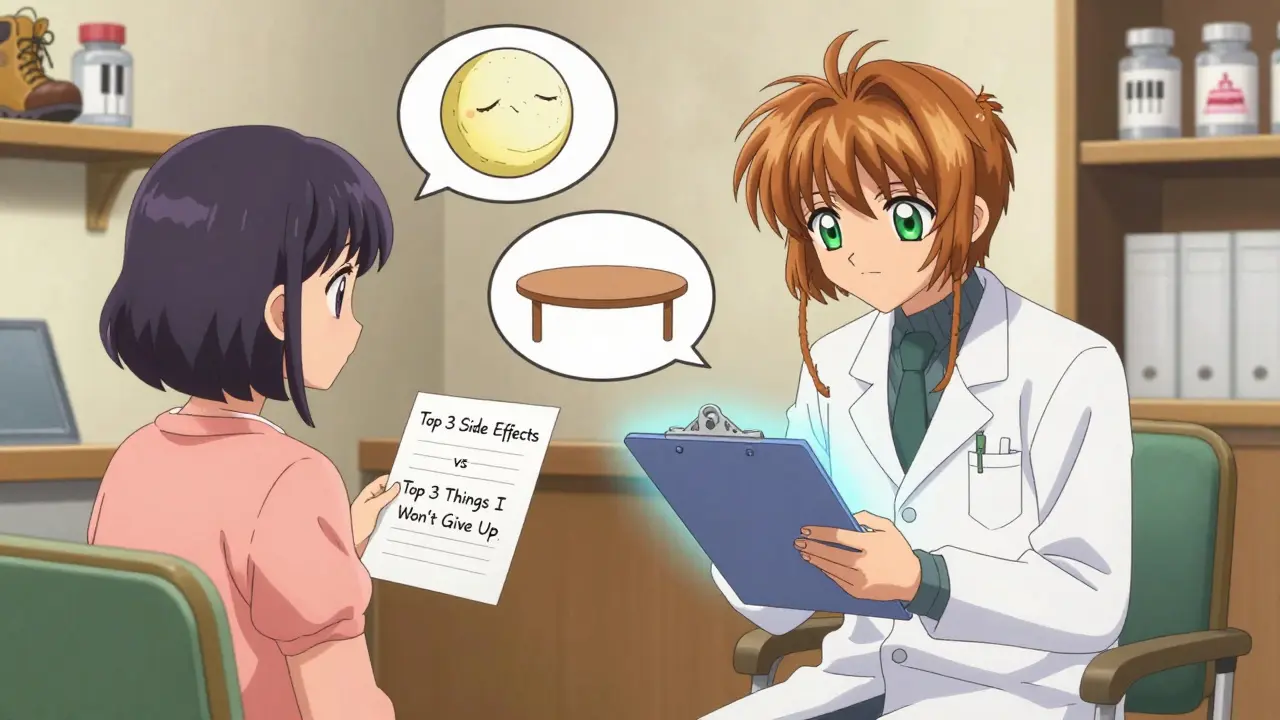
You don’t need a perfect system. You need a realistic one.Start with this: write down the top three side effects that bother you most. Then, write down the top three things you refuse to give up-family dinners, weekend hikes, sleeping through the night. Bring both lists to your next appointment.
Ask your provider:
- “Is there a version of this drug with fewer side effects?”
- “Can we try a once-daily option?”
- “What happens if I take it every other day instead?”
- “Are there programs to help lower the cost?”
Don’t be afraid to say: “I want to take this, but I can’t live like this.” That’s not defiance. That’s honesty. And it’s the first step toward a plan that actually works.

The Future of Adherence Isn’t Tech-It’s Trust
There are smart pill bottles, apps that remind you, and even ingestible sensors that tell doctors when you swallowed your pill. But here’s the catch: 68% of patients refuse to use sensors because they feel spied on. Tech won’t fix this if it doesn’t respect autonomy.The real breakthroughs are happening where patients and providers sit down and say: “What matters most to you?”
One 2023 study called this “adherence tailoring.” Instead of demanding 100% compliance, they asked patients: “Which doses are you willing to take? Which ones can we adjust?” The result? 41% higher adherence than standard care. Why? Because patients felt heard. They weren’t fighting the system-they were working with it.
That’s the future. Not perfect adherence. Personalized sustainability.
It’s Not About Taking More Pills. It’s About Living Better.
Medication adherence isn’t a number on a chart. It’s a daily act of survival and self-respect. You’re not failing if you skip a dose to go to your granddaughter’s birthday. You’re not weak if you can’t handle the fatigue from your heart meds. You’re human.And your provider should be helping you navigate that-not judging you for it. The goal isn’t to take every pill. The goal is to stay alive, and still enjoy your life while you’re here.
That’s the balance. That’s the hard truth. And that’s the only kind of adherence that lasts.
What is the 80/80 rule in medication adherence?
The 80/80 rule is a population-level metric used by health systems to measure adherence. It means that if 80% of patients in a group take their medication for at least 80% of the days in a given period, the group is considered adherent. This doesn’t mean every individual must hit 80%-it’s a broad health system benchmark to track overall performance, not individual compliance.
Is 80% adherence good enough?
For most chronic conditions, yes. Studies show that patients taking at least 80% of their prescribed doses still get significant health benefits and avoid most complications. Perfect adherence (100%) is rarely necessary-and sometimes unrealistic. The goal is to find the highest adherence level you can maintain without sacrificing your daily life. For many, that’s 80%.
Why do side effects make people stop taking their meds?
Side effects directly interfere with daily functioning. Drowsiness can mean missing work or not being able to drive. Nausea can ruin meals and social events. Frequent bathroom trips can make outings stressful. When the medication makes you feel worse than your condition, it’s natural to question whether it’s worth it. These aren’t irrational choices-they’re survival decisions.
Can I adjust my dose on my own?
Never change your dose without talking to your provider first. But you can and should tell them what you’re struggling with. Many medications have flexible dosing options-like switching from twice-daily to once-daily, or adjusting timing to fit your schedule. Your provider can help you find safer alternatives instead of guessing on your own.
What’s the best way to talk to my doctor about side effects?
Be specific. Instead of saying, “This medicine makes me feel bad,” say, “I’ve been skipping my evening pill because it makes me too tired to play with my kids.” Offer context. Bring a list of what you’re missing out on. Ask, “Is there another option that might help me keep doing the things I love?” This turns a complaint into a collaboration.
Are there cheaper alternatives if I can’t afford my meds?
Yes. Ask your pharmacist about generic versions, patient assistance programs from drug manufacturers, or discount cards like GoodRx. Some clinics offer sliding-scale pricing. Medicare and Medicaid may cover more than you think. Don’t skip doses to save money-ask for help instead. Many people don’t realize these options exist until they ask.
Do pill organizers really help with adherence?
They help some people-especially those on multiple daily meds-but not everyone. If you’re already overwhelmed or forgetful, filling a weekly organizer can feel like another chore. For others, it’s a lifeline. The key is to try it without pressure. If it adds stress, drop it. There are other tools-like phone alarms or pharmacy blister packs-that might work better for your lifestyle.
What Comes Next?
If you’re struggling with your meds, you’re not alone. And you’re not failing. The system is still catching up to the fact that people aren’t robots-they have lives, emotions, and limits.Start small. Pick one thing: write down your top side effect. Write down one thing you love doing that the meds are stealing. Then, bring both to your next appointment. That’s your first step toward a treatment plan that doesn’t just save your life-it lets you live it.










Brady K. January 2, 2026
Let’s be real - adherence is just a fancy word for ‘obey the system.’ But here’s the kicker: the system doesn’t give a damn about your life. It cares about metrics, compliance rates, and quarterly reports. You’re not a number - you’re a human with a kid’s school play, a date night, and a damn right to sleep through the night. The 80/80 rule? That’s not a guideline, it’s a lifeline for people who refuse to let pharma dictate their existence. Stop glorifying perfection. Start celebrating sustainability.
Kayla Kliphardt January 3, 2026
I’ve been on five meds for three years. I skip one every now and then - not because I’m lazy, but because I need to feel like me. I don’t know if that’s ‘adherence’ by the book, but it’s the only way I’ve stayed sane. I wish my doctor had asked me what I was losing instead of just asking why I wasn’t taking it.
John Chapman January 5, 2026
YES. THIS. 🙌 I was on a med that made me feel like a zombie. My wife said I stopped laughing. I skipped doses for weeks. Then we switched to a once-daily version - and boom. I went from ghost to human again. My doctor didn’t judge. He just asked, ‘What do you want your life to look like?’ That’s all it took. 💪💊 #LivingNotJustSurviving
Urvi Patel January 6, 2026
Adherence is a Western construct. In developing nations we don’t have the luxury of choosing between side effects and dignity. We take what we can get. Your privileged discourse about ‘quality of life’ is tone deaf. If you can afford to skip meds because of drowsiness, you’re already winning. Most of us are choosing between food and pills.
Bennett Ryynanen January 8, 2026
I used to think skipping doses was weak. Then my dad had a stroke because he stopped his blood pressure med to avoid dizziness - so he could drive his grandkids to school. He didn’t want to be a burden. He wanted to be a grandpa. That’s not non-compliance. That’s love. And we need to stop calling it a failure.
Chandreson Chandreas January 9, 2026
It’s funny how we treat meds like magic bullets. But the body isn’t a machine. It’s a messy, emotional, tired, beautiful thing. I take my pills when I can. Skip them when I need to breathe. My doctor knows. We don’t talk about percentages. We talk about Sundays. Sundays matter more than pill counts.
Darren Pearson January 10, 2026
While the sentiment expressed in this article is commendable, it fundamentally misunderstands the clinical imperative of pharmacological adherence. Deviations from prescribed regimens, even when contextually justified, introduce confounding variables into longitudinal outcome studies and compromise population-level public health metrics. The notion that ‘80% is good enough’ is statistically dangerous and ethically irresponsible in the context of chronic disease management.
Brandon Boyd January 12, 2026
My mom took her diabetes meds for 10 years. Then she started skipping them on weekends so she could dance with my dad at their 50th anniversary party. She didn’t die. She lived. And she danced. That’s not a failure. That’s a win. Doctors need to stop treating patients like robots and start treating them like people. You don’t need a smart pill bottle. You need someone who asks, ‘What do you miss?’
Frank SSS January 13, 2026
Look, I get it. You want to feel heard. But here’s the truth - if you’re skipping meds because you don’t like the side effects, you’re gambling with your life. The system’s flawed, sure. But your choices have consequences. 125,000 deaths a year? That’s not a statistic. That’s your neighbor. Your cousin. Your mom. Stop romanticizing non-adherence. It’s not rebellion. It’s risk.
Paul Huppert January 15, 2026
I just wanted to say thank you for writing this. I’ve been scared to talk to my doctor about how tired I get. I thought I was the only one. Reading this made me feel less alone.
Hanna Spittel January 17, 2026
They’re putting sensors in your pills to spy on you?? 😏 Classic Big Pharma. Next they’ll microchip your coffee cup so they know you’re not skipping your heart med with your morning latte. Wake up people. They don’t care if you live - they care if you pay for the sensor.
anggit marga January 18, 2026
Why are Americans so obsessed with pills? In Nigeria we fix things with food, prayer and rest. You think a pill can fix your life? Your ancestors didn’t need 5 meds a day to live. You’re weak. You’ve been sold a lie. Stop taking the poison. Go back to the earth.
Joy Nickles January 18, 2026
Okay but… what if you’re just… lazy?? Like I get the side effects thing… but sometimes… I just… forget… and then I feel guilty… and then I don’t take them for a week… and then I’m like… ‘maybe I’m just not cut out for this’… and then I cry… and then I take one… and then I feel better… and then I do it again… is that… normal??
Brady K. January 20, 2026
Wow. So now we’re blaming the patient for being human? You want me to die on a spreadsheet while my doctor gets a bonus for hitting 95% adherence? You’re not a clinician. You’re a corporate KPI bot. The FDA admits rigid targets harm quality of life. You’re arguing against the agency that regulates your damn pills. Take a breath. Talk to someone who’s actually living this.