Why Patients Doubt Generic Medications
It’s not about price. It’s not even about science. When a patient looks at their new prescription and sees a pill that’s a different color, shape, or size than what they’re used to, their mind jumps to the worst conclusion: this isn’t the same drug. And they’re not wrong to feel that way-because they’ve been told, implicitly or explicitly, that brand names mean quality. That’s the real problem.
Thirty-two percent of patients have no idea that the FDA requires generics to be bioequivalent to brand-name drugs. Forty-three percent believe generics contain only 80% of the active ingredient. That’s not a knowledge gap-it’s a trust gap. And when a patient stops taking their blood pressure med because the pill looks different, or skips their diabetes drug because they think it’s "weaker," the consequences aren’t theoretical. Hospitalizations. Emergency visits. Higher costs. All preventable.
The Cost of Silence
Every time a pharmacist or doctor doesn’t explain why a generic was substituted, they’re not just missing an opportunity-they’re risking harm. The average primary care visit lasts 18 seconds before the doctor interrupts the patient. That’s not enough time to ask about fears, doubts, or past bad experiences. And when patients are left to figure it out on their own, they turn to Google. Or Reddit. Or a cousin who "heard something."
One patient on Reddit described switching from a blue oval pill to a white rectangle and thinking it was a completely different medication. Another stopped taking warfarin after a generic substitution without explanation-ended up in the hospital with a blood clot. These aren’t outliers. They’re the result of communication failure.
Meanwhile, generics save the U.S. healthcare system $313 billion a year. But if patients refuse to take them, that money disappears. And patients pay more-both financially and physically.
What Actually Works: The Ask-Tell-Ask Method
Simply saying, "This is cheaper," increases acceptance by just 7%. Saying, "It’s the same drug," drops trust by 22%. But when providers use the Ask-Tell-Ask method, acceptance jumps to 68%.
- Ask: "What are your thoughts about this switch?" or "Have you had any issues with generics before?"
- Tell: "This is the same active ingredient as your old pill. The FDA requires it to work the same way-within 80% to 125% of the brand name’s effect. It’s not a copy. It’s the same medicine, just without the brand name marketing costs."
- Ask again: "Can you tell me back what you understand so we’re on the same page?"
This isn’t just polite. It’s evidence-based. A 2020 study of over 1,200 patients showed this method doubled acceptance compared to standard counseling. And when patients explain it back in their own words, adherence rises from 54% to 81%.
Personal Endorsement: The Game-Changer
Patients don’t trust data. They trust people. And they trust people who speak like they’re one of them.
Providers who say, "I prescribe this for my own family," increase generic acceptance by 37 percentage points. That’s not a trick. It’s human. It’s vulnerability. It’s proof that the provider isn’t just selling a cost-saving measure-they’re making a personal choice.
One pharmacist in Ohio started saying, "My wife takes this same generic for her cholesterol. It’s worked perfectly for her for three years." Within six months, her generic acceptance rate went from 51% to 83%. No brochures. No posters. Just a simple, honest statement.
Visuals Beat Words Every Time
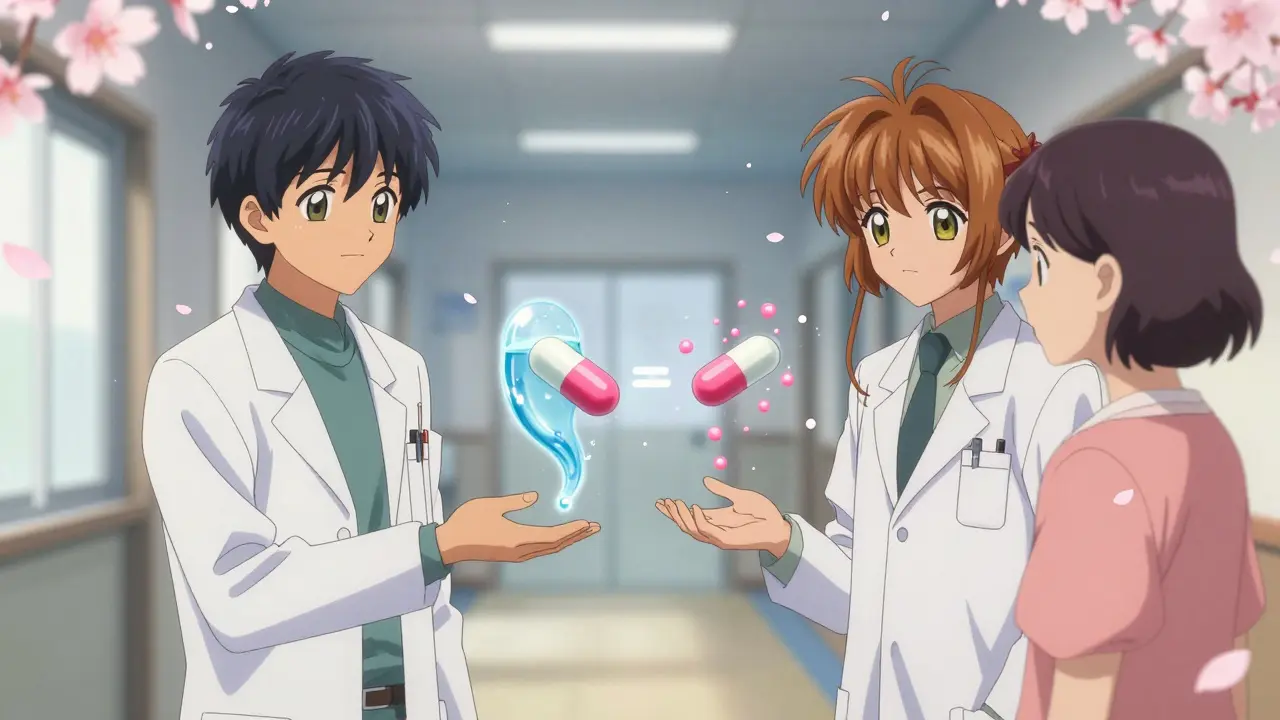
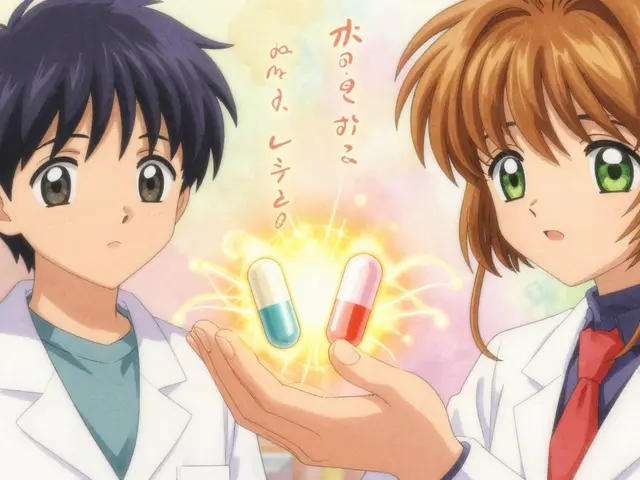
When patients see the difference in pill appearance, they panic. So show them the similarity.
The FDA’s new "Generics Smart" toolkit includes side-by-side images of brand and generic pills, side-by-side videos of manufacturing processes, and even 3D models showing how the active ingredient dissolves the same way in the body. In a pilot at 15 CVS pharmacies, using these visuals increased acceptance by 29%.
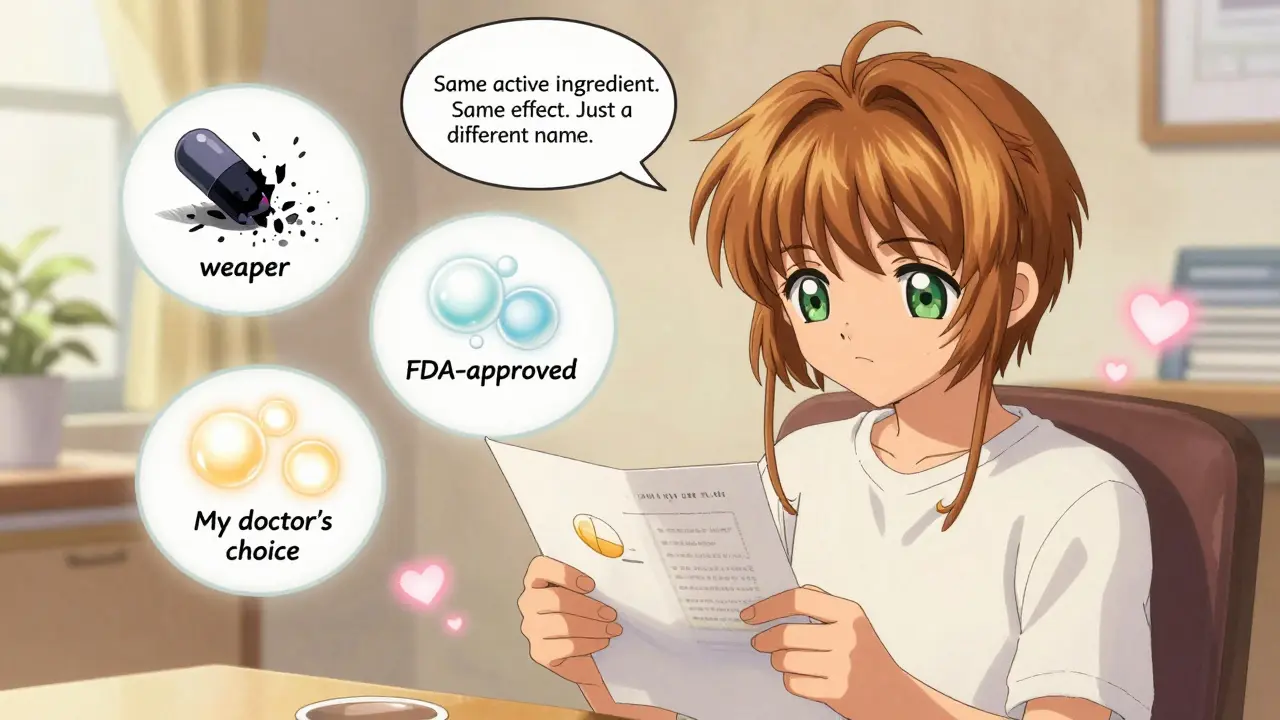
Patients don’t need to understand bioequivalence. They need to see it. A simple printout showing the two pills next to each other, with the note: "Same active ingredient. Same effect. Just a different name," works better than a 10-minute lecture.
Timing Matters More Than You Think
Most generic conversations happen at the pharmacy counter. Too late.
When education happens at the point of prescribing-when the doctor writes the script-89% of patients accept the switch. When it only happens at the pharmacy, that number drops to 63%. Why? Because by then, the patient has already imagined the worst.
Doctors should add a quick note to the prescription: "Generic substitution allowed. We’ve discussed this with you and believe it’s safe and effective." Even better: send a text or email before the patient even walks into the pharmacy.
Don’t Say "It’s the Same"-Say This Instead
Here’s what to say, and what to avoid:
- DO: "This contains exactly the same active ingredient, but without the brand name marketing costs."
- DO: "The FDA requires this to work just like the brand name. It’s not a substitute-it’s the same medicine."
- DO: "I’ve seen this work just as well for my patients as the brand."
- AVOID: "It’s cheaper." (Only helps 7%)
- AVOID: "It’s the same drug." (Triggers skepticism)
- AVOID: "Don’t worry about it." (Dismisses real concerns)
Teamwork Wins
When a doctor and pharmacist both speak up, acceptance jumps to 85%. That’s the highest rate seen in any study.
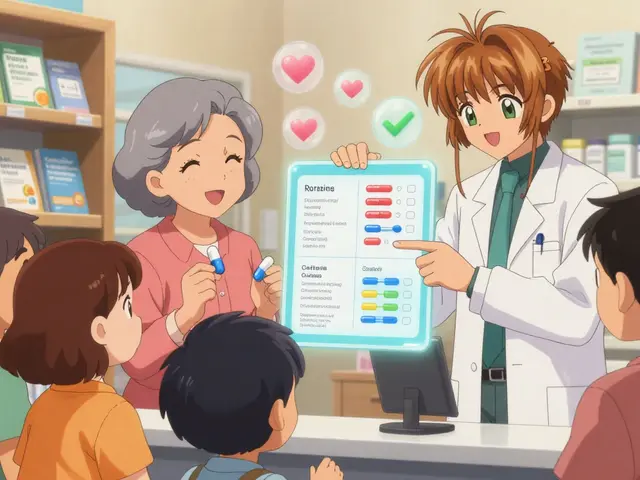
Here’s how it works: The doctor says at the visit, "I’m prescribing the generic version of your medication because it’s just as effective and saves you money." Then, the pharmacist says, "I saw your doctor’s note. I just wanted to confirm this is the same medicine you’ve been taking-just without the brand name. Here’s a picture so you can see how it compares."
This isn’t extra work. It’s coordination. Electronic health records now have prompts to remind providers to mention generics at the time of prescribing. Pharmacies can flag patients who’ve refused generics before and schedule a quick follow-up call.
What to Do When Patients Say, "It Didn’t Work for Me Before"
Some patients swear generics didn’t work. Maybe they switched brands and had side effects. Maybe they got a different generic from a different manufacturer. Or maybe they just felt worse after the switch.
Don’t argue. Don’t say, "That’s impossible." Say: "I hear you. That must’ve been scary. Let’s figure out what happened."
Then ask: "Was it the same pill every time? Did the color or shape change? Did you notice any difference in how you felt?"
Chances are, it wasn’t the generic-it was a change in manufacturer, or a different inactive ingredient. Maybe the pill had a new coating that changed how fast it dissolved. That’s not a failure of the generic system. That’s a failure of communication. And it’s fixable.
Tools You Can Use Today
You don’t need a budget to make a difference. Here’s what works right now:
- Print out FDA-approved side-by-side pill images from the FDA’s website (free, updated May 2023)
- Keep a simple one-pager on bioequivalence in your waiting room
- Use the VALUE technique: Validate concerns, Acknowledge feelings, Listen actively, Understand perspective, Educate with empathy
- Record a 60-second video explaining generics-play it on a tablet in the pharmacy
- Ask patients: "What would make you feel more comfortable with this switch?"
What’s Coming Next
By 2028, if we get this right, generic use could rise from 90.9% to 94.5%-adding $47 billion in savings. But it won’t happen by accident.
The FDA now requires all generic substitution conversations to be documented in patient records using standardized terms, starting January 2024. Medicare’s Star Ratings now include generic acceptance as a quality metric. AI tools are being tested to tailor messages based on patient beliefs. And a $2.3 million NIH study is exploring personalized communication strategies.
But the biggest change? It’s not technology. It’s mindset. We’re not just dispensing pills. We’re building trust. And that takes time, empathy, and the courage to say the right thing-even when it’s hard.
Why do patients think generics are less effective?
Patients often believe generics are less effective because of differences in pill appearance, misleading online information, or past negative experiences with switching brands. Many don’t know the FDA requires generics to have the same active ingredient and work the same way as brand-name drugs. A 2021 study found 43% of patients mistakenly think generics contain only 80% of the active ingredient. These are misconceptions-not facts-and they’re fueled by lack of clear, consistent communication.
Is it true that generics are made in worse facilities?
No. The FDA inspects all manufacturing facilities-brand and generic-using the same standards. In fact, many brand-name companies make their own generics. A 2022 FDA report showed that over 50% of generic drugs are produced by the same companies that make the brand-name versions. The only difference is the label and the price. The active ingredient, manufacturing process, and quality controls are identical.
How long should a pharmacist spend explaining generics?
The American College of Clinical Pharmacy recommends 3 to 5 minutes per patient for meaningful generic substitution discussions. That’s enough time to listen to concerns, show visuals, and use the Ask-Tell-Ask method. While time is tight, even a 90-second conversation using the right phrases can significantly increase acceptance. The key isn’t length-it’s quality. A focused, empathetic 2-minute talk beats a rushed 10-minute monologue.
Can generics cause different side effects?
The active ingredient in generics is identical to the brand name, so the same side effects can occur. But sometimes, inactive ingredients-like fillers or coatings-differ between brands. These can affect how fast the drug is absorbed, which may cause temporary changes in how a patient feels. For example, a patient might feel nauseous if a new coating dissolves faster. This isn’t a failure of the generic-it’s a variation in formulation. If this happens, the pharmacist can help switch to another generic version with a similar inactive profile.
What should I do if a patient refuses a generic?
Don’t force it. Ask why. Listen. Document their concern. Then offer options: "Would you be open to trying a different generic manufacturer?" or "Would you like me to call your doctor to see if we can stick with the brand for now?" Sometimes, patients just need to feel heard. If they still refuse, respect that-but make sure they understand the cost and potential impact on adherence. Follow up in a week. Many patients change their minds after seeing the pill and talking to someone they trust.
Are there any groups more likely to hesitate about generics?
Yes. Patients over 65 are nearly twice as likely to express concern compared to younger adults. Rural patients also show higher hesitation-47% versus 29% in urban areas. This often ties to less access to consistent care, lower health literacy, or past experiences with inconsistent medication quality. Tailoring communication-using simpler language, visuals, and trusted messengers like family members or community health workers-can help bridge these gaps.


Beth Cooper January 30, 2026
I've been taking generics for 12 years and my blood pressure is still out of control. Coincidence? I don't think so. The FDA doesn't test them like they do brand names. I've seen the factory videos. They're using the same machines that made my grandma's aspirin in 1987. And don't get me started on the fillers. Some of those generics have more sugar than my toddler's cereal.
Donna Fleetwood January 31, 2026
This is so important!! I used to be scared of generics too until my pharmacist sat down with me and showed me the side-by-side pics. Turns out my cheap pill is literally the same inside. I cried. Not because I saved money (though that helped) but because I finally felt heard. We need more people like her. 🙌
Melissa Cogswell January 31, 2026
The Ask-Tell-Ask method is gold. I've used it in my clinic for 3 years now. Patients who explain it back to me in their own words? They're 3x more likely to refill. I keep printed FDA pill comparisons on my desk. Even just pointing at them while saying 'same active ingredient' cuts confusion in half. No fancy tech needed.
Diana Dougan January 31, 2026
LMAO so the 'same drug' phrase triggers skepticism? Wow. Maybe because it's not the same? I mean, if it was identical, why do they look different? Why do they cost 10x less? Maybe because the brand name is the real thing and the generic is just a knockoff with different dyes? Also, who cares if it's 80-125%? That's a 45% swing. That's not medicine, that's Russian roulette.
Bobbi Van Riet February 2, 2026
I had a patient once who swore her generic lisinopril made her dizzy. She was convinced it was poison. So I asked her what changed when she switched - turns out the new pill had a different coating and dissolved faster, so she got a spike in blood pressure drop right after eating. We switched her to a different generic with the same coating as her old one and boom - problem solved. It wasn't the generic. It was the filler. And no one ever told her that. We need to stop treating patients like they're dumb. They're just not given the right info.
Holly Robin February 2, 2026
THIS IS A PHARMA CONSPIRACY. THEY WANT YOU TO TAKE CHEAP PILLS SO THEY CAN CONTROL YOUR HEALTH. THEY OWN THE FDA. THEY OWN THE DOCTORS. THEY OWN THE PHARMACISTS. YOU THINK THEY CARE IF YOU GET A BLOOD CLOT? NO. THEY MAKE MORE MONEY WHEN YOU'RE IN THE HOSPITAL. THAT'S WHY THEY PUSH GENERICS. THEY'RE NOT SAFE. THEY'RE NOT THE SAME. THEY'RE DESIGNED TO FAIL SO YOU COME BACK FOR MORE. I SAW A VIDEO ON TIKTOK ABOUT A WOMAN WHO DIED FROM A GENERIC. THEY'RE COVERING IT UP. I'VE BEEN WARNED.
Shubham Dixit February 3, 2026
In India we have been using generics for decades. We don't have the luxury of brand names. But here's the truth - the quality is not always consistent because of poor regulation. The FDA is better. But if you think Americans are the only ones who don't understand generics, you're wrong. In rural India, people think if the pill is small and white, it's weak. They ask for the blue one because it's 'stronger'. Same problem. Same solution. Talk. Show. Listen. Not money. Not ads. Just human connection.
KATHRYN JOHNSON February 4, 2026
The data presented here is statistically significant but methodologically flawed. The 68% acceptance rate is not causal - it's correlational. No control group for provider experience, patient literacy, or medication class. Furthermore, the 'personal endorsement' metric is ethically dubious. A physician's anecdotal statement about their family's medication use constitutes an unverified testimonial. This is not evidence-based practice - it's emotional manipulation disguised as communication.
Sazzy De February 5, 2026
I just started taking a generic for my thyroid and I was nervous but the pharmacist showed me the pill comparison and said 'same stuff, different wrapper' and I was like ohhh. That's it. No lecture. No jargon. Just real talk. I'm good now.
Blair Kelly February 5, 2026
This article is a corporate shill. They're trying to normalize the idea that your medicine can be swapped out like a soda can. What happens when the generic manufacturer changes again? Or when the inactive ingredient causes an allergic reaction? No one's tracking that. No one's responsible. The FDA just says 'close enough' and moves on. Meanwhile, people are dying quietly because no one wants to admit the system is broken.
Rohit Kumar February 6, 2026
In Indian philosophy, we say 'form is illusion'. The pill's color, shape, or brand is maya - a temporary appearance. What matters is the essence - the active molecule. The body does not care if it was made in Ohio or Hyderabad. It only responds to the chemical structure. The fear is cultural, not scientific. We must teach not just the mind, but the soul - that healing is not branded.
Lily Steele February 7, 2026
My grandma refused her generic blood pressure med for 6 months. She said it made her feel 'off'. We didn't push. We just got her the same generic but from a different maker. Same pill, different look. She took it without asking. Didn't even notice. Sometimes it's not about the science. It's about the packaging.
Gaurav Meena February 9, 2026
I work in a rural clinic in Bihar. Our patients are often illiterate. We use simple drawings - a blue pill and a white pill with a big checkmark in between. We say 'same medicine, same help, less money'. No jargon. No FDA. No science. Just truth. And guess what? Acceptance went from 40% to 80% in 4 months. You don't need a PhD to fix this. You need a heart.
Jodi Olson February 10, 2026
The reliance on anecdotal evidence and emotional appeals in this piece undermines the very principles of evidence-based medicine. While the communication strategies may yield short-term compliance, they do not address the epistemological foundation of therapeutic trust. The patient's perception of equivalence must be grounded in verifiable pharmacokinetic data, not the charisma of a pharmacist or the aesthetic of a printed image.
Carolyn Whitehead February 11, 2026
I used to hate generics too until I got my first one and realized I felt the same. I guess I just needed to see it for myself. Now I tell my friends: if it works, it works. No need to overthink it.