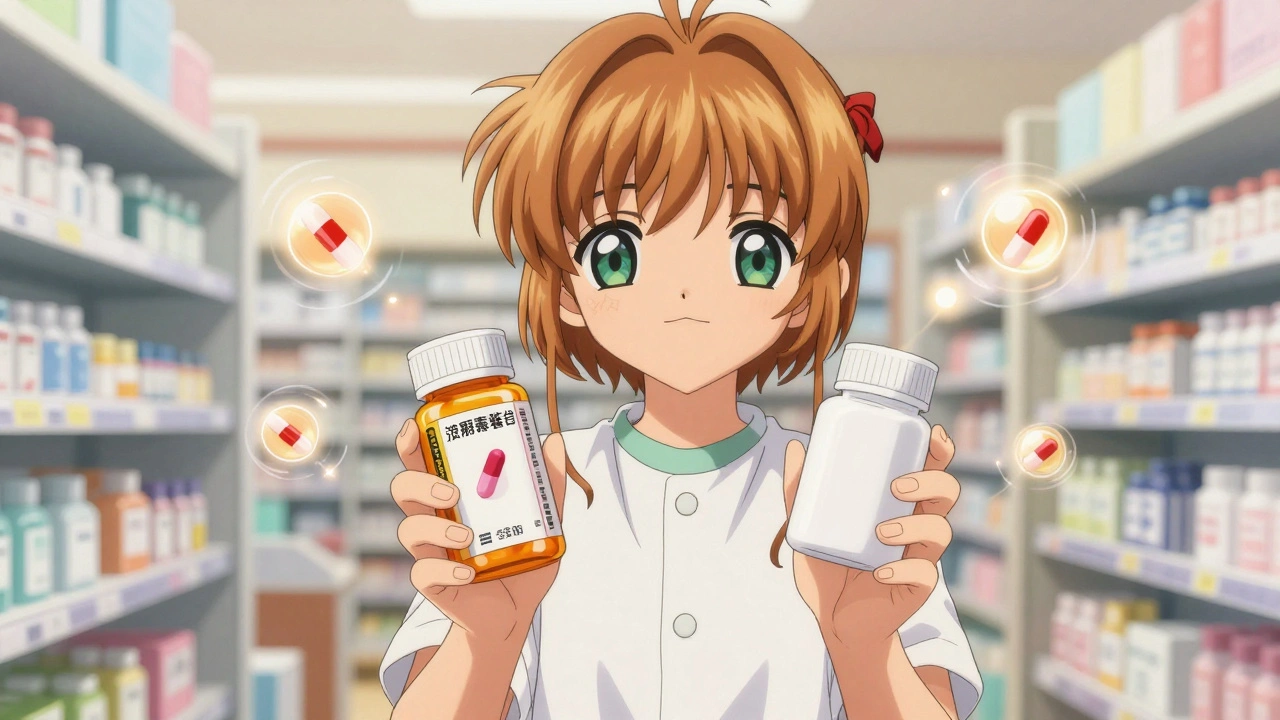
Let’s say you pick up your prescription and the pill looks totally different from last time. Same bottle, same name, but it’s a different color, shape, or size. You might panic. Did they give you the wrong medicine? Is this cheaper stuff going to work at all? You’re not alone. Most people have this moment-especially when they see a big drop in their co-pay. The truth? You probably got a generic medication. And it’s just as safe and effective as the brand-name version you’ve been taking.
Why Generic Drugs Are Just as Good
The U.S. Food and Drug Administration (FDA) doesn’t let just any company slap a label on a pill and call it a generic. To get approved, a generic drug must have the exact same active ingredient, strength, dosage form, and route of administration as the brand-name drug. It must also work the same way in your body. That’s not a suggestion-it’s a legal requirement. Studies show generics are bioequivalent to brand-name drugs, meaning they’re absorbed into your bloodstream at nearly the same rate and to the same extent. The FDA allows a tiny variation-up to 20%-in how quickly the drug enters your system. In reality, most generics fall within just 3.5% of the brand-name version. That’s like driving 60 mph instead of 61. You’re still getting where you need to go. You might notice differences in the pill’s color, shape, or taste. That’s because U.S. trademark laws prevent generics from looking identical to brand-name drugs. But those differences are only in the inactive ingredients-things like dyes, fillers, or flavorings. They don’t affect how the medicine works. And if you’re allergic to a specific dye or filler, you can always ask your pharmacist to check the ingredients list.The Real Difference: Cost
Here’s where it gets simple: generics cost 80-85% less than brand-name drugs. That’s not a marketing claim-it’s a fact backed by billions in savings. Between 2007 and 2016, generic drugs saved the U.S. healthcare system $1.67 trillion. In 2023 alone, patients saved an average of $45 per prescription by choosing generics. And it’s not just you saving money. Insurance companies and government programs like Medicare and Medicaid pay far less for generics, which helps keep premiums lower for everyone. Nine out of every 10 prescriptions filled in the U.S. are for generic drugs. But here’s the twist: brand-name drugs still make up about 75% of total prescription spending. Why? Because they’re so expensive. If you’re skipping doses because you can’t afford your meds, switching to a generic could be the difference between managing your condition and ending up in the hospital. Dr. Niteesh Choudhry from Harvard Medical School says it plainly: “Brand-name medications are not always better. Many of them are highly expensive.” And when people can’t pay, they don’t take their pills. That’s when health problems get worse.When Your Doctor Might Recommend the Brand Name
Most of the time, generic is the clear choice. But there are exceptions. For drugs with a narrow therapeutic index-where even a small change in dose can cause serious side effects or treatment failure-some doctors prefer to stick with brand-name versions. Examples include warfarin (a blood thinner), levothyroxine (for thyroid conditions), and certain anti-seizure medications like phenytoin. Even here, the FDA says approved generics are safe. But some patients report feeling different after switching between generic manufacturers. One small study from 2016 suggested that a few people on warfarin had slight changes in their blood levels when switching between different generic versions. But these findings haven’t been consistently replicated, and the FDA still considers all approved generics equivalent. If you’ve had a bad reaction after switching, or if you feel your symptoms changed, tell your doctor. Don’t assume it’s “all in your head.” Sometimes, the nocebo effect-where you expect something to go wrong and then feel it-plays a role. But sometimes, it’s real. Your doctor can decide whether to keep you on the brand or try a different generic.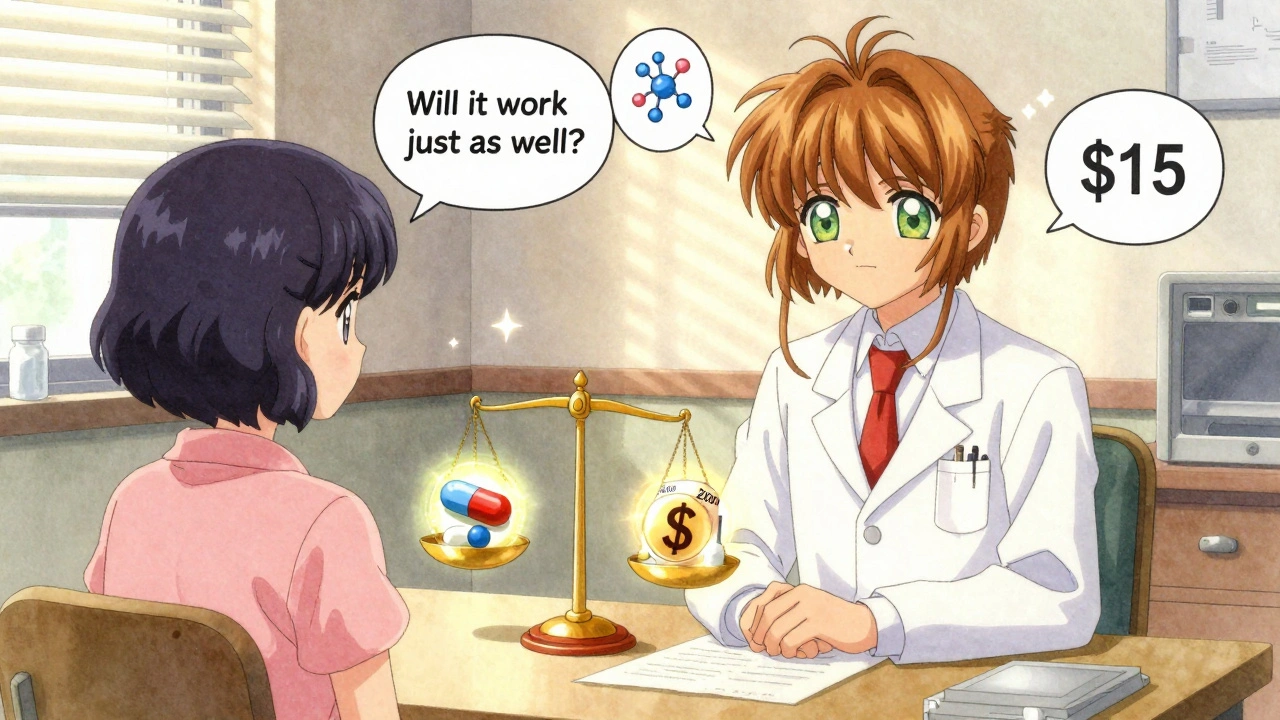
What to Say to Your Doctor
You don’t need to be a medical expert to have this conversation. In fact, you’re the most important person in it. You know how your body feels. You know what you can afford. Start with these simple questions:- “Is there a generic version of this medication?”
- “Will it work just as well for my condition?”
- “Are there any reasons I should take the brand-name version instead?”
- “I’m on a tight budget-can we go with the generic?”
What You Can Do Before Your Appointment
You don’t have to wing it at the doctor’s office. Do a little prep:- Check your last prescription bottle. Look up the drug name on GoodRx or your pharmacy’s website to see the price difference.
- Write down any side effects you’ve had-even if you think they’re unrelated. Did you feel dizzy after switching? Did your rash come back? Note it.
- Know your insurance plan. Some plans automatically cover generics at a lower tier, and you might not even realize it.
- Ask your pharmacist. They see hundreds of patients a day and know which generics work best for specific conditions. A 2022 study found that 78% of patient concerns about generics were resolved just by talking to a pharmacist.

State Laws and Automatic Substitutions
In most states, pharmacies are required by law to substitute a generic drug if one is available-unless your doctor specifically writes “dispense as written” on the prescription. That means if you don’t say anything, you might get a generic without even asking. That’s not necessarily bad. It’s meant to save money. But if you’ve had bad experiences with generics before, or if you’re on a drug where even small changes matter, you should tell your doctor ahead of time. You can ask them to write “dispense as written” or “no substitution” on the prescription. That’s your right.What About Biosimilars?
You might hear the term “biosimilar” and think it’s the same as a generic. It’s not. Biosimilars are for complex biologic drugs-like those used for rheumatoid arthritis, cancer, or Crohn’s disease. These drugs are made from living cells, not chemicals, so they can’t be copied exactly. Biosimilars are highly similar, but not identical. They’re still cheaper than brand-name biologics, but not as dramatically so as traditional generics. Right now, only about 28% of biologic prescriptions are filled with biosimilars. But that number is growing. If you’re on one of these drugs, ask your doctor if a biosimilar is an option. It could mean big savings.Final Thought: Trust the Science, Not the Price Tag
It’s easy to think expensive = better. But that’s not how medicine works. A $200 brand-name pill and a $15 generic pill with the same active ingredient are doing the exact same thing in your body. The brand-name version paid for years of research, marketing, and fancy packaging. The generic didn’t. And that’s why it’s cheaper. The FDA, doctors, pharmacists, and millions of patients agree: generics work. They’re safe. They save lives by making treatment affordable. If you’ve been avoiding a generic because you’re worried it won’t work, give it another try. Talk to your doctor. Ask your pharmacist. And if you still feel unsure, keep track of how you feel after switching. Your body will tell you.There’s no hard proof that generics are less effective. And there’s plenty of proof that they help people stay healthy without going broke.




Brian Perry December 3, 2025
so i switched to generic omeprazole and my stomach started screaming at me like i fed it razor blades lmao
Mindy Bilotta December 4, 2025
totally get this. my pharmacist sat me down and showed me the FDA bioequivalence charts. turned out my 'bad' generic was just a different filler. switched brands and boom-no more dizziness. always ask the pharmacist, they're the real MVPs.
Ethan McIvor December 5, 2025
it's wild how we equate price with power, isn't it? 🤔 we'll pay $200 for a pill that does the same thing as a $12 one, just because it looks fancier. but we'd never buy a $200 toaster that works the same as a $20 one. medicine shouldn't be an exception. it's not magic-it's chemistry.
Gene Linetsky December 7, 2025
the FDA is in bed with Big Pharma. generics are tested for 15 days on 200 people. the brand-name ones? 7 years, 10,000 patients. you think that 3.5% difference doesn't matter? it's the difference between life and death for people with epilepsy. they're lying to you.
Michael Bene December 8, 2025
oh sweet jesus here we go again with the 'generics are fine' propaganda. i've been on warfarin for 12 years. switched to generic #3 last year-INR went from 2.4 to 4.1 in two weeks. nearly bled out. they don't test for long-term stability. they don't test for how your body adapts to the new filler dye that smells like burnt plastic. the FDA doesn't care. your insurance does. that's why they push generics. not because they're better. because they're cheaper. and you're the sucker paying with your health.
my doctor told me to 'give it time.' i gave it three weeks and nearly ended up in the ER. now i pay out of pocket for brand-name. yeah, it's $180 a month. but i'm alive. and my wife doesn't have to explain to the kids why daddy's in the hospital again.
don't tell me 'trust the science.' the science is funded by the same companies that own the brand names. the study that says 'no difference'? funded by the generic manufacturer. the one that says 'yes, there's variation'? buried under 12 layers of peer review and never published. it's not conspiracy-it's capitalism.
if you're healthy and on lisinopril? sure, go for the generic. but if you're on something that keeps you from dying? don't gamble. your body isn't a lab rat. and your life isn't a cost-cutting exercise.
Ignacio Pacheco December 9, 2025
so let me get this straight-you're telling me that a pill made in India for $0.02 is magically identical to one made in New Jersey for $4.50… but only if you squint and ignore the fact that one has 17% more magnesium stearate? 🤨
also, why does the FDA allow 20% variation but only publish the 3.5% average? sounds like a PR move, not a science move.
Jim Schultz December 9, 2025
oh my god. another one of these. 'generics are just as good.' sure. just like how 'all cars are the same if they have four wheels.' you think the engine doesn't matter? the transmission? the quality of the fuel injectors? the generic is the economy model with the cheap plastic parts. it gets you to the grocery store. but if you're driving 120 on the highway? you're gonna get a rattling, smoking, expensive mess.
and don't even get me started on the fillers. talc. cornstarch. titanium dioxide. some of these are banned in Europe. but hey-FDA says it's 'safe.' safe for who? the 5% of people who have silent allergies? the elderly with 12 meds already? the ones who can't afford to complain?
you want to save money? fine. but don't pretend it's not a trade-off. it's not 'trust the science.' it's 'trust the profit margin.' and I'm not buying it.
Kidar Saleh December 9, 2025
as someone who's lived in the UK NHS system and now in Canada's public system, I can tell you this: generics are the backbone of affordable care. I've seen elderly patients in London choose between insulin and heating. Here, they get the generic. No drama. No panic. Just life. The science is solid. The savings are real. The fear? That's marketing. Not medicine.
Yes, there are edge cases. But those are exceptions-not the rule. Don't let the loudest voices scare you out of saving your own life.
Makenzie Keely December 10, 2025
My grandmother switched from brand-name levothyroxine to generic-and her TSH levels went from 4.8 to 8.2. She felt like a zombie for six months. We went back to the brand, and within two weeks, she was baking pies again. This isn't theory-it's lived experience. If your doctor says 'it's the same,' ask for the lab results. And if they can't provide them? You have every right to insist on the brand.
Also-pharmacists are your secret weapon. They know which generic manufacturers have the best consistency. Ask them. They'll tell you. Don't let insurance dictate your health.
Vincent Soldja December 11, 2025
Generics work. Cost less. FDA approved. End of story.
Chloe Madison December 12, 2025
YOU ARE NOT ALONE. I used to skip my generic blood pressure med because I thought it wasn’t working. Then I started a journal. Wrote down how I felt every day. Turns out-I felt worse on the generic because I EXPECTED to feel worse. Once I stopped believing it was 'lesser,' my anxiety dropped, my BP stabilized, and I saved $120/month. Your mind is powerful. Don’t let fear write your prescription.
But also-ask your pharmacist. They’ve seen it all. And if you’re on warfarin or thyroid meds? Keep a log. Track your numbers. Be your own advocate. You’ve got this.