
Ever feel like the world is just a bit blurry, no matter how hard you squint? You aren't alone. For millions of people, the problem isn't that their eyes are "broken," but rather that they are shaped slightly off. This is what doctors call refractive errors is a common vision impairment where the shape of the eye prevents light from focusing directly on the retina . When light doesn't hit that target perfectly, you get blurriness, headaches, and a lot of frustration. Whether you're a parent noticing your child squinting at the chalkboard or an adult struggling to read a menu, understanding how your eyes work is the first step to seeing clearly again.
The Big Three: Myopia, Hyperopia, and Astigmatism
To understand how to fix your vision, you first need to know what's actually happening inside your eye. Think of your eye like a camera lens; if the lens is too curved or the camera body is too long, the image comes out fuzzy.
Myopia is commonly known as nearsightedness, where distance objects appear blurry because the eye is too long or the cornea is too curved . In a myopic eye, the light focuses in front of the retina instead of on it. This usually kicks in around age 10 and can get progressively worse through the late teens. In some parts of East Asia, this is incredibly common, affecting up to 90% of young adults.
Hyperopia is farsightedness, occurring when the eye is too short or the cornea is too flat, causing light to focus behind the retina . While you might be able to see far-off signs just fine, reading a book or looking at a phone becomes a struggle. Some people are born with this, while for others, it only becomes a real problem as they age.
Then there's Astigmatism is a condition where the cornea or lens is shaped more like a football than a basketball, causing light to scatter across multiple focal points . Unlike the other two, this one is a bit of a wild card-it can mess with both your near and far vision at the same time. It's actually more common than you'd think, affecting between 30% and 60% of the population.
| Condition | Common Name | Core Problem | Focus Point | Primary Symptom |
|---|---|---|---|---|
| Myopia | Nearsightedness | Eye too long / Cornea too curved | In front of retina | Blurry distance vision |
| Hyperopia | Farsightedness | Eye too short / Cornea too flat | Behind retina | Blurry near vision |
| Astigmatism | Distorted Vision | Irregular corneal shape | Multiple points | Blurry at all distances |
How We Fix the Blur: Non-Surgical Options
The goal of any refractive errors correction is simple: move the light so it hits the retina exactly where it should. Depending on your prescription, you have a few reliable paths.
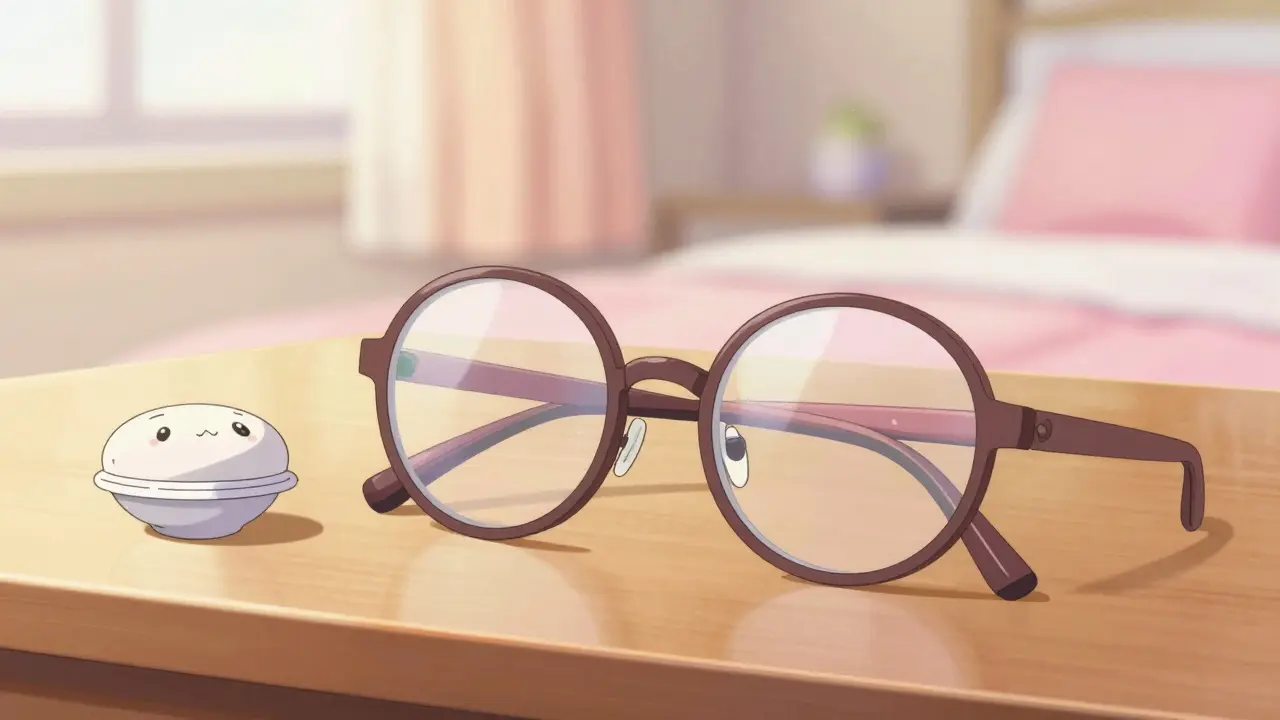
Eyeglasses are the most common and safest way to correct vision using plastic or glass lenses to bend light before it enters the eye . If you have myopia, you use "minus" power lenses to spread the light out. For hyperopia, "plus" power lenses converge the light. Astigmatism requires special "cylinder" lenses that are curved differently along one axis to flatten out that football shape.
Contact Lenses provide a wider field of view than glasses because they sit directly on the eye. They're great for athletes or people who hate the look of frames. However, they come with a learning curve-most people take about a week to get comfortable putting them in and taking them out. There is also a small risk of infection, so hygiene is everything here.
For those with high myopia (prescriptions worse than -6.00 diopters), it's not just about blurriness. These individuals face a much higher risk of retinal detachment or degeneration. In these cases, regular check-ups are non-negotiable to ensure the retina stays healthy.
Permanent Solutions: Refractive Surgery
If you're tired of the "glasses dance" every morning, surgery might be an option. Modern lasers can reshape your cornea with incredible precision-often within 0.25 diopters.
- LASIK (Laser-Assisted In Situ Keratomileusis) is a procedure where a thin flap is created in the cornea, and a laser reshapes the underlying tissue . It's the most popular choice and offers almost immediate results. Just be aware that some patients experience dry eyes in the first few months after surgery.
- PRK (Photorefractive Keratectomy) is a surface-level laser treatment that doesn't involve creating a flap . It's often recommended for people with thinner corneas.
- SMILE (Small Incision Lenticule Extraction) is a newer, minimally invasive technique that removes a small piece of corneal tissue through a tiny incision . This method is gaining popularity because it typically results in fewer dry-eye issues than LASIK.
Not everyone is a candidate for surgery. To be safe, you generally need to be over 18, have a stable prescription for at least a year, and have a cornea thickness of at least 500 microns. A surgeon won't touch your eyes unless these boxes are checked.

Managing Myopia in Children
We are currently seeing a global "myopia epidemic." Kids are spending more time on tablets and less time outdoors, which is a recipe for nearsightedness. If you notice your child squinting, don't just get them glasses-look into myopia control.
One effective method is Orthokeratology (Ortho-K) which involves wearing specially designed hard contact lenses overnight to temporarily flatten the cornea . This can significantly slow down how fast a child's vision worsens. Another emerging tool is low-dose atropine eye drops, which can reduce the progression of myopia by up to 80% over two years.
The best preventative measure? Get them outside. Sunlight and distance-viewing help the eye grow correctly, reducing the likelihood that they'll need a heavy prescription by the time they hit high school.
Can astigmatism be cured without surgery?
No, astigmatism is a physical result of the shape of your eye. While glasses, contact lenses, and Ortho-K can correct the vision and make things look clear, they don't "cure" or change the shape of the eye permanently. Only refractive surgery can permanently alter the corneal shape.
Why do my glasses feel weird for the first few days?
Your brain is used to processing blurry images. When you put on new lenses-especially for astigmatism where the "axis" of the lens must be perfect-your brain needs time to calibrate. This adjustment period usually lasts a few days, but for complex prescriptions, it can take up to three weeks.
Is LASIK safer than wearing glasses?
"Safer" isn't the right word; they just have different risks. Glasses are virtually risk-free. LASIK is generally safe but carries risks like chronic dry eye, glare or halos around lights at night, and a very small risk of infection. The choice depends on whether you prefer a daily habit (glasses) or a one-time surgical risk.
What is the difference between hyperopia and presbyopia?
Hyperopia is usually caused by the shape of the eye (too short) and can be present from birth. Presbyopia is an age-related condition that happens to almost everyone over 40, where the lens inside the eye loses its flexibility, making it hard to focus on close objects.
Can using too many screens cause myopia?
While screens themselves might not "cause" the genetic trait of myopia, excessive close-up work combined with a lack of outdoor time is a major trigger. It encourages the eye to elongate, which leads to nearsightedness.
What to do next
If you're experiencing blurry vision, the first step is a comprehensive eye exam. Don't just go to a kiosk for a quick screen; see an optometrist or ophthalmologist. They can map your corneal curvature and check your retinal health.
If you're a parent, keep an eye on your child's habits. Encourage outdoor play and limit screen time to 2 hours a day if possible. If your child is already myopic, ask your doctor about Ortho-K or atropine drops to stop the progression before it becomes a high-risk situation.
For adults considering surgery, start a "vision diary." Note when your blurriness is worst-is it only at night? Only when reading? This data helps your surgeon decide if LASIK, PRK, or SMILE is the best fit for your specific eye anatomy.







Timothy Brown April 27, 2026
Most people just ignore their eyes until they can't see the TV anymore. Just get the exam and stop complaining about the blur.
prince king April 28, 2026
It's honestly amazing how science can just reshape our biology to give us a clearer view of the world 🌟 Nature is wild, but technology is a beautiful bridge 🌈✨
Jarrett Jensen April 30, 2026
The simplistic reduction of these optical pathologies to a mere "camera lens" analogy is profoundly pedestrian. One would expect a more nuanced discourse regarding the physiological intricacies of corneal curvature and the precise refractive indices of the intraocular media. This discourse lacks the academic rigor necessary for a truly sophisticated audience.
Justin Crice May 2, 2026
The mention of diopter variance in SMILE versus LASIK is pertinent. The biomechanical stability of the corneal stroma is often overlooked in these summaries, yet it remains the primary determinant for long-term ectasia prevention. The precision of 0.25 diopters is an acceptable clinical benchmark, though the variance in patient healing responses creates a significant stochastic element in the final refractive outcome.
Aubrey Johnson May 2, 2026
Some people think a quick test at a store is enough. It is not. You need a real doctor.
Steve Grayson May 3, 2026
I've seen a lot of people in my area struggling with the same things. It's good to know there are options like Ortho-K for the kids because that could really change things for many families.
Trish Perry May 3, 2026
The whole idea of a "myopia epidemic" is kind of a wake-up call. We're basically evolving our eyes to look at screens instead of the horizon. It makes you wonder where we're heading as a species if we lose our innate ability to see the distance without a piece of plastic on our faces.
Kali Murray May 3, 2026
love my contacts but the first time i put them in i almost had a panic attack lol 😅
Jean Robert May 4, 2026
It is so important to remember that every person's journey with their vision is different, and if you are feeling overwhelmed by the choices between glasses and surgery, just take a deep breath and know that you have a whole team of professionals ready to support you through the process. I truly believe that taking the time to maintain a vision diary as suggested is a wonderful way to feel empowered and in control of your own health, especially when you're dealing with the anxiety of a medical procedure, so please be kind to yourself while you navigate these options and remember that your well-being is the top priority here.
Kat G May 4, 2026
Regular eye exams are necessary for everyone.
Thomas Jorquez May 6, 2026
I think its laudable that the post emphasizes the importance of professional diagnostics over retail kiosks. Proper ocular health requires a comprehensive evaluation.
Darrin Oneto May 8, 2026
My vision is just totally wonky and these glasses feel like a weird kaleidoscope for a week. Totally trippy stuff man.
Amber McCallum May 9, 2026
People just want a quick fix with surgery. They don't realize that the body is telling them something about their lifestyle. If you can't see, maybe stop staring at a phone all day. It's not a medical failure, it's a life failure.
Dale Kensok May 11, 2026
The causal nexus between digital ocular strain and axial elongation is barely scratched here. We are dealing with a systemic failure of the circadian rhythm affecting the dopaminergic inhibition of eye growth. The superficiality of this advice-"go outside"-ignores the complex socioeconomic stratification that prevents access to green spaces in urbanized environments, rendering the prescription practically moot for the proletariat. This is a textbook example of a reductionist approach to a multifaceted physiological crisis, failing to account for the epigenetic triggers that predispose certain cohorts to high myopia regardless of sunlight exposure. The author assumes a level of agency that is simply non-existent for the modern office worker chained to a blue-light emitting workstation for ten hours a day. It is a banal suggestion for a profound problem. One must analyze the intersection of myopia and urban architecture to truly understand the pathology. The lack of mention of the accommodative-convergence dysfunction is a glaring omission. I find the prose to be offensively simplistic. It treats the cornea like a piece of clay rather than a complex biological membrane. Truly a pedestrian analysis of refractive errors.