Why Sarcopenia in COPD Is a Silent Threat
Most people think of COPD as a lung disease-shortness of breath, wheezing, coughing. But for more than 1 in 5 people with COPD, the real danger isn’t just in the airways. It’s in the muscles. Sarcopenia, the progressive loss of muscle mass and strength, affects 22% of COPD patients, and it’s one of the biggest reasons they die sooner, get hospitalized more often, and lose the ability to do everyday tasks like climbing stairs or carrying groceries.
This isn’t just aging. It’s not the same as what happens to healthy older adults. In COPD, muscle wasting happens faster-up to 3.2% per year compared to 1-2% in people without lung disease. And it’s not just the legs. The muscles that help you breathe, like the pectoralis major, are often the first to shrink. Studies show 68% of COPD patients have noticeable chest muscle loss, while only 22% of healthy people their age do. That’s why even simple movements can leave you gasping.
The link between COPD and muscle loss is clear: inflammation, low oxygen levels during sleep, lack of movement, and poor nutrition all team up to break down muscle faster than your body can rebuild it. And here’s the kicker: if you have both COPD and sarcopenia, your risk of dying within five years jumps from 45% to 32%. That’s not a small difference. It’s life or death.
How Doctors Diagnose Sarcopenia in COPD Patients
There’s no single test, but doctors now use a three-part checklist to spot sarcopenia in COPD patients. First, they check muscle strength. For men, that’s a handgrip strength below 27 kg. For women, it’s below 16 kg. If you can’t squeeze that grip test hard enough, it’s a red flag.
Second, they look at muscle quantity. This is usually measured with a DEXA scan or CT scan. In COPD, the standard numbers don’t always apply because patients often have low body weight and different fat-muscle ratios. That’s why experts now use something called the pectoralis muscle index (PMI)-a measurement of the chest muscle size adjusted for body weight. If PMI is below 1.06 cm²/BMI, sarcopenia is likely.
Third, they test how well you move. The Short Physical Performance Battery (SPPB) measures how fast you walk 4 meters, how long you can stand on one foot, and how well you rise from a chair. A score below 8 means your physical performance is severely limited. Some clinics also use the 6-minute walk test. If you can’t walk more than 300 meters without stopping, that’s another sign.
And here’s what most doctors miss: they don’t check for low oxygen at night. If your blood oxygen drops below 88% for more than 30% of your sleep, your risk of severe sarcopenia goes up by 47%. That’s why some clinics now use overnight pulse oximeters as part of the screening.
Why Standard Exercise Programs Fail for COPD Patients
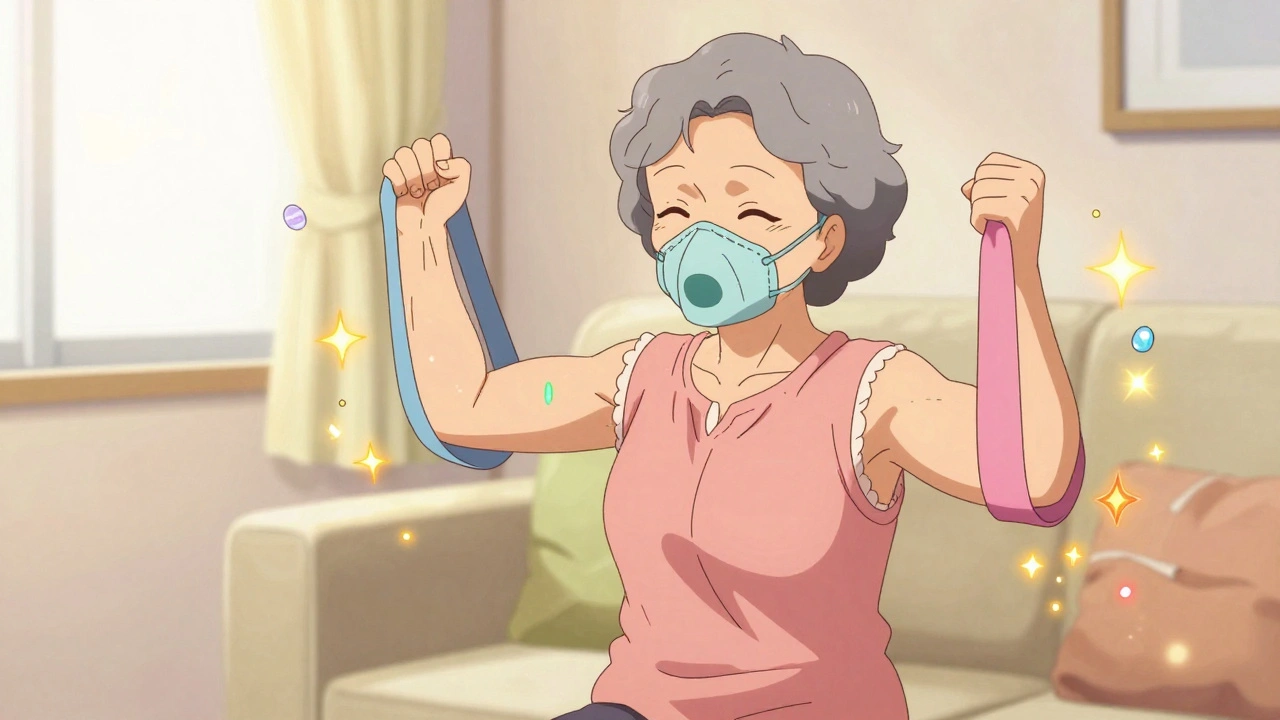
Many people assume that if you have muscle loss, you just need to lift weights. But for someone with COPD, standard resistance training can make breathing worse. In fact, 42% of COPD patients need supplemental oxygen just to do light strength exercises. Without it, they get so short of breath they quit.
Traditional gym routines-3 sets of 10 reps with heavy weights-are dangerous here. They spike heart rate and oxygen demand too quickly. That’s why pulmonary rehab specialists now start at just 30% of your one-rep maximum (1-RM). That’s the lightest weight you can lift once. For many, that means using resistance bands or 1- to 2-pound dumbbells.
Progression is slow. You don’t ramp up weights every week. You wait until you can complete a set without gasping for air. Rest periods are longer-2 to 3 minutes between sets-to let your breathing recover. Sessions are short: 20 to 30 minutes, 2 to 3 times a week. And they always include seated exercises to reduce strain.
Studies show this approach works. Patients in structured programs improved their 6-minute walk distance by 23% in just 16 weeks. That’s not just a number-it means you can walk to the mailbox without stopping. Or carry your own laundry. Or play with your grandkids without needing a break.

The Nutrition Mistake Most COPD Patients Make
Doctors often tell COPD patients to eat more calories. But that’s not enough. What you eat matters more than how much. The average COPD patient eats only 0.9 grams of protein per kilogram of body weight each day. The recommended amount? 1.2 to 1.5 grams per kg. That’s a 33% to 67% gap.
Why does this matter? Muscle repair needs protein-and not just any protein. Your body needs leucine, an amino acid that acts like a switch to turn on muscle building. Most diets don’t provide enough. A 70kg (154 lb) COPD patient needs at least 84 to 105 grams of protein daily. That’s 3 meals of 28 to 35 grams each.
Here’s how to hit that target:
- Breakfast: 2 eggs + 1 cup Greek yogurt + 1 scoop whey protein (25g protein)
- Lunch: 100g chicken breast + 1 cup lentils + 1 oz cheese (35g protein)
- Dinner: 120g salmon + 1 cup quinoa + 1 cup cottage cheese (40g protein)
- Snack: 1 cup milk + 1 tbsp peanut butter (12g protein)
That’s about 112g total. If you struggle to eat that much, use a supplement with 10g of leucine per serving. Studies show this boosts muscle synthesis by 37% in COPD patients.
Don’t wait until you’re weak to fix this. If you’re diagnosed with COPD, start optimizing protein intake right away. Muscle loss doesn’t reverse easily. Prevention is far easier than recovery.
Real Stories: What Works and What Doesn’t
Mary Thompson, 68, was diagnosed with GOLD Stage 3 COPD and sarcopenia in early 2024. She couldn’t lift her purse without stopping to catch her breath. After joining a pulmonary rehab program that combined light resistance bands with protein shakes after each session, she saw changes in 12 weeks. "I can carry groceries now," she said. "I didn’t think I ever would again."
But not everyone has the same luck. John Peterson, 72, tried resistance training at his local gym. He didn’t know he needed oxygen during exercise. After three sessions, he was so breathless he quit. "I thought I was just getting weaker," he said. "I didn’t realize the program was wrong for me."
These stories show the same truth: success depends on personalization. A one-size-fits-all approach fails. The key is starting slow, using oxygen if needed, and matching nutrition to your body’s needs.

What’s New in 2025: The Future of Sarcopenia Treatment
In 2024, the Global Initiative for Chronic Obstructive Lung Disease (GOLD) released its first-ever algorithm for managing sarcopenia in COPD. It’s simple: screen for muscle loss at every visit, check nighttime oxygen levels, and match resistance training intensity to breathing tolerance.
Researchers are also testing new drugs. One, called PTI-501, blocks myostatin-a protein that limits muscle growth. Early results show it helps preserve muscle mass in COPD patients who can’t exercise due to severe symptoms.
Another promising option is HMB, a compound your body makes from leucine. In a major European trial launching in late 2024, patients taking 3g of HMB daily along with resistance training preserved 18% more muscle than those who only trained.
But the biggest shift isn’t medical. It’s cultural. More clinics are now training staff to treat sarcopenia as seriously as low oxygen or high CO2. And insurance companies are starting to cover protein supplements and home-based resistance equipment for COPD patients with documented muscle loss.
Where to Start Today
If you or someone you care about has COPD, here’s what to do right now:
- Ask your pulmonologist for a handgrip strength test and a 6-minute walk test.
- If you’re not already using supplemental oxygen at night, ask for a sleep study to check your oxygen levels.
- Calculate your daily protein needs: weight in kg × 1.2 to 1.5. If you’re eating less than that, add a whey protein shake after your morning meal.
- Start resistance training with light bands or 1-pound weights. Do 1 set of 10 reps for arms, shoulders, and legs, 3 times a week. Rest 2 minutes between sets.
- Find a pulmonary rehab program that includes sarcopenia-specific training. If none are nearby, ask for a home-based program with telehealth coaching.
There’s no magic pill. But combining the right nutrition with the right exercise can change the trajectory of COPD. It doesn’t just help you move better. It helps you live longer.
Is sarcopenia the same as general muscle loss in aging?
No. While both involve muscle loss, sarcopenia in COPD is faster, more severe, and affects different muscles. In healthy aging, leg muscles decline first. In COPD, chest and upper body muscles shrink first due to breathing struggles and inflammation. The rate of loss is also higher-3.2% per year in COPD versus 1-2% in healthy aging.
Can I do resistance training if I use oxygen all the time?
Yes, and you should. Many people with COPD who use oxygen at rest benefit even more from resistance training because it improves how efficiently your muscles use oxygen. Use your oxygen during exercise-most programs recommend keeping your oxygen saturation above 90%. Start with very light weights and short sessions. Your breathing will improve over time.
How much protein do I really need if I have COPD and sarcopenia?
You need 1.2 to 1.5 grams of protein per kilogram of body weight each day. For a 70kg person, that’s 84 to 105 grams daily. Spread it across 4 meals-about 25-30 grams per meal-to keep muscle building active all day. If you struggle to eat that much, use a whey protein supplement with at least 10g of leucine per serving.
What if I can’t get to a pulmonary rehab center?
Home-based programs work. Use resistance bands, light dumbbells, or even water bottles. Do seated exercises: shoulder presses, seated rows, leg extensions. Do 1 set of 10 reps, 3 times a week. Pair it with protein after each session. Ask your doctor for a home exercise plan or look for telehealth pulmonary rehab services, which many insurers now cover.
Will improving muscle strength help my breathing?
Yes. Stronger chest and arm muscles help you breathe more efficiently. When your respiratory muscles are weak, your body works harder just to get air in and out. Strength training reduces that effort, so you feel less breathless during daily tasks. Studies show patients who train regularly report lower breathlessness scores and better quality of life-even if their lung function doesn’t change.







Paul Dixon December 10, 2025
Man, I wish my dad knew this stuff when he was diagnosed. He just kept trying to lift weights like he was 30 and ended up in the ER after one session. Light bands and seated stuff? That’s the real MVP. Took me months to convince him to try it, but now he can walk to the porch without stopping. Life-changing.
Monica Evan December 11, 2025
protein is everything i swear i thought eating chicken was enough but nope my mom went from 0.8g/kg to 1.4 and her grip strength jumped in 6 weeks she can open jars now 😭 no joke
Sylvia Frenzel December 12, 2025
So now we’re giving out protein supplements like candy? Next they’ll be handing out oxygen tanks at Walmart. This is just another way for Big Pharma to profit off scared seniors. My uncle had COPD and he lived to 89 just by walking his dog and eating real food. No shakes. No bands. Just common sense.
Courtney Blake December 12, 2025
Wow. Another feel-good article that ignores the fact that most of these people can’t afford protein shakes or home equipment. Meanwhile, Medicare cuts home health visits every year. You’re telling me to train with bands but not telling me how to pay for the damn oxygen. This is performative medicine. 🤡
Jean Claude de La Ronde December 13, 2025
So we’ve turned muscle loss into a fitness challenge? Fascinating. In the 1980s, we called this ‘the body giving up.’ Now it’s a ‘sarcopenia protocol.’ Same thing, just with better branding and a 200-page manual. I’ll stick with my nap and my soup.
Aidan Stacey December 15, 2025
Let me tell you about my neighbor, Rosa. 74, COPD Stage 3, used to sit all day because she was scared to move. Then her granddaughter got her a $15 resistance band set and started doing 5 minutes of seated shoulder presses with her every morning. Two months later? Rosa carried her own groceries. Not because she got stronger - because she stopped believing she couldn’t. This isn’t just science. It’s hope. And hope doesn’t come from a lab. It comes from someone saying, ‘I’ll do it with you.’
And yeah, protein matters. But so does showing up. So does not giving up on someone because their lungs are tired. We treat COPD like it’s a broken pipe. But it’s a person. A person who still wants to hug their grandkids without gasping.
I’ve seen people quit rehab because the trainer was too focused on reps and not on tears. The real metric isn’t the 6-minute walk. It’s whether they smiled after.
And if you’re reading this and you’re scared to start? Do one rep. One. Just one. And then sit down. That’s enough. That’s everything.
And if you’re a caregiver? Don’t just bring the protein shake. Bring your voice. Bring your patience. Bring your presence. That’s the real therapy.
They say muscle loss is silent. But it’s not. It’s screaming. And we’re finally learning how to listen.
john damon December 15, 2025
bro i just started using a 1lb dumbbell and my oxygen sat stayed at 92% the whole time 😍 i thought i was gonna die but now i can lift my cat 🐱💪
Jim Irish December 15, 2025
Consistency matters more than intensity. Start small. Stay steady. Measure progress in weeks not days. Protein intake should be daily. Oxygen use during exercise is not weakness. It’s strategy. And recovery is part of training. Not an afterthought.