Planning an international trip and taking medication for a chronic condition? If your meds include opioids, stimulants, benzodiazepines, or other controlled substances, you’re not just packing pills-you’re carrying legal documents that could make or break your journey. One missing signature, one wrong dosage listed, or one country’s strict rule you didn’t know about, and you could face detention, confiscation, or even arrest. This isn’t a hypothetical risk. In 2022, the International Narcotics Control Board documented 127 cases where travelers were detained for inadequate medical documentation, with average detention periods of over two weeks. You don’t need to be one of them.
Why a Doctor’s Letter Isn’t Optional
International drug laws don’t care if you’re a student, a retiree, or a business traveler. If you’re carrying a substance regulated under the 1961 Single Convention on Narcotic Drugs or the 1971 Convention on Psychotropic Substances, you’re subject to rules that span 186 countries. These treaties allow exceptions for medical use-but only if you can prove it. A doctor’s letter isn’t a suggestion. It’s your legal shield.The letter’s purpose is simple: prove you’re not smuggling drugs. It tells border agents, customs officers, and immigration officials that your medication is prescribed, legal, and necessary for your health. Without it, even a small bottle of Adderall or Xanax can look like contraband. According to the CDC’s 2023 Yellow Book, 68% of medication-related travel incidents happen because travelers didn’t carry proper documentation.
What Must Be in the Letter
A generic note from your doctor won’t cut it. The letter must include specific details, exactly as outlined by the CDC and FDA. Missing even one element can cause delays or denial of entry. Here’s what you need:- Your full legal name and date of birth (must match your passport)
- The prescribing physician’s full name, title, clinic/hospital name, phone number, and email
- The generic name of each medication (not the brand name-brand names vary by country)
- The exact dosage (e.g., 10 mg, not "one pill")
- The frequency of use (e.g., "once daily", "as needed for pain")
- The route of administration (oral, patch, injection)
- A clear statement of your medical condition (e.g., "treatment for ADHD", "management of chronic neuropathic pain")
- A formal request that you be permitted to carry these medications for personal use during your trip
- The physician’s handwritten or digital signature
- Official letterhead from the medical practice
For Schedule II-V controlled substances (like oxycodone, Adderall, or lorazepam), the DEA requires the letter to explicitly state the drug’s classification. Many doctors skip this-and that’s why 43% of incidents, according to the American Medical Association, are preventable with better-formatted letters.
How Much Can You Carry?
There’s no global standard for quantity, but most countries follow a 90-day personal use limit. The FDA and U.S. Customs and Border Protection (CBP) advise travelers to carry no more than a 90-day supply. Some countries are stricter. Singapore and Malaysia impose criminal penalties if you exceed 30 days’ supply-even with a letter. Japan bans many ADHD medications entirely, regardless of documentation. The UAE requires advance approval from their Ministry of Health before arrival.Here’s what the data shows:
| Country | Max Allowed Supply | Special Requirements |
|---|---|---|
| United States | 90 days | Doctor’s letter + original prescription |
| Canada | 100 dosage units | Letter sufficient for personal use |
| United Arab Emirates | 30 days | Advance approval required |
| Japan | Varies | Many stimulants banned outright |
| Singapore | 30 days | Criminal penalties for excess |
| EU Countries | 90 days | Letter recognized across member states |
Always check your destination’s official health or customs website. Don’t rely on travel blogs or forums. The U.S. Department of State found that 58% of travelers use inaccurate sources for medication rules.
How to Pack Your Medications
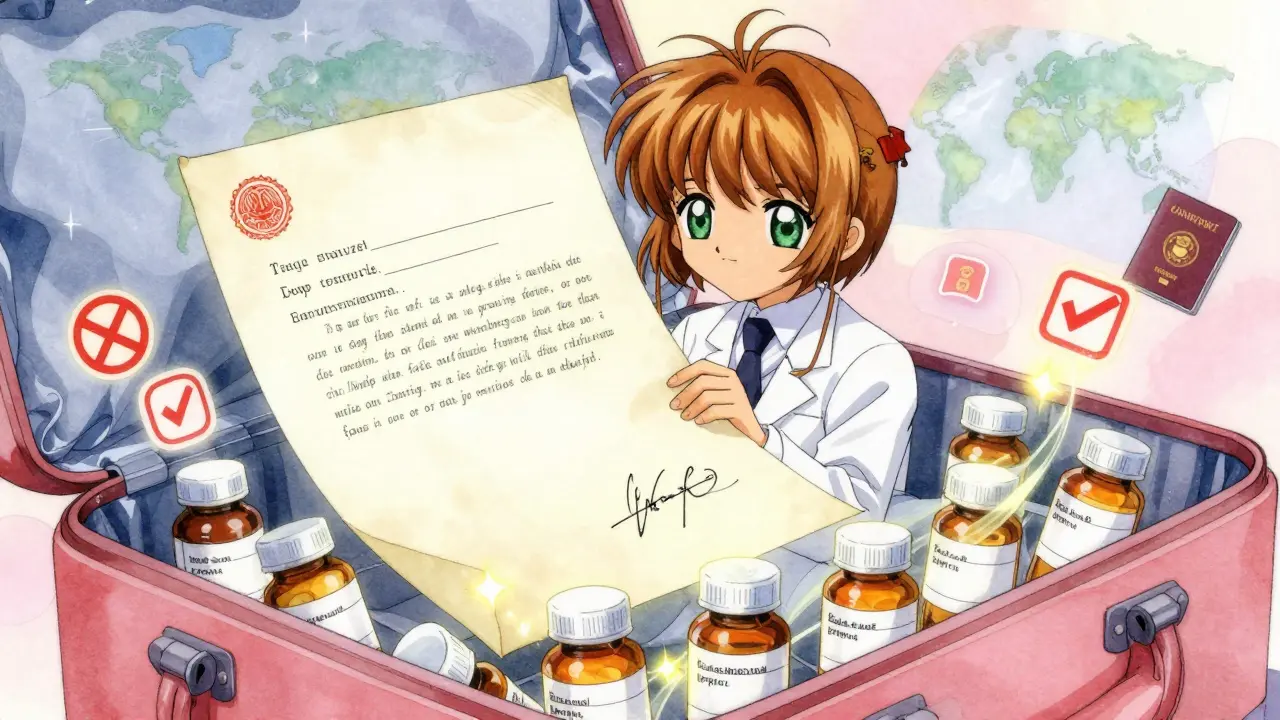
Your doctor’s letter means nothing if your pills aren’t in the right containers. The FDA requires all controlled substances to be carried in their original labeled containers with the prescription label attached. That means no pill organizers, no unlabeled bottles, no ziplock bags-even if they’re labeled "for travel."There’s one exception: if you need to use a pill organizer for daily doses, you can transfer pills-but only if you carry the original containers alongside it, and your doctor’s letter explicitly mentions the transfer. Otherwise, customs agents may treat your pills as unverified substances.
Also, carry a copy of your original prescription. For Schedule II drugs, the DEA requires it. Even if your country doesn’t, having it reduces risk. Keep your medications in your carry-on. Never check them. Lost luggage is one of the top reasons people get stuck abroad without meds.
Language and Translation
If your letter isn’t in English, it must be accompanied by a certified translation. The FDA requires this. Many countries will not accept foreign-language documents. Even if the destination country speaks English, officials may not trust a letter written in another language without official translation.Don’t use Google Translate. Use a certified translator. Many pharmacies and medical offices offer translation services. Some embassies can recommend approved providers. This isn’t optional-it’s a legal requirement in over 70 countries.
Country-Specific Pitfalls
Some countries are more dangerous than others for travelers with controlled meds. Here’s what to watch for:- Japan: Adderall, Ritalin, and other amphetamine-based ADHD meds are illegal, even with a letter. Many travelers are detained on arrival.
- United Arab Emirates: Benzodiazepines like Xanax and Valium are classified as narcotics. You need pre-approval from the Ministry of Health. Apply at least 30 days before travel.
- Singapore: Any controlled substance over a 30-day supply can lead to arrest. They test luggage and have zero tolerance.
- Thailand: Codeine and tramadol are controlled. You need a letter and a prescription. Even then, some pharmacies refuse to fill them.
- China: All opioids are strictly controlled. Only a handful of hospitals can dispense them. Bring enough for your entire stay.
For ADHD medications specifically, 89% of countries require special documentation. That’s higher than any other class of drug. If you’re taking Vyvanse, Concerta, or Focalin, start planning early.

What to Do Before You Leave
Don’t wait until the airport. Start two months before departure. Here’s your checklist:- Make a complete list of all medications, including generics, dosages, and reasons for use.
- Call your doctor’s office and ask them to prepare a letter using the CDC’s template (available online since 2019).
- Confirm the letter includes the chemical name of each active ingredient (e.g., "methylphenidate" not "Ritalin").
- Verify your destination’s rules using official government sites-not travel agencies or third-party blogs.
- Contact the embassy or consulate of your destination country and ask about medication import rules.
- Get your prescriptions filled with enough supply for your trip plus a 10-day buffer.
- Carry the letter, prescription, and original containers together in a clear plastic folder labeled "MEDICATIONS - INTERNATIONAL TRAVEL".
A 2022 survey by the International Association for Medical Assistance to Travellers found that 72% of physicians don’t provide full generic names or chemical compositions. If your doctor doesn’t know what’s required, print out the CDC’s template and give it to them. Most will sign it.
What Happens If You’re Denied Entry?
If customs confiscates your meds or detains you, don’t argue. Stay calm. Ask to speak with a supervisor. Request to contact your country’s embassy. Do not sign anything without legal advice. Most countries will hold your medication until you leave, but some may charge you with a crime.The INCB reports that travelers detained for medication issues spend an average of 14.3 days in custody. That’s not just lost time-it’s lost income, missed flights, and emotional trauma. Proper documentation prevents this entirely.
What’s Changing in 2026?
The future is digital. The INCB began piloting a standardized digital medical certificate in 12 European countries in 2023. By 2025, over 40 countries plan to adopt this system. The European Commission is funding a €2.4 million project to create a unified EU-wide digital travel medication record. The FDA and CBP now accept electronic prescriptions from telehealth visits-so long as they’re signed and verifiable.But until that system is global, paper is still king. Don’t rely on apps or digital copies. Print two copies. Keep one in your carry-on. Give one to a travel companion. Leave one at home with a trusted person. Redundancy saves lives.
Traveling with controlled substances isn’t about breaking rules. It’s about following them-exactly. The system is designed to protect you, not punish you. Do the work ahead of time, and you’ll walk through customs with confidence.
Do I need a doctor’s letter if I’m only traveling within the EU?
Yes. While EU countries recognize each other’s medical documentation, you still need a doctor’s letter that includes the generic name of your medication and your prescribing physician’s details. Some countries may also require the letter to be in their official language. Always check the destination country’s rules before departure.
Can I use a telehealth prescription for my doctor’s letter?
Yes, if the telehealth provider is licensed in your state or country and the prescription is signed electronically with a verifiable digital signature. The FDA and CBP accept telehealth documentation as long as it meets the same standards as in-person prescriptions. Make sure the letter includes the provider’s license number and contact information.
What if my medication isn’t available in the country I’m visiting?
Some countries ban or restrict medications that are legal in the U.S. or Europe. For example, Adderall is illegal in Japan, and codeine is tightly controlled in Thailand. Always research availability before you go. If your medication isn’t available, ask your doctor for an alternative that’s permitted in your destination. Never assume you can refill your prescription abroad.
Do I need a letter for over-the-counter meds like melatonin or cough syrup?
Melatonin is generally fine. But some OTC cough syrups contain codeine, dextromethorphan, or pseudoephedrine-substances that are controlled in many countries. Always check the active ingredients. If in doubt, carry a doctor’s letter even for OTC drugs. A few countries treat pseudoephedrine like a controlled substance.
Can I send my medication ahead by mail?
No. Most countries prohibit the international mailing of controlled substances, even with a prescription. Shipping your meds ahead is illegal and risky. Always carry them with you in your personal luggage. If you need more than a 90-day supply, plan to refill them locally with proper documentation.







Stacie Willhite February 11, 2026
Just got back from a trip to Germany last month with my gabapentin and oxycodone. Had the letter, original bottles, and prescription copies-all in a clear folder like the post says. Border agent barely glanced at it and waved me through. I was so nervous, but this guide? Lifesaver. Seriously, do the prep work. It’s not scary if you’re organized.
Jason Pascoe February 12, 2026
Had a friend get detained in Singapore for carrying 40 days’ worth of Xanax. She had a letter, but it didn’t list the generic name-just "Xanax". They confiscated everything, held her for 11 days. She cried when she told me. This post isn’t overkill-it’s survival. Always use generic names. Always.
Rob Turner February 13, 2026
Been to Japan twice with ADHD meds. First time? Got pulled aside. Second time? I printed the CDC template, had my doc write "methylphenidate" in bold, and carried the original script with the DEA schedule II note. They still looked skeptical… but let me through.
Pro tip: Bring printed copies of Japan’s MOH page on meds. Show it to them. It’s like magic. 🤞
Luke Trouten February 13, 2026
The legal framework here is actually quite elegant. The 1961 and 1971 conventions were designed to prevent abuse while preserving medical access-but enforcement varies wildly due to cultural and bureaucratic factors. The real issue isn’t the letter itself; it’s the lack of harmonization across jurisdictions. A global digital ID for medical travelers would eliminate 90% of these incidents. Until then, paper is the only reliable currency.
Gabriella Adams February 14, 2026
Just had to do this for my mom’s chronic pain meds before our trip to Italy. I called her doctor’s office and said, "I need the CDC template, full generic names, DEA classification, and a handwritten signature on letterhead." They were confused at first-then gave me a 10-page packet. We printed 3 copies. One in carry-on, one in checked bag (just in case), one in my backpack. She’s 72. I’m not risking her getting stuck overseas.
Kristin Jarecki February 14, 2026
Important note: Some countries require the letter to be notarized. The post doesn’t mention this. For example, Brazil and South Africa demand a notarized translation-even if the letter is in English. Always check with the destination’s embassy. A notary costs $15. A detention costs thousands.
Jonathan Noe February 16, 2026
Y’all are making this way harder than it needs to be. I travel to Dubai every 3 months with my Adderall. Got the letter? Good. Got the original bottle? Good. Got the email from the UAE Ministry of Health confirming approval? Then you’re golden. I emailed them 45 days out. Got a reply in 3 days. No drama. Stop overthinking. Just do the 3 things: letter, original bottle, email confirmation. Done.
Jim Johnson February 16, 2026
My brother got caught in Thailand with tramadol. He had a letter but didn’t know it was controlled there. They held him for 17 days. He lost his job.
So yeah. This isn’t "be careful." This is "don’t risk your life over a 10-minute task." Print the CDC template. Call your doc. Get the damn letter. Carry the bottles. Don’t be the guy who turns a vacation into a nightmare. I’m not even mad-I’m just tired of seeing this happen.