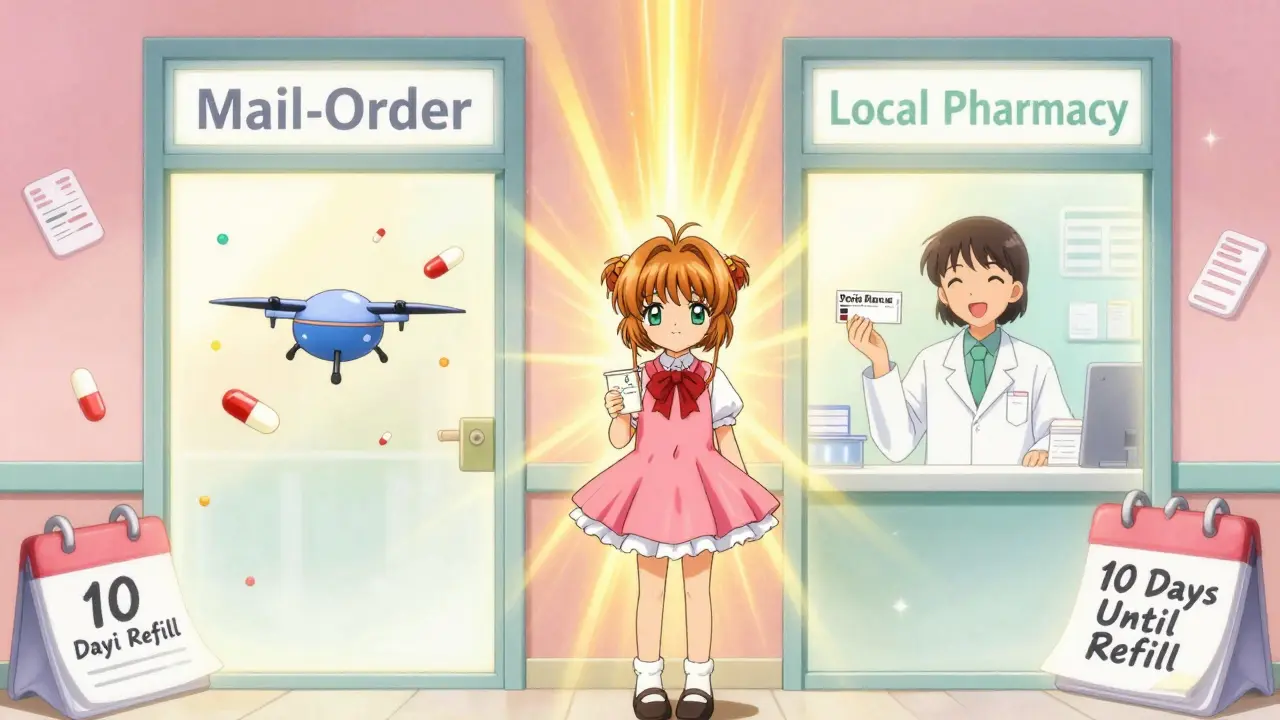
Running out of your blood pressure pill on a Saturday? Or paying $45 for a 30-day supply when you could get 90 days for $115? You’re not alone. Millions of Americans are overpaying for medications because they don’t know how to use mail-order pharmacy and local pharmacies together. The truth? You don’t have to choose one or the other. Used right, they can cut your annual drug costs by hundreds - even over $500 - without sacrificing speed or safety.
Why Mail-Order and Local Pharmacies Work Better Together
Most people think of mail-order pharmacies as just a way to get pills delivered to their door. But that’s only half the story. The real savings come from using each pharmacy for what it does best. Mail-order pharmacies - like Express Scripts, OptumRx, or CVS Caremark - are built for long-term meds. They offer 90-day supplies at lower copays because they cut out the middleman. A 2007 study in the Journal of Managed Care Pharmacy found that for maintenance medications, mail-order saved patients an average of 29% compared to retail. That’s not a guess. That’s real data from millions of prescriptions. But here’s the catch: mail-order takes 7 to 14 days to ship. If you need an antibiotic after a doctor’s visit on Monday, waiting two weeks isn’t an option. That’s where your local pharmacy comes in. They can fill your prescription the same day. They also have pharmacists on-site who can answer questions, check for drug interactions, and even help you switch to a cheaper generic. Think of it like this: mail-order is your grocery warehouse - buy in bulk, save money. Local pharmacy is your corner store - quick, personal, and perfect for emergencies.How to Split Your Medications Between the Two
Not all meds are created equal. The key is sorting them into three buckets:- Maintenance meds - These are drugs you take every day for months or years: blood pressure pills, diabetes meds, cholesterol statins, thyroid hormones, antidepressants.
- Acute meds - Short-term drugs: antibiotics, painkillers after surgery, steroid packs, anti-nausea meds.
- Variable-dose meds - Drugs where your dose changes often: insulin, blood thinners like warfarin, or new psychiatric meds.
Check Your Insurance - You Might Be Missing Out
Here’s the biggest mistake people make: they assume mail-order is always cheaper. It’s not. Insurance plans vary wildly. Some plans charge the same copay for 90-day fills at your local pharmacy as they do for mail-order. CVS, Walgreens, and Walmart all offer 90-day generic programs with prices matching or beating mail-order. You just have to ask. Call your insurance company and say: “What’s my copay for a 90-day supply of [medication name] at a retail pharmacy?” Don’t assume. Verify. Walmart’s $4/$10/$25 generic program is one of the best kept secrets. For $10, you can get 90 days of metformin, lisinopril, or simvastatin - no insurance needed. That’s cheaper than most mail-order plans. And if you’re on Medicare Part D, use the Medicare Plan Finder tool. It shows exact prices for both mail-order and local pharmacies side by side.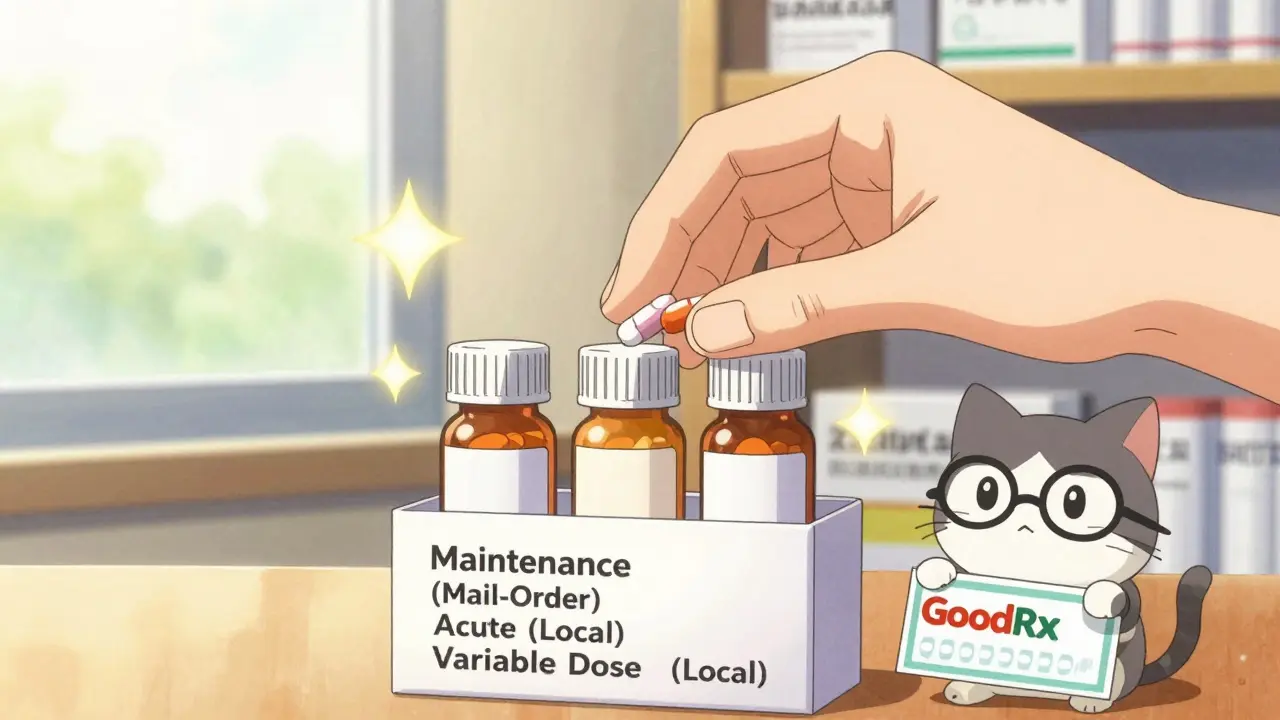
Set Up a System - Don’t Rely on Memory
The biggest reason people fail at this system? They forget to reorder. You don’t want to run out on a weekend. Here’s how to stay ahead:- Make a list of all your meds and which ones go to mail-order.
- Check your refill dates. Most mail-order pharmacies let you set up automatic refills - use them.
- Set calendar reminders 10 days before your supply runs out. That gives you time to order and avoid delays.
- Keep a backup 7-day supply of your top 3 maintenance meds at home. Just in case.
Build a Relationship With Your Local Pharmacist
Don’t just see your local pharmacy as a place to pick up pills. Talk to the pharmacist. Ask: “Is there a cheaper generic?” “Can I switch to a 90-day supply here?” “Are there any coupons I can use?” Pharmacists know about discount programs, manufacturer coupons, and even patient assistance programs you didn’t know existed. One Pittsburgh man saved $200 a year just by asking his local pharmacist to switch his cholesterol pill to a different generic - same effect, half the price. Also, use them for medication reviews. Once a year, bring your whole list - pills, supplements, OTC meds - to your pharmacist. They’ll spot duplicates, interactions, or drugs you no longer need. The American Pharmacists Association says 40% of patients could save $200+ a year just by doing this.Watch Out for These Traps
It’s not all easy. Here are the common pitfalls:- Mail-order delays - If your doctor changes your dose or adds a new med, mail-order won’t know right away. Always call them to confirm the new prescription.
- Insurance changes - Plans update formularies every January. What was cheap last year might cost more now. Review your benefits statement every fall.
- Temperature-sensitive meds - Insulin, biologics, and some liquid meds can spoil if shipped in extreme heat or cold. If you’re on one of these, stick with local pickup or choose a mail-order service with temperature-controlled shipping.
- State laws - Some states restrict out-of-state mail-order pharmacies. Make sure your mail-order provider is licensed in Pennsylvania.

What’s Changing in 2025?
The game is shifting. In 2023, UnitedHealthcare launched Optum Perks, which lets you switch between mail-order and local pharmacies with one click. Medicare’s 2024 Part D changes are making 90-day pricing more consistent across channels. By 2025, most commercial plans will have integrated systems that auto-suggest the best pharmacy for each med based on your plan, cost, and delivery needs. But here’s the catch: 71% of Americans still don’t know local pharmacies can match mail-order prices. That’s your edge. If you act now, you can lock in savings before the system changes.Real Savings, Real Examples
Take Sarah, 58, from Pittsburgh. She takes four maintenance meds: metformin, lisinopril, atorvastatin, and levothyroxine. She switched all four to mail-order. Her monthly out-of-pocket dropped from $110 to $42. That’s $816 saved a year. She keeps her albuterol inhaler and ibuprofen at her local CVS, where she uses the $4 generic program. She also gets her annual flu shot there. Total annual drug cost: $504. Before? $1,320. She saved $816 - and never ran out of anything. Another user, Mark, 62, used to pay $15 for his 30-day warfarin at his local pharmacy. He called his insurer and found out he could get 90 days for $20 at a local pharmacy that matched mail-order pricing. He switched. Saved $140 a year. No shipping delays. No risk of dosing errors.Start Today - Here’s Your Action Plan
1. List every medication you take - including doses and how often. 2. Sort them into maintenance, acute, or variable-dose. 3. Call your insurer and ask: “What’s my copay for a 90-day supply of each maintenance med at a retail pharmacy?” 4. Compare prices - Use GoodRx or Medicare Plan Finder. Don’t assume mail-order is cheapest. 5. Set up automatic refills for mail-order meds - and calendar reminders 10 days out. 6. Visit your local pharmacist - bring your list. Ask about cheaper options and coupons. 7. Review every fall - insurance changes. Don’t wait until you’re out of pills. You don’t need to be a expert. You just need to be organized. The system isn’t broken - it’s just hidden. And right now, you have the chance to use it better than 70% of other people.Can I use mail-order pharmacy for all my medications?
No - not all medications work with mail-order. Avoid it for drugs you need immediately (like antibiotics), those with changing doses (like insulin or blood thinners), or temperature-sensitive meds (like insulin or biologics). Mail-order takes 7-14 days to arrive, so it’s only safe for stable, long-term medications you take daily.
Is mail-order pharmacy cheaper than local pharmacies?
It depends. For 90-day supplies of maintenance medications, mail-order is often cheaper - sometimes by 20-30%. But many local pharmacies, like Walmart and CVS, offer 90-day generic programs that match or beat mail-order prices. Always check your insurance’s exact copay for both options before deciding.
How do I avoid running out of my mail-order meds?
Set up automatic refills with your mail-order pharmacy and add calendar reminders 10-14 days before your current supply runs out. Most people run out because they wait until the last minute. Starting early ensures you get your refill before the 7-14 day shipping window.
Can I get a 90-day supply at my local pharmacy?
Yes - many insurance plans let you get a 90-day supply at any retail pharmacy for the same price as mail-order. Ask your insurer or pharmacist. Walmart, CVS, and Walgreens all offer $10 or $25 90-day generic programs that can be cheaper than mail-order.
What should I do if my mail-order pharmacy sends the wrong medication?
Call the pharmacy immediately and keep the medication. Do not take it. Then contact your doctor to confirm the correct prescription and ask them to send a new order. Also, notify your insurance company. If you took the wrong dose, contact your doctor or poison control right away. Keep records of all communication - this is a billing error, not your fault.
Are there any risks to using mail-order pharmacies?
The main risks are delays, temperature damage (for insulin or biologics), and outdated prescriptions if your doctor changes your dose. Mail-order pharmacies don’t always sync with your electronic health record, so you may get the wrong strength or dose. Always verify your refill before it ships. For critical meds, keep a small backup supply.
How often should I review my medication plan?
Review your medications at least once a year - ideally in the fall before insurance changes take effect in January. Check your formulary updates, compare copays, and ask your pharmacist if any meds can be switched to cheaper generics. Even small changes can save you hundreds.
Start small. Pick one maintenance med. Compare the price of a 30-day vs. 90-day supply. You might be surprised. The money you save isn’t just on pills - it’s peace of mind.







Nadia Spira December 30, 2025
Let’s be real-this whole mail-order vs. local pharmacy thing is just another corporate sleight of hand. You think you’re saving money? Nah. You’re just trading convenience for bureaucratic hell. Insurance companies push mail-order because it reduces their overhead, not because they care about your wallet. And don’t get me started on the ‘automatic refill’ trap-what happens when your doctor changes your dose and the system doesn’t sync? You’re stuck with 90 days of the wrong medication. This isn’t empowerment. It’s passive compliance wrapped in a GoodRx bow.
henry mateo December 31, 2025
im legit gonna try this lol. i’ve been paying $40 for my blood pressure pill every month and just assumed that was the price. just called my local walgreens and they said i can get 90 days for $12 if i ask for the $10 generic program. mind blown. thanks for the tip!! 🙏
Kelly Gerrard January 1, 2026
This is not merely a financial strategy. It is a paradigm shift in personal healthcare autonomy. The systemic fragmentation of pharmaceutical access has been exploited by profit-driven institutions. By strategically aligning maintenance medications with mail-order logistics and acute needs with localized clinical expertise, you are not optimizing expenditures-you are reclaiming agency. The data is unequivocal. The behavioral architecture required is minimal. The moral imperative is clear. Execute.
Glendon Cone January 3, 2026
Bro this is gold 🙌 I’ve been using mail-order for my statin and local for my antibiotics and it’s been smooth as butter. Just set a reminder on my phone for 10 days before refill and boom-no panic. Also, my pharmacist hooked me up with a $5 coupon for my diabetes meds. Never knew they did that. Just talk to the people behind the counter. They’re wizards. 💊✨
Henry Ward January 4, 2026
Everyone’s acting like this is some groundbreaking revelation. Newsflash: you’re paying more because you’re lazy. You don’t want to call your insurance. You don’t want to compare prices. You don’t want to learn how your own damn system works. So you pay $45 for 30 days and then complain on Reddit. This isn’t a trick. It’s basic adulting. If you can’t figure this out, maybe you shouldn’t be managing your own meds.
Aayush Khandelwal January 4, 2026
Man, this is the kind of financial guerrilla warfare we need in healthcare. Mail-order = bulk procurement. Local = tactical ops. You’re not just saving cash-you’re weaponizing access. And let’s not forget the pharmacist’s secret sauce: they know the hidden formularies, the manufacturer coupons, the patient assistance pipelines. Most folks treat pharmacists like vending machines. But they’re the real gatekeepers of the system. Treat them like allies, not clerks. That’s how you win.
Sandeep Mishra January 5, 2026
There’s a quiet dignity in managing your own health with intention. This isn’t about cutting corners-it’s about aligning your actions with your values. You don’t need to be a genius to save hundreds. You just need to be consistent. Set a reminder. Ask one question. Visit your pharmacist once a year. These aren’t chores. They’re rituals of self-respect. And in a world that treats health like a commodity, choosing to care for yourself deliberately? That’s revolutionary.
Joseph Corry January 5, 2026
How quaint. You’ve discovered that combining two existing systems yields marginal efficiency gains. The real issue is the structural incoherence of American pharmaceutical pricing-a system so absurd that the cheapest 90-day supply of a generic is determined by whether your pharmacy is owned by CVS or Walmart. This isn’t empowerment. It’s coping. And the fact that you’re patting yourself on the back for navigating a broken system is the real tragedy.
Colin L January 6, 2026
I’ve been doing this for years, and let me tell you, it’s not as simple as they make it sound. My mail-order pharmacy once sent me a bottle of lisinopril that had been sitting in a warehouse in Arizona during a 110°F heatwave. The pills were slightly discolored. I called them, they said ‘sorry, next shipment in 7 days.’ So I drove 40 miles to my local pharmacy, paid full price, and then spent three hours on hold with my insurer trying to get reimbursed. Meanwhile, my wife had to cancel her yoga class because I was in the ER with a panic attack. So yes, technically, you can save money. But at what cost? The emotional toll, the time, the stress-it’s not worth it unless you have a personal assistant and a therapist on speed dial.
Hayley Ash January 7, 2026
Wow. A whole article about how to not get ripped off by the healthcare system and you still sound like a corporate pamphlet. ‘Use mail-order for maintenance meds.’ Oh really? And who decided what’s ‘maintenance’? The same people who set the copay tiers? The same people who banned generic insulin until last year? This isn’t a hack. It’s a survival guide for people trapped in a rigged game. And you’re acting like you invented the wheel.
kelly tracy January 7, 2026
Everyone’s so proud of themselves for ‘saving money’ when the real problem is that medicine costs this much in the first place. You’re not a hero for finding a loophole. You’re a victim who learned to play the game so you don’t die. And now you’re turning it into a lifestyle blog? How pathetic. This isn’t empowerment. It’s trauma response with a GoodRx sticker on it.
srishti Jain January 8, 2026
lol why are you even talking about this? just use GoodRx. cheaper than both. done.
Cheyenne Sims January 9, 2026
This article is a commendable attempt at navigating a deeply flawed system. However, it fails to address the root cause: the absence of universal price transparency and federal regulation of pharmaceutical pricing. The onus should not be placed on individual consumers to become logistical experts in order to access essential medications. True reform requires systemic intervention-not consumer hacks.