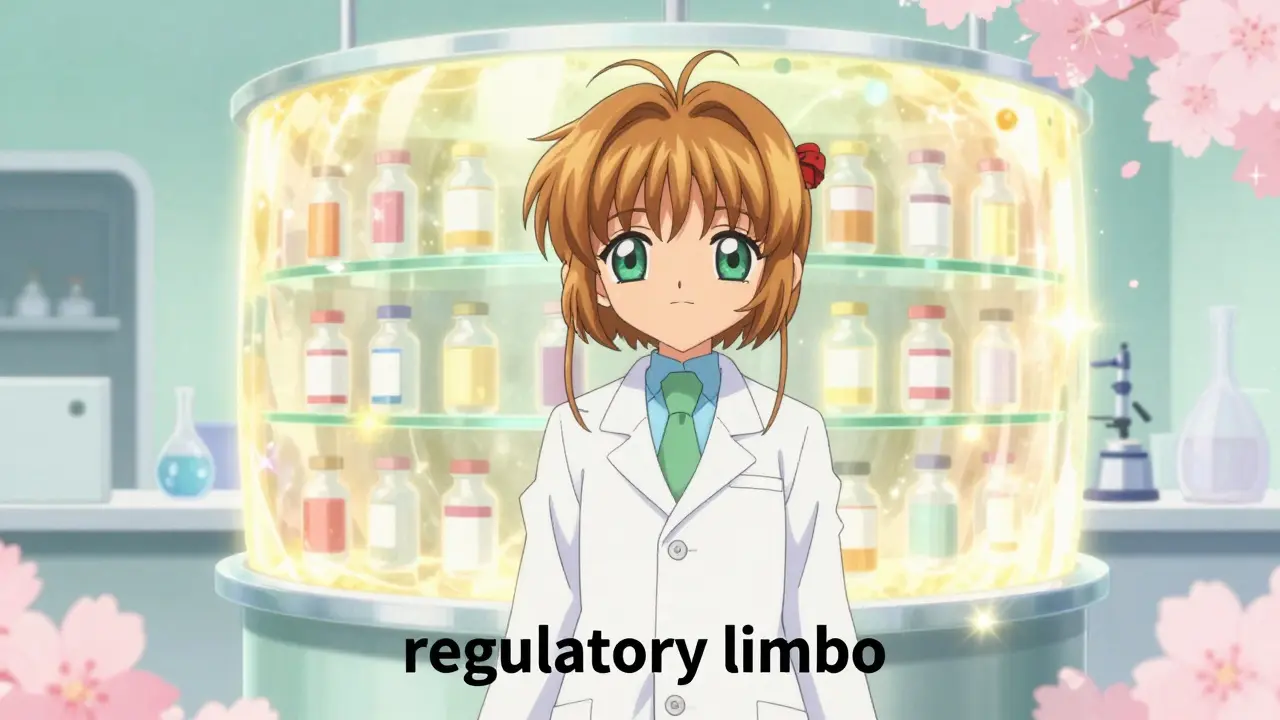
Imagine spending years and millions of dollars developing a generic version of a blockbuster drug, only to find out you're legally banned from selling it the moment it's finished. This is the reality for pharmaceutical companies facing the "waiting room" of the FDA. In the U.S. market, getting a green light on the science doesn't always mean you can start shipping. You might hit a wall called tentative approval, where the government says your drug works, but the law says you can't sell it yet because of an active patent.
For generic manufacturers, this phase is a high-stakes game of chess. It is a regulatory limbo where the drug is scientifically ready, but the legal battle is still raging. Understanding how to manage this gap is the difference between capturing 80% of a market or losing millions in potential revenue due to a simple paperwork error.
What Exactly is Tentative Approval?
Tentative Approval is a regulatory status granted by the U.S. Food and Drug Administration (FDA) to Abbreviated New Drug Applications (ANDAs) that have met all scientific and safety requirements but cannot be fully approved due to unexpired patents or exclusivity periods.
Think of it as a "conditional pass." The FDA has reviewed your data, checked your manufacturing sites, and confirmed that your generic version is bioequivalent to the brand-name drug. However, because of the Hatch-Waxman Act-the law that balances innovation with affordability-the FDA cannot give you a final license to sell until the brand's patent expires or a court decides the patent is invalid.
This isn't just a formality; it's a strategic tool. By granting tentative approval, the FDA clears the scientific hurdles early. This means that the moment the legal barriers vanish, the drug can theoretically hit the shelves without another multi-year review process. On average, the FDA processes about 1,000 of these approvals every year, acting as a critical bridge for companies trying to time their entry perfectly.
The Strategic Role of Paragraph IV Certifications
Most companies don't just wait for patents to expire naturally; they fight them. This is where the Paragraph IV certification comes into play. When a generic company files an ANDA, they must certify that the brand's patent is either invalid or will not be infringed by their generic product.
Filing a Paragraph IV certification is essentially a legal challenge. It often triggers a 30-month litigation stay, during which the generic company and the brand-name manufacturer fight it out in court. If the generic company wins, they don't just get to enter the market early-they often secure a prized 180-day exclusivity period. During this window, they are the only generic provider allowed to compete with the brand, allowing them to capture a massive chunk of the market share, sometimes as high as 80%.
| Feature | Tentative Approval | Final Approval |
|---|---|---|
| Scientific Requirements Met? | Yes | Yes |
| Legal/Patent Barriers Cleared? | No | Yes |
| Allowed to Market in U.S.? | No | Yes |
| Position in Approval Queue? | Secured | Active |

The Danger of the "Passive Waiting" Myth
A common mistake regulatory teams make is assuming that tentative approval is a "set it and forget it" status. They believe that once the patent expires, the FDA will automatically flip the switch to final approval. That is not how it works.
The FDA requires active management. If your application has been sitting in tentative approval for years, the agency needs to know that your data is still current. According to FDA guidance from 2020, you must submit amendments to your application well before your target launch date. If you've been in tentative status for three or more years, major amendments might need to be submitted ten months in advance. Minor changes usually require a three-month window.
Failure to do this leads to what industry experts call "avoidable delays." For instance, if a company changes its manufacturing site during the waiting period but fails to document it properly in the final approval request, they could be delayed by several months. This happened to Aurobindo Pharma with its generic version of Jardiance, resulting in an estimated $150 million loss in revenue because they missed their window. Conversely, Teva Pharmaceuticals successfully timed their request for generic Januvia exactly 90 days before patent expiration to ensure a seamless launch.
Navigating the Final Hurdle: The Conversion Process
Converting a tentative approval into a final marketing authorization is a precision exercise. You need a perfect synchronization between your legal team (who tracks the patent) and your regulatory team (who talks to the FDA).
- Patent Tracking: Maintain a live tracker for all relevant patents and pediatric exclusivity extensions. Missing a pediatric extension can delay you by six months, as seen in Mylan's experience with the generic EpiPen.
- Amendment Submission: Submit necessary updates (manufacturing changes, labeling updates) based on the 3-month or 10-month rules.
- Final Approval Request: Send a formal request to the FDA to convert the status, providing proof that all legal barriers have expired or been resolved through litigation.
- cGMP Compliance: Ensure your facilities are inspection-ready. About 27% of final approval delays in 2022 were caused by manufacturing compliance issues discovered at the last minute.
When this is done correctly, the results are explosive. Lupin Limited converted its tentative approval for generic Cialis into a market launch within 24 hours of the patent expiring, instantly capturing 42% of the market in just one month.
Future Trends and Complex Generics
The landscape is getting harder. We are seeing a rise in "complex generics" and biologics where the patent portfolios are like spiderwebs-interconnected and intentionally confusing. This makes the tentative approval process even more strategic. Some "first-filers" are now using their tentative approval as a bargaining chip, settling with brand companies to enter the market on a specific agreed-upon date in exchange for a share of the market.
Looking ahead, the FDA is trying to speed things up. As part of the GDUFA III commitments, there are plans to reduce the review time for final approval requests for minor amendments from 60-90 days down to just 30 days. While this helps, the overarching challenge remains the complexity of the legal landscape. With the potential for new legislation like the "Protecting Drug Patents Act," the timelines could shift again, making a robust internal patent tracking system more valuable than ever.
Does tentative approval guarantee final approval?
Not automatically. While it means the scientific and safety requirements have been met, final approval depends on the resolution of patent or exclusivity issues. Additionally, if the FDA finds that the drug is no longer compliant with current Good Manufacturing Practices (cGMP) or if major amendments are improperly handled, final approval can be delayed or denied.
How long does the FDA take to convert tentative approval to final approval?
It varies by the type of amendment. Minor amendments typically have a 3-month window, though the FDA is working to reduce certain review times to 30 days. Major amendments for applications in tentative status for over three years may require up to 10 months of lead time to avoid launch delays.
What is the 180-day exclusivity period?
This is a reward for the first generic company to successfully challenge a brand-name patent through a Paragraph IV certification. It allows that company to be the only generic version of the drug on the market for 180 days, providing a significant competitive advantage and higher profit margins.
Can a company lose its tentative approval status?
Yes. If a company submits an amendment that is not permitted under the tentative approval status, or if they fail to maintain regulatory standards (like cGMP compliance), the FDA can revoke or delay the status.
Why is the Hatch-Waxman Act important for this process?
The Hatch-Waxman Act created the ANDA process. It allows generic companies to prove their drug is the same as the brand-name version without repeating expensive clinical trials, while also protecting the brand's patents, creating the very need for "tentative approval" as a holding state.



Dale Kensok April 27, 2026
The systemic asymmetry of the ANDA pathway is essentially a masterclass in regulatory arbitrage. Most people fail to grasp that the 180-day exclusivity isn't just a 'reward' but a critical lever for price skimming before the inevitable commoditization of the molecule. The synergistic intersection of Paragraph IV litigation and tentative approval creates a Pareto-optimal scenario for first-filers, provided they possess the operational agility to navigate the cGMP bottleneck without succumbing to the catastrophic inertia that plagued Aurobindo's Jardiance launch. It's a high-fidelity game of legal gymnastics where the intellectual property moat is breached not by brute force, but by surgical precision in regulatory filing.
Sharon Mathew April 27, 2026
Oh please, as if this is some brilliant game of chess! It's just a bunch of corporate lawyers fighting over who gets to hoard the money while patients suffer! Absolutely ridiculous that a 'paperwork error' can cost millions while the actual people needing the meds are left in the dust. Total madness!
lalit adesara April 29, 2026
Indian pharma dominates this. Global standards follow us. Pure brilliance.
Nigel Gosling April 29, 2026
It is honestly disgusting that we've built a society where a 'tentative approval' is treated as a strategic asset. We are literally gambling with human health for the sake of a 180-day window of profit! The sheer moral bankruptcy of this entire pharmaceutical industrial complex is staggering. Why are we pretending this is a sophisticated business strategy when it's actually just legalised greed on a global scale? It's a tragedy that the law protects the patent holder's hoard more than it protects the patient's right to affordable medicine. Truly a dark reflection of our priorities!
Trish Perry May 1, 2026
Makes you wonder about the balance between rewarding innovation and ensuring access. If there was no patent, nobody would spend the billions to find the drug in the first place, but the 'waiting room' feels like a glitch in the system that only benefits the wealthy.
Raymond Lipanog May 2, 2026
It is perhaps beneficial to consider that the Hatch-Waxman Act was an attempt to harmonize these conflicting interests. While the tension is evident, the framework provides a predictable, albeit complex, path for market entry that preserves the incentive for original research.
Angela Cook May 4, 2026
The US market is the gold standard for a reason! We have the best laws and the best companies. Anyone trying to cheat the system with 'complex generics' should be shut down immediately. Keep the profits in America!
Aubrey Johnson May 6, 2026
The explanation is clear, but the examples of failure are simply embarrassing. A professional organization should not lose $150 million due to a failure in basic documentation.
Kali Murray May 6, 2026
wow just wow 😵💫 the legal side of medicine is so wild lol
Steve Grayson May 6, 2026
This is a very helpful breakdown of the process. I think the point about cGMP compliance is especially important because people often overlook the manufacturing side once the legal battle is won.
Jenna Riordan May 8, 2026
I bet the people managing these 'live trackers' are stressed out of their minds. Imagine the kind of coffee intake in those regulatory offices just to make sure they don't miss a pediatric extension by one day. It sounds like a nightmare for the employees.